





NASA mission managers will wait until earlyApril to pick a new launch date for the space shuttle Atlantis pending additionalrepairs and checks of its hail-batteredfuel tank, top agency officials said Wednesday.
The U.S.space agency is eyeing April 10 as the decision day on whether to press ahead witha possible mid-May launch for Atlantis or swap its damaged fuel tank with a newone, which would push the planned space shot to June.
"Ourultimate goal is to get the best tank that we can get ready to go fly," WilliamGerstenmaier, NASA's associate administrator for space operations, told reportersin a Wednesday teleconference. "It looks like by about April 10 or so, weshould have enough information."
A new shuttlefuel tank, which would be used if mission managers go for the swap option, isdue to arrive at NASA's Kennedy Space Center (KSC) spaceport in Cape Canaveral,Florida on April 10, Gerstenmaier added.
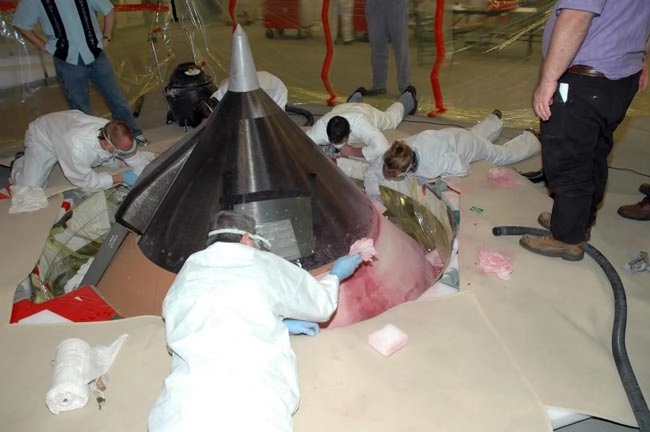
A freakstorm bombarded Atlantis at its Pad39A launch site at KSC on Feb. 26, battering the orbiter and its fuel tankwith hail up to the size of golf balls, etching more than 2,500 dings intoAtlantis' external tank's vital foam insulation [image].The resulting damage prompted mission managers to delaythe planned March 15 launch of the orbiter's STS-117spaceflight to allow time for repairs.
NASAcurrently has a window stretching from late April to around May 21 to launchAtlantis' six-astronautSTS-117 crew towards the International Space Station(ISS). Commanded by veteranshuttle flyer Rick Sturckow, the 11-day mission will deliver newstarboard solar arrays to the orbital laboratory.
Swappingout the damaged fuel tank for a new one would push the launch to no earlierthan June 8, NASA has said.
NASAshuttle program manager Wayne Hale said Atlantis' hail-spawned delay will likelylimit the space agency to launching four orbiter flights this year - as opposedto the ambitiousfive previously targeted - to continue assembly of the ISS. But that rippleeffect will likely dampen out by mid-2008, he added.
"We expectthat we will be able to get back on the prescribed [flight] manifest in about12 months," Hale said of the impact. "It certainly does not affect our plan tocomplete space station construction by 2010."
NASA plansto complete at least 13 ISS-bound shuttle flights to complete assembly of the $100billion orbital laboratory by September 2010, when its three-orbiter fleet isdue to retire to make way for its successorOrion.
Damageassessment continues
NASA haspaid close heed to the health of shuttle fuel tank foam since 2003, when a briefcase-sizedchunk popped free during the launch of Columbia and pierced heat shielding onthe orbiter's left wing.
The damage led to the orbiter's destruction,and loss of its seven-astronaut crew, during as they reentered the atmosphere,prompting NASA to devise a hostof fuel tank improvements to limit foam shedding during liftoff in thefuture.
But statisticallyspeaking, hail storms the strength of the Feb. 26 tempest are expected toaffect a shuttle flight once every 10 years, NASA officials said, adding thatthe last hail-related damage to shuttle hardware occurred 11 years ago.
NASA'sdeputy external tank project manager John Honeycutt said Wednesday that most ofthe damage to Atlantis' tank is concentrated near the nose cone [image],where engineers plan to spray a new layer of foam and then sand it into theproper shape to withstand the aerodynamic heating stresses that occur duringlaunch [image].
"The longpole in the tent here is doing the testing and evaluation to make sure that wecan apply this spray foam in a way that it will be safe," Hale said, adding that he is confident the tank can be repaired to fly the STS-117 mission. "We have ahigh degree of confidence that it will be, or else we wouldn't have picked thisroute, but that work is still ahead of us."
Ifeverything goes well, and engineering studies of the spray foam repair methodand others bear out, Atlantis could be primed to launch in the mid-Maytimeframe, Hale added.
But shuttleofficials stressed that the reason they are not choosing a new launch date forAtlantis now is to allow the agency's engineering teams to complete their tank surveysand repairs without any artificial schedule pressure.
"We'regoing to fly this tank when it's safe to fly and not before," Hale said.
- STS-117 Power Play: Atlantis Shuttle Crew to Deliver ISS Solar Wings
- VIDEO: Space Station Building Blocks
- IMAGES: An Insider's View of the International Space Station
- IMAGES: The Spacewalks of NASA's STS-116 Mission
- The Great Space Quiz: Space Shuttle Countdown
- Complete Shuttle Mission Coverage
- All About the Space Shuttle
