





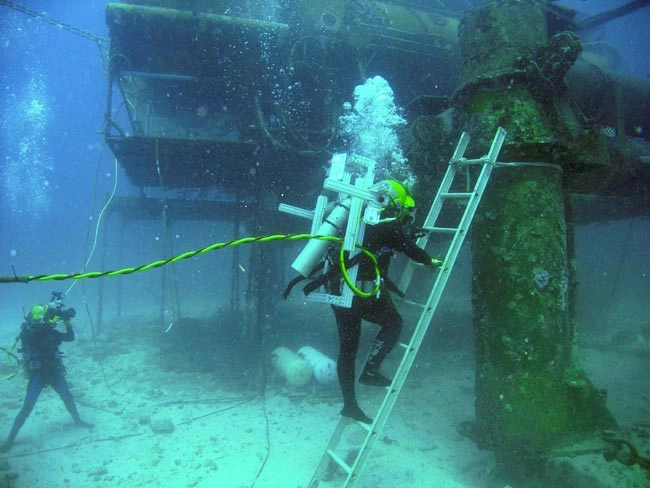
Sixaquanauts will rise from the deep today after nearly a week stationed on theocean floor testing spacesuitconcepts for future Moon and Mars missions.
A joint teamof astronauts and divers, the NASA Extreme Environment MissionOperations (NEEMO) 10 crew is set to resurface just off Key Largo in theFlorida Keys by 12:00 p.m. EDT (1600 GMT), leaving their undersea Aquariushabitat 67 feet (20 meters) beneath the ocean waves.
"It takes17 hours for us to surface safely," shuttle flight veteran Koichi Wakata, NEEMO 10 commander and aJapanese Aerospace Exploration Agency (JAXA) astronaut, told SPACE.comin a sea-to-surface phone call. "In a sense, it is a very extreme environment."
The primarygoal of NEEMO 10's six-day mission aimed at testing changes in spacesuit weightdistribution that could affect an astronaut's performance during excursions onthe Moon or Mars.
"This isoutstanding," Wakata said during one "moonwalk" dive,while his helmet-mounted video camera - webcast livevia the Aquarius website - relayed images of the undersea laboratory and itssurrounding sea life.
Wakataand NASA astronauts Andrew Feustel and KarenNyberg dived down to Aquarius on July 22 with professional divers Mark Hulsbeck and Dominic Landucci. Theywere joined by Karen Kohanowich, deputy director ofthe Undersea Research Program for the National Oceanic and AtmosphericAdministration (NOAA), which owns Aquarius.
"The onething that's so wonderful about Aquarius is that it's good for so manydifferent things," Kohanowich told reporters during ateleconference this week. "[As] a NASA analogue, marine science and education,it's a very important aspect of what we do."
Aquarius isoperated for NOAA by the University ofNorth Carolina at Wilmington's(UNCW) National Undersea Research Center. The metal habitatcontains about the same living area as NASA's Destinylaboratory berthed at the International SpaceStation (ISS).
Findingyour center (of gravity)
NEEMO 10aquanauts staged daily dives while wearing an adjustable rig that allowed them tosimulate walking on the Moon(one-sixth Earth's gravity) or Mars(one-third Earth normal), as well as physically change the center of gravity ontheir mock spacesuits.
"Anybodythat's backpacked knows that if you haven't packed your backpack just right,you end up top-heavy or feel like you're going to fall over," said Nyberg, whoserved as a spacesuit environmental control systems engineer for NASA beforejoining the Astronaut Corps in July 2000, in a telephone interview. "So thecenter of gravity is really important for how we pack the portable life supportsystem, and how that weight is distributed on the suit itself."
Aquanautswent through the motions of walking, retrieving cargo from a simulated resupply container - an essential task for long-durationMoon or Mars missions - and fell over, then got back up, to evaluate how slightchanges in a spacesuit's center of gravity alter an astronaut's mobility.
"We were sosurprised how, depending on the location of the center of gravity, it reallyaffects the efficiency and effectiveness of the spacewalk," Wakatasaid, adding that Aquarius moonwalks were a substantial change from the trainingruns he conducted in NASA's immense spacewalk training pool near Johnson SpaceCenter (JSC). "It was a very strange feeling to be able to walk for aspacewalk, because [NASA's] spacewalks now are for zero gravity."
Feustelsaid the NEEMO 10 crew also conducted a series of communications and mappingdemonstrations for moonwalk navigation. The aquanauts also worked with missioncontrollers at NASA's Exploration Planning andOperations Control (ExPOC) center at JSC to handoffcontrol of a small ocean rover.
"What makesit special is that the decisions we make going out the door are life criticaldecisions, just like [those] you'd make in space," Feustelsaid.
Undersealiving
While theNEEMO 10 crew's mission is ending, NASA plans at least one more expedition toAquarius this year.
The agency'syet-to-be-announced NEEMO 11 crew is slated to begin training on Sept. 12 anddive down to Aquarius on Sept. 16 for a six-day mission, according to theundersea lab's schedule.
Despitetheir hectic daily timelines, some NEEMO aquanauts managed to take time out to ponderthe sea life around their aquatic home.
"I did adusk dive the other night and I saw a spotted moray eel I've never seen before,and I love moray eels," Nyberg said."So I was pretty excited."
New fish aside,Aquarius is also home so some neighborly creatures that have earned a place inthe hearts of NEEMO crews.
"Thishabitat has become home to so many fish, and there are a few that we'verecognized," Nyberg said."There's a huge grouper and a big barracuda named Bob."
- VIDEO: NEEMO 10 Commander Koichi Wakata on his STS-92 Shuttle Flight
- NASA's NEEMO 9: Remote Surgery and Mock Moonwalks on the Sea Floor
- NEEMO's Undersea Operations: Making Telemedicine a Long Distance Reality
- NEEMO 7: NASA'S Undersea Robotic Telemedicine Experiment
