


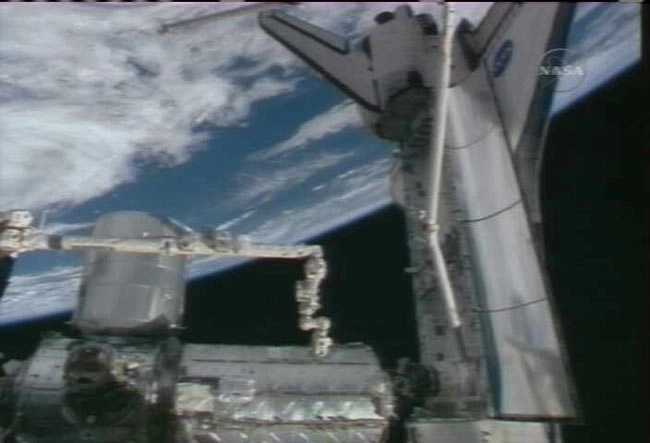
HOUSTON - Astronauts aboard NASA's space shuttle Discovery will begin afinal inspection of their spacecraft's wings today in a first-ever hunt for any signs ofimpact from miniscule space rocks.
Discovery'sSTS-121 mission specialists LisaNowak and StephanieWilson will scan the shuttle's port wing with its sensor-laden inspectionboom to determine whether micrometeorites or other orbital debris have struckthe spacecraft during its stay at International Space Station(ISS).
"Anyspacecraft in orbit has a fundamental risk of being hit by something,"Discovery's pilot Mark Kelly told CNN Friday during a series of space-to-groundinterviews on NASA TV. "By doing a late inspection, it will slightly reduce therisk of damage to our thermal protection system, or at least, if there isdamage we'll know about it."
Friday'slate inspection is slated to begin at 1:18 p.m. EDT (1718 GMT) after Discovery'sastronauts unberth the Italian-builtLeonardo cargo module from the ISS and stow it in the shuttle's payloadbay. Once Discovery and its six-astronaut crew undock from the ISS on Saturday,Nowak and Wilson - which flight controllers dubbed the "ROBO chicks" in today'sexecute package - will also inspect the shuttle's nose cap and starboard wing.
"It is moreremote than ascent debris," Wilson told CBS News today of the micrometeoritethreat.
Nowak addedthat the initial FlightDay 2 inspections of Discovery's heat shield coupled with focusedlooks after the shuttle docked at the ISS should help make this weekend'sfinal checks of the orbiter's nose and wing leading edges go smoother. Discovery'sheat shield has already been clearedof any launch debris concerns.
Steve Poulos,NASA's orbiter project manager, told the Associated Press Thursday that thelate inspections could reduce the odds of losing a spacecraft due tomicrometeorite damage from the average 1 in 210 to about 1 in 282.
Discovery'sSTS-121 mission is NASA's the second shuttle to visit theISS since the 2003 Columbiaaccident and the last of two test flights before major constructionresumes on the orbital laboratory. Launchedon July 4, the 13-daymission has returned the station to its three-person capacity,delivered vital supplies to the outpost and tested shuttle heat shield repairtools and methods.
Engineerson the ground continue to study a pair ofissues with two of three Auxiliary Power Units (APUs) that power Discovery'shydraulics during reentry and landing.
Aworkaround has been developed for an errant heater in one of the units, andcalls for the STS-121 crew to switch to a backup or orient the Discoverytowards the Sun to keep the APU warm. The second problem, a potential fuelleak, is still under study, according to today's flight execute package.
Back towork
Discovery'sSTS-121crew and the three-astronaut Expedition13 team aboard the ISS are getting back to work today after a lightday of rest and nominal duties on Thursday.
In additionto having a joint meal aboard the ISS and speaking with their families fromorbit, the STS-121 astronauts fielded several questions from reporters on Earthand - in the case of one spacewalker - Texas governor Rick Perry.
A graduateof Texas A & M University, Perry called STS-121 mission specialist andfellow Aggie Michael Fossum to congratulate him on completing the thirdand last of the spacewalks planned for his mission.
"I justwanted to call to tell you how proud we are of you Mike, the entire state of Texas," Perry told Fossum. "Of course, the Aggies are up in great arms and in celebrationtoday to have the first Aggie in space, you're making history Mike."
Fossum thankedPerry for his support for NASA's Johnson Space Center (JSC) here in Houston and graciously accepted an offer for 50-yard-line tickets for the big football gamebetween the Texas A & M Aggies and the University of Texas Longhorns laterthis year.
Fossum'screwmate Wilson, a Longhorn, was also offered the tickets, Perry said.
Fossum,Wilson and Nowak are making their first spaceflight for Discovery's STS-121mission. While all three of them have waited long - at least 10 years forWilson and Nowak and 25 for Fossum, the patience has paid off.
"It wasdefinitely a long wait and it was definitely worth it," Nowak said Thursday. "Thisis a trip of a lifetime...it's thrilling to be up here."
TheAssociated Press contributed to this report.
- Gallery: Shuttle's First Flight
- Gallery: Rare Space Shuttle Images
- Shuttle Discovery: Complete Mission Coverage
- Great Space Quizzes: Space Shuttle Countdown
- Great Space Quizzes: The Space Shuttle
- Great Space Quizzes: Life in Orbit
