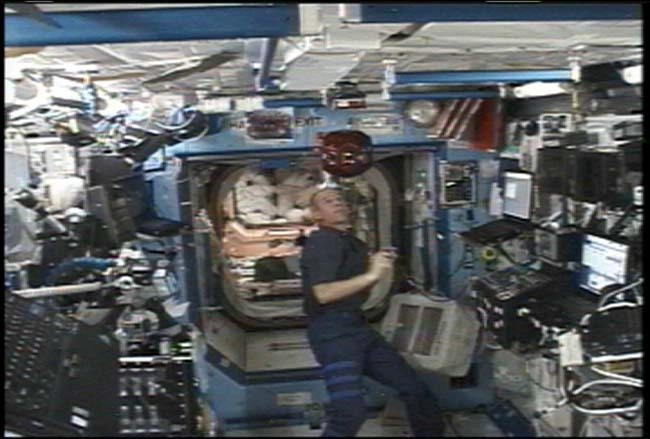
NASAastronaut Jeffrey Williams has put a small satellite through its initial pacesaboard the International Space Station (ISS), deploying the free-flying craftinside outpost's Destiny lab.
Williams,NASA science officer and ISS Expedition 13 flight engineer, piloted the SPHERESmicrosatellite in the first of a series of test aimed at demonstratingfundamental concepts for autonomous docking in small vehicles and formationflying. The tests could lay the groundwork for cooperative satellites andhelper robots to aid spacewalking astronauts, NASA officials said.
SPHERES -short for Synchronized Position Hold Engage Re-orient Satellite - is anexperiment designed by researchers at the Massachusetts Institute of Technology(MIT) to aid the development of future cooperative space robots.

Williamswatched over the single SPHERES satellite last week as it approached twobeacons - one handheld and one wall-mounted - during simulated rendezvous anddocking maneuvers. The satellite's first flight included up to 15 pre-plannedmaneuvers, each of which lasted 10 minutes, to check attitude control, stationkeeping, collision avoidance, target tracking and fuel balance performance,NASA officials said.
Theeight-inch (20-centimeter) wide, seven-pound (three-kilogram) SPHERES satelliteis the first of three to launch toward the ISS and arrived at the space stationaboard Progress21 on April 26. Two additional units are expected to launch toward thestation on future NASA shuttle visits.
- Mini-Satellite to Test Big Concepts Aboard Space Station
- Complete Coverage: ISS Expedition 13
