A NASA mission to two of the
largest asteroids in the solar system being readied for liftoff next year has
been placed in "stand down" mode.
The ion-engine propelled
Dawn mission is dedicated to investigating the two most massive asteroids
known: Vesta and Ceres. These two "baby planets" are very different from each
other yet both offer tantalizing clues about the formation of the solar system.
Dawn is designed to improve scientific understanding of how planets formed
during the earliest epoch of the solar system.
Dawn has been on NASA's
books for liftoff in mid-June 2006.
The decision to stand down,
according to SPACE.com sources, appears related to budget-related
measures and workforce cutbacks at the Jet Propulsion Laboratory (JPL) in Pasadena, California.
Extremely robust mission
"Yes...NASA has asked us to
stand down," said Dawn's principal investigator, Christopher Russell of the University of California, Los Angeles (UCLA). "None of us take this as any indication that they
[NASA Headquarters] do not want to launch Dawn," he told SPACE.com,
given "strong words of support" from space agency personnel in Washington, D.C.
Russell said that Dawn is an
extremely robust mission. The particular launch opportunity that the spacecraft
mission is heading for is extremely long--over a year long, he noted.
"This is both a blessing and
a curse," Russell said. "Typically a planetary mission heading to a launch
opportunity has a very limited time for any delays. In this case, we can
tolerate delay in launch without science impact, and so when someone wishes to
review an issue to gain more confidence that it is completely resolved then it
may result in increased expenditures but not loss of the mission," he added.
Russell said that there are
a number of technical issues that on a chemical launch would be examined in
parallel to development, "but in this case we were asked to stand down while an
independent assessment team reports back to headquarters. This has interrupted
the final preparations for launch and we wish that they had not done this, but
it is something we can tolerate."
Econo-class mission
Dawn is a NASA
Discovery-class mission, selected in December 2001. The goal of the Discovery
program is to launch many smaller missions with fast development times, each
for a fraction of the cost of NASA's larger missions. Such spacecraft missions
are designed to tackle important questions in science yet do it for a very
modest cost.
Dawn is managed by JPL with
Orbital Sciences Corporation of Dulles, Virginia developing the spacecraft.
Earlier this year, the Dawn
spacecraft began Assembly, Test and Launch Operations (ATLO). Spacecraft
integration and testing of Dawn has been progressing very well, according to
Tom Fraschetti, JPL's Dawn Project Manager in a status update last month that
was posted on the Dawn project website.
Ceres, the mini planet
The importance of spacecraft
exploration of Ceres, for instance, was recently underscored by astronomical
study of the object.
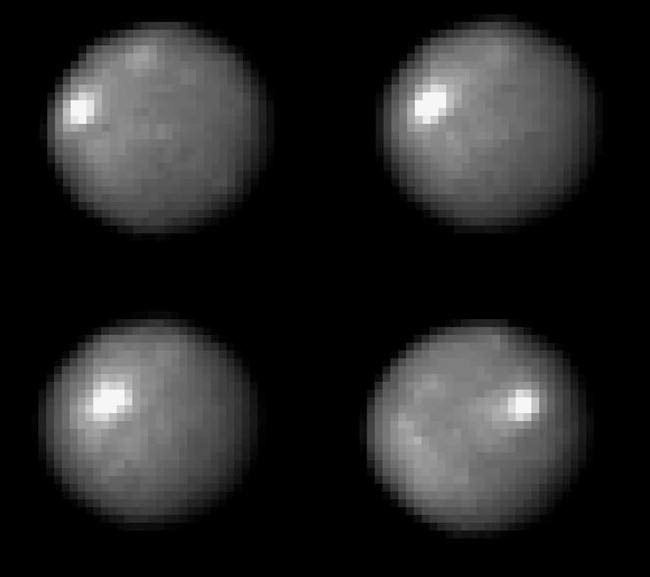
In September it was
announced that observations of Ceres made by NASA's Hubble Space Telescope
revealed that the object may be a "mini planet"--perhaps loaded with large
amounts of pure water ice beneath its surface.
"Ceres is an embryonic
planet," noted Lucy McFadden of the Department of Astronomy at the University of Maryland in College Park, Maryland. She is a member of the team that made the
Hubble observations, and is also a member of the science team on the Dawn
mission.
"Gravitational perturbations
from Jupiter billions of years ago prevented Ceres from accreting more material
to become a full-fledged planet," McFadden explained in a press release
announcing the observations, issued by the Space Telescope Science Institute in
Baltimore, Maryland.