





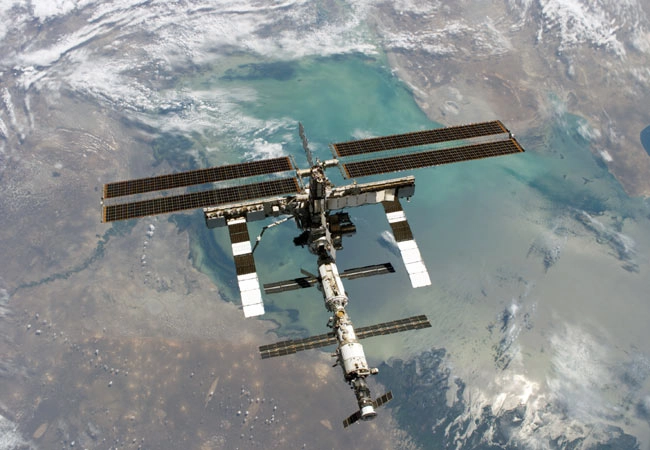
Five NASAastronauts held a reunion of sorts in Houston, Texas Thursday to celebrate theupcoming birthday of a rather bulky five-year-old to be: the International SpaceStation (ISS) currently orbiting Earth.
Theastronauts - all of them space station veterans- gathered at NASA's Johnson SpaceCenter (JSC) to reminisce about their experiences aboard the ISS, which willhit the five-year mark of manned operations on Nov. 2.
"It was solong ago, the memories have almost faded," said retired astronaut Jim Voss, whoflew aboard the ISS in 2001 as one of three members of the Expedition2 crew, of his time in orbit. "It was really very special, we had prepared[for it] for over four years."
Voss wasjoined by Expedition5 astronaut Peggy Whitson, Expedition 7'sEd Lu and Expedition8 commander Michael Foale, with Michael Fincke - who served as flightengineer during the ninth ISS mission- appearing via video link from Russia's cosmonaut training center in Star City.The space station's current crew - Expedition12 commander Bill McArthur and flight engineer Valery Tokarev - recorded avideo statement for reporters and NASA employees.
"It is aunique honor," McArthur said of the opportunity to contribute to humanity'songoing presence in space. His comments came on the station's 1,820thday of operation, NASA officials added.
Astronautshave lived and worked aboard the ISS continuously since the arrival of itsfirst three-member crew - Expedition1's Bill Shepard, Yuri Gidzenko and SergeiKrikalev - in 2000 under an international effort that, today, relies on thecontributions of 16 nations and two manned spacecraft designs; NASA's spaceshuttles and Russia's Soyuz vehicles.
"I thinkthe International Space Station represents a big symbol [of cooperation]," saidWhitson, who is hoping for another tour aboard the station. "What makes itspecial is that it's not just a bunch of people who sit back and talk aboutcooperation, we actually built something out of it."
Russia'srobust Soyuzand unmanned Progressspacecraft, which resupply the ISS with food, water, spare parts othernecessities every six months, have proven vital to the station's survival sincethe 2003 Columbia accidentthat stalled NASA's shuttle flights. The agency's shuttle fleet returned toservice in July with Discovery's STS-114launch, though the next flight is not expected until at least May2006.
"TheRussians are, as you say, carrying a pretty fare share of the partnership atthe moment, and I think that's the value of the partnership," Foale toldreporters, adding that NASA aided Russia to continue its operation of space stationMir. "I think, actually, the favor has been returned in the last couple ofyears."
The dropin NASA shuttle flights to the ISS has limited crews to two astronauts due tothe decreased availability of supplies and prolonged the station's completion,since orbiters are the only vehicles capable of launching the orbital platform'smassive components. The next ISS construction flight will not flight until afterthe NASA's Discovery's STS-121 spaceflight- the agency's second return toflight mission - next May, NASA officials have said.
But the astronautssaid Thursday that despite its troubles, the space station is a vital orbitalplatform for the science and human physiology experiments needed to push humanexplorers back toward the Moon and beyond. While the move to two-person crews hascut down the amount of science that can be performed aboard the ISS, there hasnever been enough time to fit in all the experiments researchers hoped for,they added.
"You can'tlose sight of the big picture," said Lu, who served as flight engineer during 2003'sExpedition 7, marking the first two-person crew and the firstmanned spaceflight after the Columbia accident. "When you step back andtake a look at what we're trying to do...it's amazing."
Last month,NASA officials announcedplans to return astronauts to the moon by 2018 aboard its planned CrewExploration Vehicle, which could deliver four astronauts to the lunar surfaceor six astronauts to the ISS. Under those plans, the space station is expectedto be completed by 2010, the retirementdeadline for NASA's shuttle fleet.
Fincke, whoalong with Expedition 9 commander Gennady Padalka performed the first spacewalkon U.S. station segment using Russian-built Orlan spacesuits, said NASA and theU.S. must continue to lead the way in space exploration.
"We're therichest country in the world," Fincke said. "We can't afford not to look atthis frontier."
