


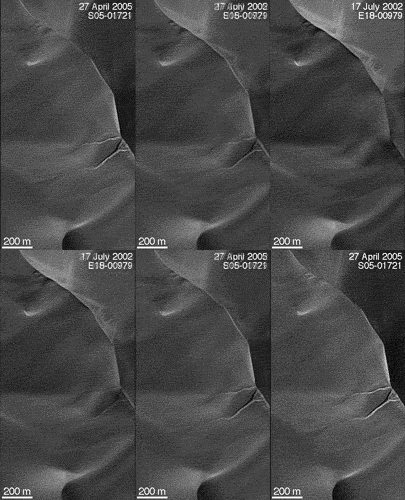
NASA's Mars Global Surveyor (MGS)spacecraft has spotted new gullies and a fresh crater - in astronomical terms -etched into the red planet's surface, mission scientists said Tuesday.
Now in its eighth year in orbitaround Mars, the MGS spacecraft found the new gullies cutting through a sanddune, as well as numerous other signs that the planet is far from a static,unchanging world.
"[The gullies] are probably not theresult of water action on the sand dune," said Michael Malin,principal investigator for the Mars Orbiter Camera aboard MGS, duringteleconference with reporters. "What we think is going on here is that carbondioxide snow has been incorporated into the sand dune."
As the snow melts and evaporatesinto gas, it allows the sand around it to fluidize andrun down the dune slope, Malin added.
The gullies are unique in thatthey're carved in sand, and not in the rock faces of crater walls, researcherssaid. [An animation of the gullies spied by MGS is available here.]
Meanwhile, researchers poringthrough MGS images by hand found a fresh craterthat apparently formed in the 1980s.
The crater, a 65-foot (20-meter) pitcarved into the southern rim of the Martian volcano Ulysses Patera,did not appear in photographs taken by NASA's Viking orbiter in 1976. But MGS'camera found the crater, ringed by a dark ejectablanket and radial lines, in 1999. By 2005, the ejectablanket was nearly faded, but the crater remained.
Based on the amount of ejecta fading, researchers estimated the crater formedbetween 1980 and 1985, and believe it is the remains of an impact by a smallhunk of rock a few feet in diameter.
"Actually, we have five or six ofthese types of craters," Malin said, adding thatunlike the Ulysses crater, most of the others were not in areas also studied byViking. "The number [of young craters] we've seen is much less than the numberwe'd predicted."
Before MGS arrived at Mars in 1997,researchers expected to find much more evidence of impact craters, given theplanet's location near the asteroid belt, researchers said. But MGS has onlyphotographed about four percent of the Martian surface, and there may be manymore young craters waiting to be found, they added.
"I suspect that the reason why the cratering rate looks different is that the impact ratecomes in clusters, and not a constant, uniform bombardment," Malin said.
Rockfalls and ice caps
Mars scientists also revealed MGSimages of a recent rockfall, in which many bouldersbroke free and rolled down a crater wall sometime between November 2003 andDecember 2004.
Researchers are unsure whether the rockfall was caused by strong winds, annearby impact event or seismic activity.
"These images describe a dynamicsurface of the planet Mars," said Jack Mustard, an associate professor ofgeological sciences at Brown University, during the telecon."They catch Martian geology in action."
If the rockfallwas caused by seismic activity, such as a marsquake, it could support views that Martiantectonics and volcanism are still active at the planet, Mustard added.
The spacecraft also observed agradual evaporation of carbon dioxide ice in one of Mars' polar caps, pointingto a slowly changing Mars climate.
"They way these polar pits areretreating is absolutely astounding," Mustard said.
But like the rockfalls,researchers were unable to account for the gradual climate change.
"Why is Mars warmer today that itwas in the past, we really have no way of knowing why," Malinsaid.
An orbiter's long life
NASA's MGS mission is in its third extendedmission phase, and the added years have been crucial to its ability toexplore Mars, researchers said.
"Some of the things [observed]changed in few weeks or months, and others have changed over years," Malin said. "Most of the discoveries that we've made cameduring the extended mission."
The spacecraft has returned morethan 250,000 images of Mars and a wealth of other data from its onboardinstruments, NASA officials have said.
In addition to its Mars-watchingrole, MGS has spiedtwo of its fellow red planet orbiters - NASA's Mars Odyssey and the EuropeanSpace Agency's Mars Express spacecraft - during its mission.
Michael Meyer, NASA's MarsExploration Program chief scientist, said that overall, MGS remains in goodhealth and still has years of red planet exploration ahead of it.
NASA has budgeted about $9.5 millionfor the MGS mission this year, and the spacecraft has enough propellant to lastwell into the next decade, Meyer said.
"I think we have much more scienceto be done by this spacecraft itself, and it will serve an important functionas a communications asset [for future missions]," Meyer said.
