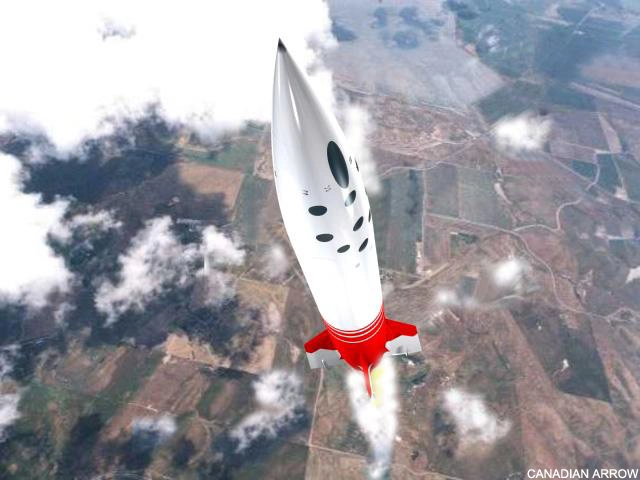
A Canadian
space tourism firm has teamed up with a U.S. businessman to form a new company
that aims to launch its first public spaceflight by 2007.
The London,
Ontario-based Canadian Arrow effort announced today its plans to work with
Internet and telecommunications entrepreneur Chirinjeev Kathuria to form
PLANETSPACE, a new firm that will not only complete and launch a
passenger-carrying suborbital spacecraft, but branch into other mediums as
well.
"It brings
the resources to Canadian Arrow to allow us to complete our vehicle," said
Canadian Arrow leader Geoff Sheerin, also serving as PLANETSPACE president and
CEO, of the partnership during a telephone interview. "So it's pretty
significant from that standpoint."
The
Canadian Arrow team conducted a successful May 12 engine test that demonstrated
some 50,000 pounds of thrust. The firm's launch vehicle is designed to fly on
between 52,000 and 57,000 pounds of thrust, Sheerin added.
Kathuria, a
major investor in the MirCorp
effort that helped Dennis Tito
become the first space tourist, said the new partnership will be a step forward for private space tourism. Initially slated to visit the Russian space station Mir with the help of MirCorp, Tito flew to the International Space Station (ISS) under an agreement brokered by Virginia-based Space Adventures.
"My idea
was to create a company that would pick up where MirCorp left off," said
Kathuria, who serves as chairman of PLANETSPACE. "I think it's really the last
untapped frontier."
Under
PLANETSPACE, Sheerin and Kathuria hope to complete the first Canadian Arrow
rocket and related tests in time for public suborbital spaceflights in the next
two years. Tickets for initial flights are set at about $250,000 a seat and
will include 14 days of training before launch day.
The new
partnership also includes plans for a reality television show, as well as
discussions with a company to hold an international lottery with spaceflight
prizes.
Launching
Canadian Arrow
The
Canadian Arrow effort began during the Ansari X Prize competition, an
international contest to develop and launch a reusable, three-person spacecraft
up to suborbital space twice in two weeks. The $10 million prize was won
in October 2004 when the privately-built spacecraft SpaceShipOne made its third
successful suborbital launch.
Earlier, in
August 2004, Sheerin told SPACE.com that Canadian Arrow was just $2
million away from making its first launch.
"But that
was to complete the vehicle and go after the X Prize," Sheerin said in the new
interview. "The quantities have gone up since then because now we're building
an industry...it's in the millions of dollars."
Kathuria
said he is putting up some funds for Canadian Arrow's development, and is also
working with possible investors.
The
Canadian Arrow vehicle's design is based on the German V-2 rocket, and may
launch from either a Great Lake-based barge or a shoreline launch site. Those
discussions are still underway, Sheerin said, adding that there are currently four potential launch sites - two onshore and two offshore - under review.
"Basically,
they are using proven technology," Kathuria said, adding that the design is
what attracted his interest in Canadian Arrow. "It's the best, and possibly
most cost-effective, vehicle."
Sheerin has
recruited a team of test astronauts that has been training for the first
piloted Canadian Arrow test flights.
"You'll see
a mission patch for each mission," Sheerin said, adding that Canadian Arrow
passengers will be part of their flight's crew. "You may find that every flight
has some experiment for schools on board."
A new
space business
Today's
PLANETSPACE announcement is the latest in a flurry of activity by private firms
committed to developing a private human spaceflight industry.
Last week,
former X Prize competitor Bill Sprague and his firm AERA Corp. announced plans
to launch their first manned suborbital spaceflight by December 2006, with
ticket prices also set at $250,000 a seat. The firm is currently developing Altairis,
a six-person rocket, which is expected to be the first of a planned fleet of rocket
ships to launch paying passengers into suborbital space.
The Poway,
California-based SpaceDev, led by CEO Jim Benson, also announced that it has
nearly completed a NASA-funded study into potential designs for suborbital and
orbital spacecraft. In September 2004, SpaceDev unveiled
plans to build Dream Chaser, a hybrid-engine propelled spacecraft planned to
loft six people on suborbital flights initially, with an ultimate goal of
reaching toward orbital space. Initial manned suborbital test flights are
slated for 2008, with piloted orbital launch tests planned for 2010, SpaceDev
officials said.
Those
efforts and others, including the Canadian Arrow team, the Toronto-based da Vinci
Project and Rocketplane
Ltd. of Oklahoma, are working hard as the anniversary of the successful
first suborbital human flight of the privately-built SpaceShipOne.
That airplane-launched spacecraft, built by aviation veteran Burt Rutan and his
Scaled Composites firm and financed by millionaire Paul G. Allen, made its
first piloted suborbital space shot on June 21,
2004. SpaceShipOne won by flying twice in two weeks between September and
October of 2004.
Rutan is
also developing a passenger version of his successful spacecraft for the Virgin
Galactic venture set forth by British millionaire Richard Branson. Tickets
for those spaceflights are set at about $208,000 per ride, and the first passenger -
a contest winner named Doug Ramsburg from Colorado -
has already been chosen.
"We
definitely want to be the first to offer suborbital flights...[but] I think there
is room out there for more than one company," Kathuria said of private space
tourism. "No one company is going to be able to fulfill the demand."