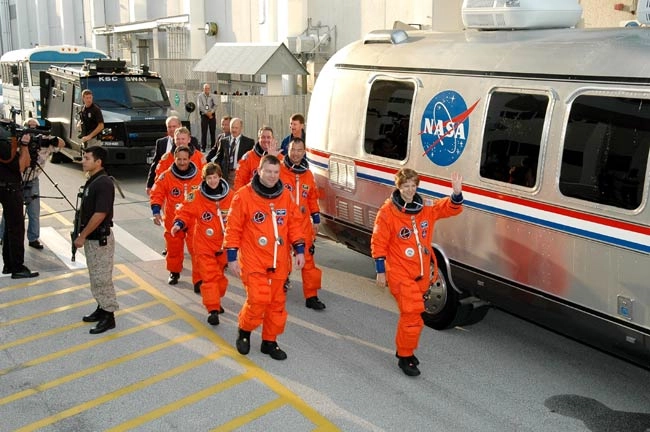
CAPE CANAVERAL, FL - The seven astronauts slated to lift off aboard NASA's first space shuttle to fly in more than two years aborted the mock launch of their Discovery orbiter Wednesday, evacuating the vehicle during a dress rehearsal of the final hours before liftoff.
With just four seconds left in their simulated countdown, the astronauts and launch controllers for NASA's STS-114 mission halted the launch after computers detected a main engine cutoff in the orbiter's engines. The astronauts then exited the shuttle and rehearsed procedures to ride slide wire baskets away from their launch site at Pad 39B here at NASA's Kennedy Space Center (KSC).
"We had a very good test today," said Eileen Collins, STS-114 mission commander, during a post-test briefing. "It felt to me like a real launch date."

Collins, a three-spaceflight veteran, and her STS-114 crew are currently scheduled to launch toward the International Space Station (ISS) no earlier than July 13. The flight is NASA's first shuttle mission to fly since the 2003 Columbia disaster that led to the loss of that orbiter and its STS-107 crew.
NASA had previously targeted a launch window opening on May 22 for Discovery, before pushing to July to allow more time for external tank checks, ice debris evaluation and contaminated thermal blankets on the orbiter. It was launch debris - a suitcase-sized chunk of external tank insulation - that damaged to Columbia's left wing, allowing hot gases to seep in during reentry and ultimately destroy the orbiter, investigators found.
But Discovery's launch delay will come in handy for the shuttle's crew, the astronauts said.
"It helps keep us moving and by working ahead [and] helps us point out our weak areas," Collins said, adding that she and her crew are committed to launch. "Yes we have had a delay...we will fly."
A test run
Under cloudy skies, the STS-114 astronauts walked out of their crew quarters in orange flight suits and boarded the AstroVan bus that would carry them to Launch Pad 39B, where Discovery and its propulsion stack currently sits.
The launch rehearsal, a standard activity that precedes every shuttle launch, is called a Terminal Countdown Demonstration Test (TCDT).
"We never did the TCDT for our original launch," said Collins, adding that the STS-114 mission was originally set to launch in March 2003 but was rescheduled following the Columbia accident. "We stopped training."
While Discovery's crew reported to the launch pad at about 7:45 a.m. EDT (1145 GMT), the simulated countdown actually began a day earlier - at 8:00 a.m. EDT (1200GMT) May 3 - for the mission's launch team.
"The thought did go through my mind today that the last crew that strapped in at the launch pad was the STS-107 crew," Collins said. "So we were very focused coming out of this test to make sure that every little detail is being considered."
The first significant glitch occurred at about 8:52 a.m. EDT (1252 GMT), when launch controllers were unable to communicate with Discovery's mid-deck crew. After replacing a communications box and resetting a switch, the problem was solved.
The poor weather, however, persisted and would have ultimately violated shuttle flight rules on launch day, NASA officials said. A second communication problem, this one between launch controllers and the Eastern Range that tracks the shuttle after liftoff also persisted, and would also have posed a dilemma.
"We're not going to troubleshoot the range problem any more today, but on launch day that would be an issue because it is a requirement for launch," said NASA spokesman George Diller, who provided mission commentary during the mock launch attempt.
Wednesday's launch abort test capped four days of flight procedure and emergency training for the STS-114 crew, which the astronauts said was a motivating experience as they worked toward a July launch.
"We're going to get the shuttle flying, we'll get the International Space Station built and onto our exploration agenda," Collins said. "This is a very short delay in the big picture and we need to do it right."
- Fixing NASA: Complete Coverage of Space Shuttle Return to Flight
