





An asteroid the size of two football fields could wipe out alarge city or set off a series of tsunamis across the world. The threat of suchan Earth-smashingasteroid has lead scientists to dream up several methods of defending theplanet against such a catastrophe.
Solutions have ranged from pushing the asteroid with aspacecraft to mounting a thruster on its surface. But pushing it would requiretoo much fuel and could break up the asteroid. Also, asteroids rotate, whichcould complicate the firing of a surface thruster.
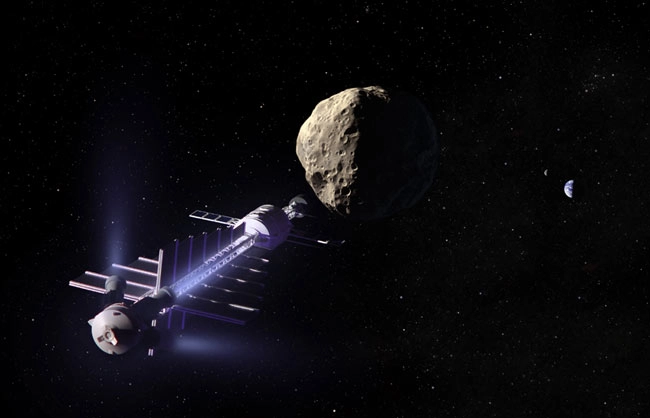
Now, two NASA astronauts have presented a plan for an"asteroid tractor"--an unmanned, 20-ton spacecraft that uses the invisible bondof gravity to gently pull an asteroid into a new, non-threatening orbit.
"You can think of it like a big elastic band between the twopulling them together," said Edward Lu, who presents the concept for thespacecraft with fellow astronaut Stanley Love in the Nov. 10 issue of thejournal Nature.
The tractor would hover above the surface of the asteroid,without touching it, and use gravity as a towline. If the spacecraft maintainsa consistent distance between it and the asteroid, and always tows in the samedirection, this method won't disturb the asteroid's rotation or composition.
Despite the urge to give the asteroid a hardy tug, the keyto moving an asteroid with gravity is to be gentle. An asteroid is likely to beloosely packed material, so tugging on it too hard could break it intounmanageable pieces. Or, the force from the spacecraft's thrusters could breakup the asteroid or stir up unwanted dust if fired too vigorously.
To make sure the thrusters couldn't break up the asteroid--orhinder the net towing force by pushing the asteroid away--Lu and Love angled thethrusters slightly away from the body of the spacecraft.
"The jets fire off to the side, not quite as efficient asfiring straight down. It's like rowing forward by pushing off to the sides--itkeeps you moving forward, but very slowly," Lu told SPACE.com. "It takesless than a pound of force--about what you need to hold up a cup of coffee."
In 2029,the 1,000-foot (320 meters) asteroid 99942 Apophis (2004 MN4) will whiz by Earth at a distance ofabout 18,600 miles (30,000 kilometers). That's about as close as manygeosynchronous satellites. It will swing by the Earth again in either 2035 or2036, and scientists predict it has a small chance of hitting the planet onthis pass.
"The kind of spacecraft we've talked about could move anasteroid 650 feet (200 meters) across provided we have decades of advancedwarning," Lu said. "That's not out of line with what you'd expect - we canpredict the orbit of an asteroid decades in advance."