


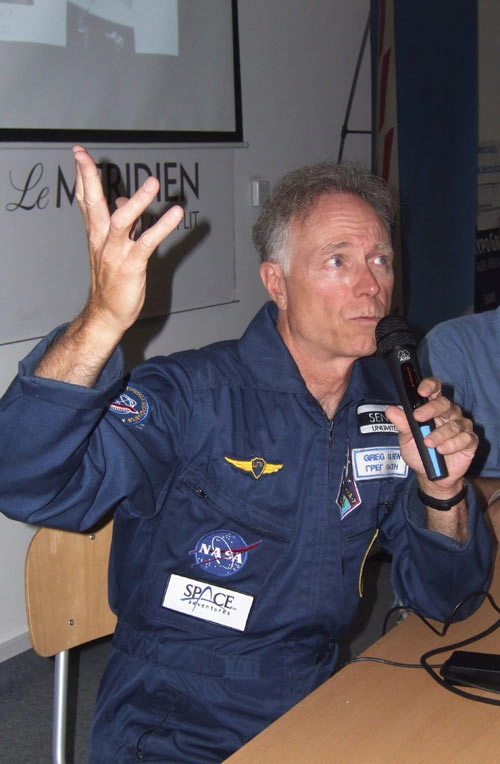
SPLIT, Croatia — On the occasion of the fiftieth anniversary of space travel, space travelers with a combined 415 days of space experience gathered in Croatia to discuss the future of human spaceflight.
The summit brought together private space traveler Greg Olsen, veteran astronaut Ed Lu, active cosmonaut Valery Tokarev, and prospective space traveler Per Wimmer. Olsen, Lu and Tokarev all have substantial time on the International Space Station, while Wimmer has tickets on future suborbital flights. It was the first time that all types of space travelers had come together in Europe.
Summit organizer Dr. Bojan Pecnik remarked, "This is the first time that space travelers have visited this region since Yuri Gagarin in the early sixties."
The conference, "Human Presence in Space," was organized by the Croatian organization Znanost.org, a non-profit dedicated to science education and outreach. The aim of the event was to inspire the next generation of scientists in Europe and Croatia, and to chart the future role of smaller countries in human spaceflight.
Vladimir Ivkovic, a co-organizer of the summit, stated, "We hope these space pioneers will inspire children to pursue studies in science, math and technology."
Croatia in Space
Croatia, like many smaller countries, has never had one of its own citizens go into space. The country gained its independence from the former Yugoslavia in 1991. While the Soviet Union had a program to launch representatives of Eastern Bloc countries, Yugoslavia was a non-aligned country and so did not participate in the program.
Despite this, or perhaps because of this, there is substantial interest in spaceflight in Croatia. Croatia is a prospective member of the European Union, and one of the topics of discussion was whether Croatia might join the European Space Agency in the future.
Another hot topic was the lack of spaceflight regulation in Croatia, which could open up commercial opportunities for future space tourism companies operating in Europe, including zero gravity flights.
Tonka Buric, a Croatian student, presented a case study that showed that it was possible under existing Croatian laws and airspace regulations to fly parabolic flights. "Starting parabolic flight in Croatia would expand Croatia's international reputation for tourism. The market is there. All that is required now is the will."
Ed Lu — The Role of Coastal Countries in Asteroid Defense
Astronaut Ed Lu has accumulated over 205 days in space on two space shuttle flights and one long-term mission to the International Space Station. Lu was on the first space launch to fly after the Columbia accident, and he described how he had had to prepare to co-pilot the Soyuz TMA vehicle in only nine weeks due to the accident. On that flight, he became the first American to co-pilot a Russian launch vehicle.
Lu recently left the astronaut corps for private industry. His recent research focus has been the threat of asteroids to Earth, and how global space agencies might defend against the threat. Coastal countries like Croatia have a strong interest in such work, since they are at a greater risk due to the possibility of an impact-created tsunami.
Lu underscored how countries like Croatia must be part of the decision-making process to decide how Earth governments choose which method of asteroid defense to use.
Greg Olsen — Don't Give up Your Spaceflight Dreams
Olsen, the third private space traveler to the International Space Station (ISS), is a successful entrepreneur who now devotes much of his time to promoting science and mathematics education among students.
He described how he had had the idea of going into space while at a Starbucks coffee reading an article about the first private spaceflight participant, Dennis Tito. The article sparked him to call Space Adventures, the company which has brokered private trips to ISS.
Olsen emphasized the importance of perseverance in pursuit of his spaceflight goals. After beginning his training in 2004, Olsen was medically disqualified by Russian doctors after discovery of a minor medical issue. Olsen did not give up and was eventually re-accepted into spaceflight training, launching in the fall of 2005.
Valery Tokarev — International Cooperation in Space
Tokarev is an active cosmonaut and the commander of the Soyuz flight that launched Olsen to orbit. His first flight was on the US space shuttle in 1999, which he trained for in five months. In 2005, Tokarev launched to ISS for what would become a 189-day mission as part of the Expedition 12 crew. An accomplished test pilot, Tokarev was also selected to test fly the Buran vehicle, a Russian space shuttle which made only one unmanned flight before being cancelled due to budget constraints.
Tokarev discussed how space technology is now widely available for many nations, and how this trend has broadened global participation in space flight. As more nations build space capabilities, international cooperation will become increasingly important.
Per Wimmer — Private Space Travel an Opportunity for Small Countries
Per Wimmer has bought tickets to fly to space with two of the leading space tourism companies, Virgin Galactic and Space Adventures. The Danish adventurer and financier described the training activities he has pursued to prepare for his spaceflight, including high altitude MIG flights to 80,000 feet and centrifuge training at the Gagarin cosmonaut training facility outside of Moscow.
Wimmer emphasized that the coming revolution in personal spaceflight will open opportunities for countries like Croatia to fly citizens in space. As the price of space travel decreases over time, more and more people will be able to experience spaceflight. This in turn will inspire other people to pursue their dreams, which is a main goal of his project, Wimmer Space.
Wimmer, a lawyer with four masters degrees, also described the international legal framework of space activities. He argued that the patchwork of treaties and agreements, including the 1963 Outer Space treaty ratified only a few years after the launch of Sputnik, must be expanded and that mechanisms for enforcement must be re-thought.
The Future of Croatia in Space
Sited in the coastal city of Split, the three-day conference drew attendees from across Croatia. The conference was opened by the Croatian Minister of Science, Education and Sport, Dragan Primorac, and underscored how important space is to the future development of the country. The event also included a series of lectures to over 200 local schoolchildren.
Znanost.org, the producer of the event, is led by a group of dynamic young scientists, many of whom have trained abroad but have returned to their home country to help develop the next generation of scientists.
Dr. Dejan Vinkovic, president of Znanost.org, said, "For a small country like Croatia without a space program, this event has opened the minds of children to the possibilities in space and science, and showed the general public the value of investment in science and technology."
The summit capped several years of space and astronomy outreach organized by the group, including the development of a national network of astronomy education, higher education and scientific research. The name of this broader program is Astrophysics Initiative in Dalmatia. www.aphyid.org
The next goal within the Initiative is the creation of a center of excellence for space sciences. Znanost.org has teamed with the physics department of the University of Split to launch a new graduate program in astrophysics in 2008. http://fizika.pmfst.hr/astro
George Whitesides is the executive director of the National Space Society.
NOTE: The views of this article are the author's and do not reflect the policies of the National Space Society.
Visit SPACE.com/Ad Astra Online for more news, views and scientific inquiry from the National Space Society.