Black holes are some of the universe's most enigmatic and mysterious objects. The extremely dense and massive objects have such a strong gravitational pull that nothing — not even light — can escape if it gets too close.
Because light cannot escape from a black hole's event horizon (the point of no return), black holes are difficult to capture in images, as the objects simply appear black. Although they cannot be directly observed, astronomers can observe a black hole's surroundings, which can emit various types of radiation. Scroll through this gallery to see images of black holes throughout the universe, captured with the aid of radiation-detecting telescopes on Earth and in space.
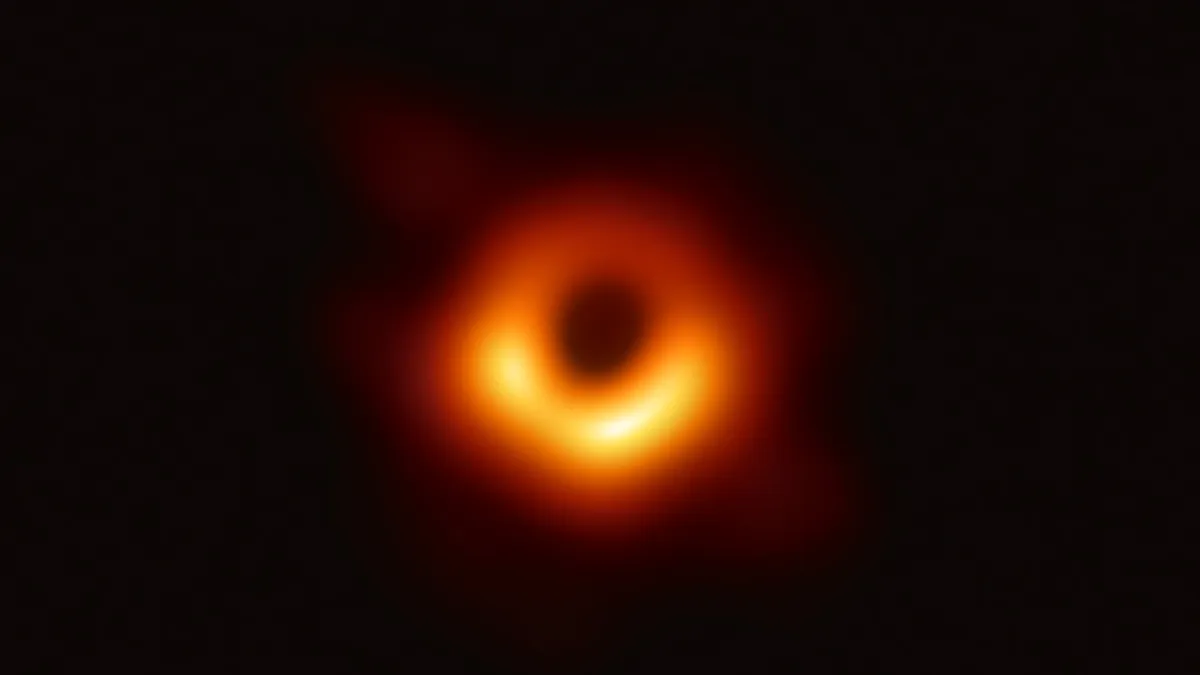
The first-ever photo of a black hole, seen above, was captured in 2019 using the Event Horizon Telescope, a planet-scale array of eight ground-based radio telescopes forged through international collaboration, captured this image of the supermassive black hole and its shadow that's in the center of the galaxy M87.
This NASA visualization shows how a black hole warps its cosmic neighborhood like a carnival mirror with its immense gravitational pull.
Full story: Weird black hole physics revealed in NASA visualization
Blasting jets at (almost) the speed of light

The jets emanating from a famous black hole are cruising along at about 99% the speed of light, according to observations from NASA's Chandra X-Ray Observatory. Researchers spotted the speedy jets emanating from a black hole in the galaxy Messier 87 — the same black hole that was imaged directly for the first time by the Event Horizon Telescope. In this wide-field image of Messier 87 from the Chandra X-ray Observatory, the white box indicates the approximate location of the black hole's jet.
Black hole boost star birth millions of miles away

Using data from NASA's Chandra X-ray Observatory and other telescopes, researchers discovered a black hole that has sparked star formation in multiple galaxies across tremendous distances. Chandra observed powerful X-rays (red) produced by hot gas circling around a black hole at the center of a galaxy located 9.9 billion light-years from Earth.
Cygnus X-1

The skewed light from near the black hole Cygnus X-1 reveals new details about the warped space and extraordinarily powerful magnetic fields close to it. Cygnus X-1, the first black hole ever discovered, is about 10 times the mass of the sun, 18 miles (60 kilometers) wide and 8,000 light-years away from Earth in the constellation Cygnus. It sucks gas away from a closely orbiting blue supergiant star, which super-heats as it spirals inward, emitting high-energy X-rays and gamma rays.
MWC 656

Artist's concept of the MWC 656 system, which consists of a massive "Be" star and a companion black hole. The star rotates at very high speed, ejecting an equatorial disc of matter that is transferred to the black hole through an accretion disk.
Blowing bubbles

A huge, invisible bubble surrounds the black hole Cygnus X-1. The cavity is carved from space by the activity of the black hole itself and was detected with a radio telescope. The cross marks the location of the black hole Cygnus X-1 in this radio image. The bright region to the left (east) of the black hole is a dense cloud of gas existing in the space between the stars, the interstellar medium.
Sagittarius A*

Theoretical calculations predict that the Milky Way's central black hole, called Sagittarius A*, will look like this when imaged by the Event Horizon Telescope. The false-color image shows light radiated by gas swirling around and into a black hole. The dark region in the middle is the "black hole shadow," caused by the black hole bending light around it.
Black hole swallows a star

These images, taken with NASA's Galaxy Evolution Explorer and the Pan-STARRS1 telescope in Hawaii, show a brightening inside a galaxy caused by a flare from its nucleus. The arrow in each image points to the galaxy. The flare is a signature of the galaxy's central black hole shredding a star that wandered too close.
Black hole simulation

The inner workings of black holes are a bit clearer thanks to a supercomputer simulation that showed how matter falling into black holes emits light. By analyzing a simulation of a black hole about the size of a star, researchers saw how two kinds of X-rays can be emitted by the stuff falling into the densest objects in the known universe. This annotated image labels several features in the simulation, including the event horizon of the black hole.
Stuck in the middle with a black hole

The image shows 1 out of the 9 large galaxies included in a study from NASA's Chandra X-ray observatory about how black holes spin. This galaxy, named NGC 5846, contains a supermassive black hole in its center.
Evidence

On left, a blob of glowing hydrogen gas appears yellow. On right, the blue light is evidence for a growing supermassive black hole in the center of the galaxy.
Eat to the beat
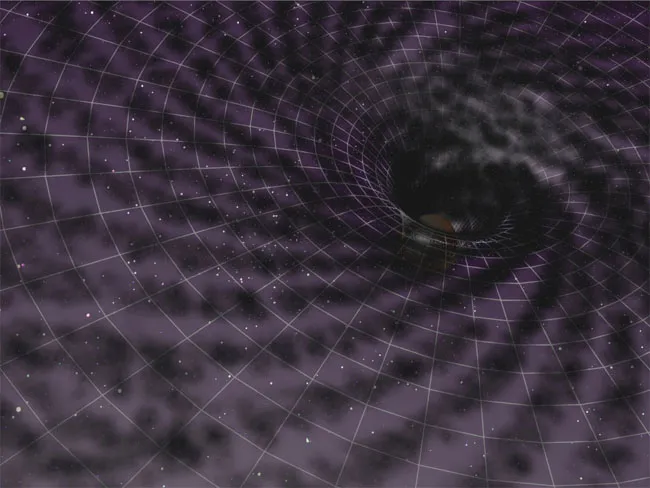
Artist's schematic impression of the distortion of space-time by a supermassive black hole at the center of a galaxy. The black hole will swallow dark matter at a rate which depends on its mass and on the amount of dark matter around it.
Smash it up

A massive black hole hidden at the center of nearby galaxy, Centaurus A, feeds on a smaller galaxy in a spectacular collision.
Warm jets

Combining observations done with ESO's Very Large Telescope and NASA's Chandra X-ray telescope, astronomers have uncovered the most powerful pair of jets ever seen from a stellar black hole. The black hole blows a huge bubble of hot gas, 1000 light-years