


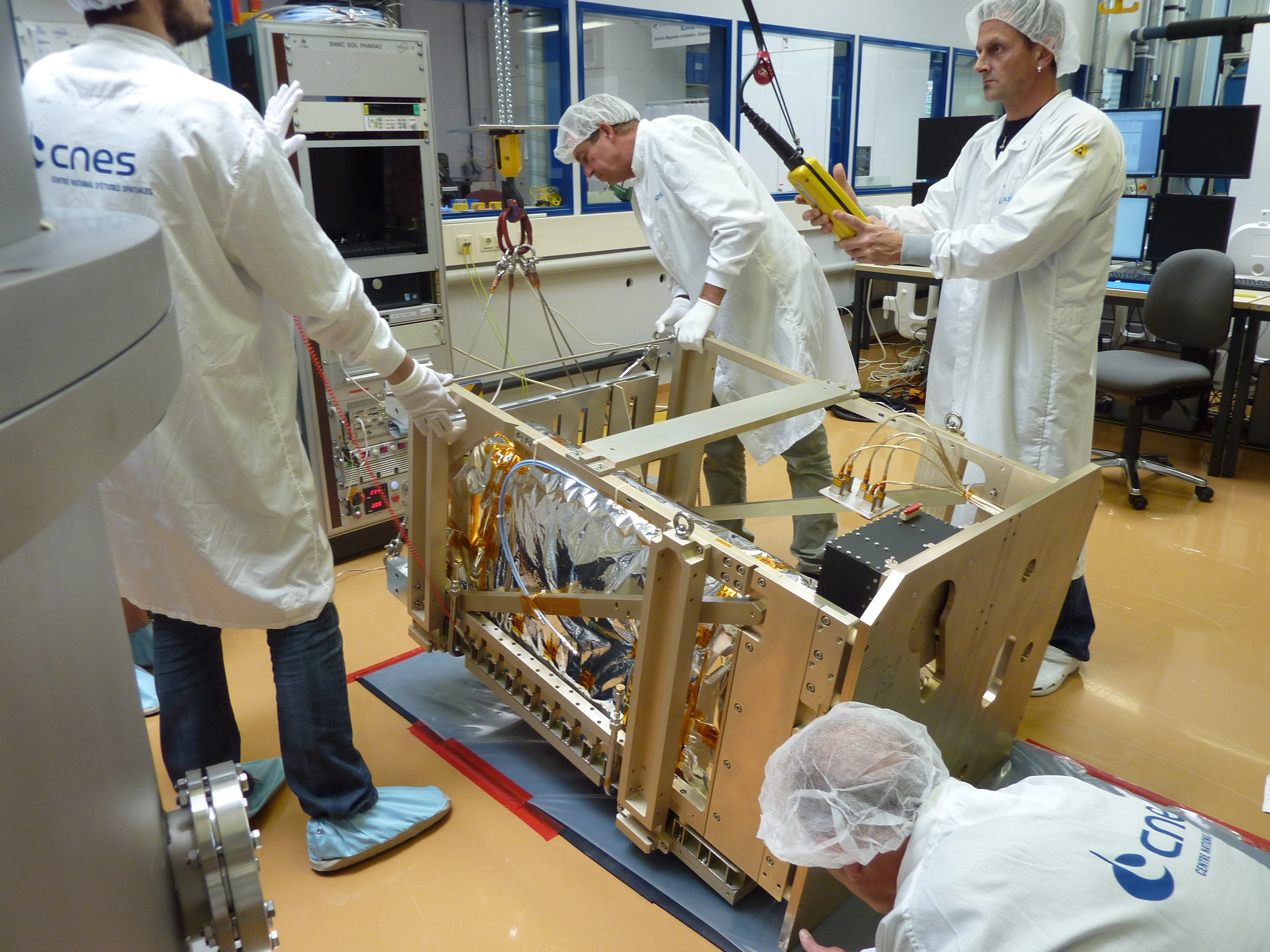
A new atomic clock is due for installation on the International Space Station in 2016, ushering in a new age of physics experiments probing the relationship between space and time.
Called PHARAO (short for Projet d'Horloge Atomique par Refroidissement d'Atomes en Orbit), the atomic clock tells time by using lasers to chill cesium atoms to minus 273 degrees Celsius. It was designed by CNES, the French space agency, and is expected to travel to the station in two years. Once there, the space station's robotic arm will install it on a payload platform outside the Columbus Laboratory, one of the station's research modules.
But PHARAO won't be alone. Another atomic clock called SHM, or Space H-Maser will also be on the orbiting outpost. SHM keeps time by using microwave radiation and hydrogen atoms.
Together the two clocks will make up the Atomic Clock Ensemble in Space (ACES), a device that will be so accurate that it will lose only one second every 300 million years.
During the European Space Agency's ACES's 18-month mission, PHARAO and SHM will be connected to atomic clocks in Japan Australia, Europe, and the United States. This network will allow the two space-bound clocks to compare various kinds of atomic time measurement.
"Taking full advantage of the microgravity environment and world-wide coverage provided by the ISS [International Space Station], ACES will establish a stable and accurate onboard timescale which will be used to perform space-to-ground and ground-to-ground comparisons of best available atomic frequency standards," ESA officials said in a statement.
In addition, the two space clocks will also test Einstein's general theory of relativity, which maintains that time and gravity are intermeshed. The theory holds that a clock in a gravitational field will be slower than a clock in low-gravity environment. The more accurate the clock, the more finely scientists can test the theory.
Extremely precise timekeeping is not just a scientific curiosity. Ultra-accurate clocks help the modern world run, making global positioning systems possible. GPS systems help power companies distribute electricity more efficiently, as well as make it easier for businesses to track transactions.
Follow Raphael Rosen @raphaelrosen22. Follow us @Spacedotcom, Facebook and Google+. Original article on Space.com.
