





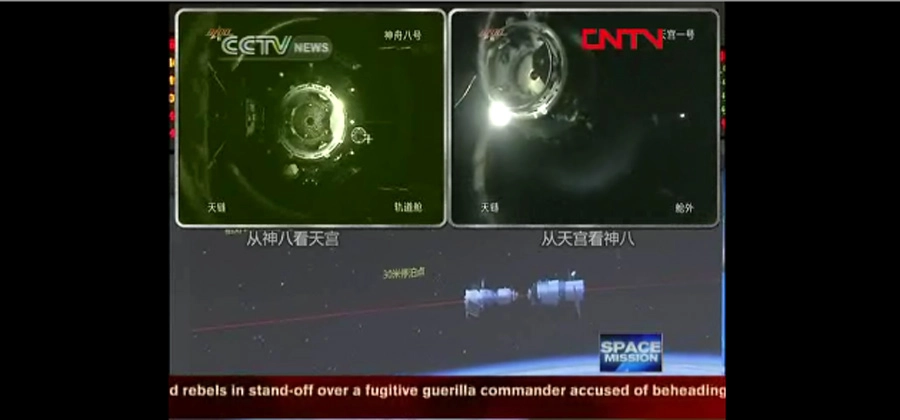
The first Chinese space docking today (Nov. 2) inspired not just national and scientific pride, but some romantic sentiment as well.
Several different Chinese newspapers and commentators have described the Tiangong 1 ("Heavenly Palace") and Shenzhou 8 ("Divine Vessel") spacecraft, which linked up in orbit today for the first time, as "lovers" making a "kiss in space," state newspaper Xinhua reported.
"Tiangong, my lover, for the arrival of this moment -- wait for me. I'm coming," reads a poem called "Lovers' Talk," published in Tianfu Zaobao, a Sichuan-based daily, according to Xinhua.
Another article, published by Xinhua itself, wrote, "If we compare the space docking mission with the pact of a pair of lovers deeply in love, it will be the most romantic story of the season."
The spacecraft docking maneuver has reminded many in China of a famous folk story involving a cowherd and a weaver, who are punished by the Goddess of Heaven and can only meet in the sky once a year by crossing a bridge formed by magpies, mythology and folklore expert An Deming told Xinhua.
"When talking about a rendezvous in space, Chinese people will immediately think of the story of the cowherd and the weaver girl," said An, who is a researcher with the Chinese Academy of Social Sciences. "Technological development often draws heavily upon a nation's historical and cultural heritage, and the two supplement each other in the modern world."
The folklore legend is the inspiration for China's annual Qixi Festival, which is sometimes called Chinese Valentine's Day.
Today's docking experiment was pronounced a "complete success" by Chinese space agency leaders. It will be followed by a second docking between the same two spacecraft, and then dockings between Tiangong 1 and Shenzhou 9 and 10, set to launch in 2012.
The activities are all part of China's plans to develop its own manned space station by 2020.
You can follow SPACE.com assistant managing editor Clara Moskowitz on Twitter @ClaraMoskowitz. Follow SPACE.com for the latest in space science and exploration news on Twitter @Spacedotcom and on Facebook.
