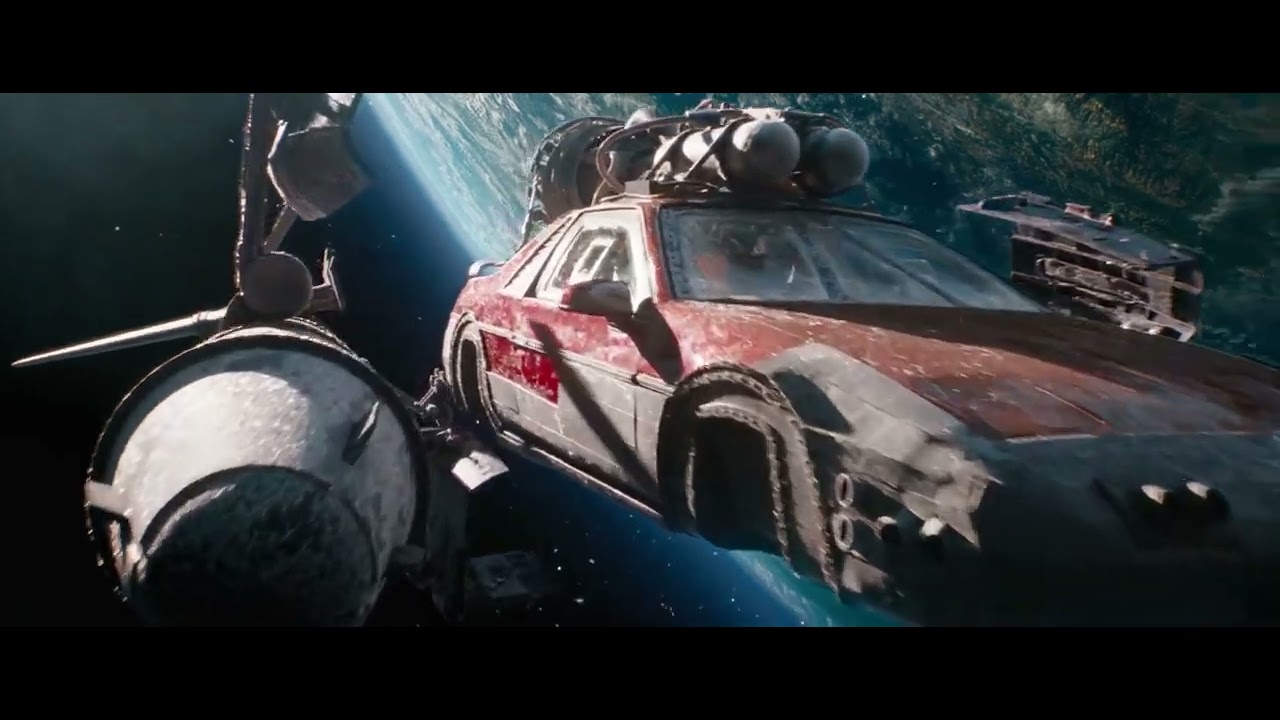
Five years ago, an internet meme turned into a reality in "F9" when the Fast & Furious crew launched a car into space. Depending on your sense of humor and ability to suspend disbelief, it's either peak cinema or extreme tomfoolery, but it's clear that the only way this franchise will ever top this moment is by drag racing a velociraptor in a "Jurassic World" crossover.
The "F9" scene sees Tej Parker (played by Ludacris) and Roman Pearce (Tyrese Gibson) sit inside a rocket-strapped Pontiac Fiero that's launched from a plane and sent into orbit to destroy a satellite. They succeed in their mission, then find themselves hanging about in space and waving at the International Space Station crew, who wonder if they're Minions. No, they aren't, but they're (say this part in Dom Toretto's deep voice) family.
Now, the Fast & Furious franchise has never played by the rules of physics, or reality for that matter. It values entertainment above all, but it's still fun to explore where it gets certain parts right and wrong at times. So we asked three experts about this car-launched-into-space scene and how ridiculous it is. Surprisingly, it isn't as dumb as everybody might think it is.
The filmmakers flub the carrier plane, though. Remember the aircraft that takes the Fiero up into the sky? It's something of a Frankenstein's monster. "The cockpit that they show is crossed between a Boeing 767 and 777," David Cohen, the current dean of aeronautics at Lynn University and former colonel of the U.S. Air Force, tells Space. "However, the aircraft from the external shot looks a little like a military C-17 – except that it has four engines. The C-17 was actually used as the basis for the transport aircraft in the 'Avengers' movies."
According to Cohen, another major issue in this sequence is how the Fiero sits on top of the carrier aircraft before it's dispatched. "Even in a military aircraft that's carrying weapons and missiles, there's a tremendous amount of time that is spent on both the carriage and the release of that weapon from the aircraft, including multiple cameras and a lot of testing," he says.
"So there's never something as simple as, 'Oh, we're just going to strap this on and see how it goes.'" When the Fiero is released, it's far too close to hitting the tail of the plane. In other words, it would have needed to be launched in another manner.
Now, there is a precedent of air-launch-to-orbit (ALTO) in the real world, such as the Northrop Grumman Pegasus. However, Bryan Schmidt, assistant professor of mechanical and aerospace engineering at Case Western Reserve University, thinks the "F9" filmmakers took direct influence from the first spaceflight of Virgin Galactic's SpaceShipTwo, which would coincide with the film's production timeline.
"Burt Rutan and Richard Branson formed a company called Virgin Galactic, and if you remember, they built a space plane for essentially space tourism," Schmidt says.
"The SpaceShipTwo could fly six people in this little rocketship that would get airdropped from a plane. Their first flight into space was in 2018, and this movie came out in 2021, so my guess is that the filmmakers were actually drawing a lot of inspiration from that system where the space plane would get carried up by an airplane, then the airplane would drop it around 40,000 feet, and the rockets would ignite and take it up to space."

As Schmidt explains, the SpaceShipTwo dropped at around 40,000 feet while the vehicle in "F9" is at 50,000 feet, but it's still a similar-enough concept. "The densest part of the atmosphere is the bottom," Schmidt says.
"By using an airplane to get you up, you're dramatically reducing the amount of work that the rockets on the spacecraft have to do. So you can make your engine and your spacecraft a lot smaller and still be able to attain a pretty high altitude. If you look at SpaceShipTwo, its rocket engine is pretty small – the engine itself is about the size of a person. The other interesting thing is that if you look in the movie, there's a tank of nitrous oxide in the car. In the SpaceShipTwo, the oxidizer that they used for their rocket fuel was nitrous oxide."

Ashmeet Singh, assistant professor of physics at the Indian Institute of Technology Delhi, sees the same logic in the ALTO but thinks the Fiero would struggle to reach its ultimate destination. "To stay in orbit you have to be moving sideways at about 7.8 kilometres per second, and thanks to Newton's Third Law of action equals minus reaction, rockets burn and eject fuel to get an opposite directed thrust," he says. "To get to those fantastic speeds, real rockets are almost entirely propellant by weight. A couple of boosters bolted to a car can't carry anything close to that."
There's also the question of the Fiero itself, and if it would last the entire journey. According to Earl (Jason Tobin) in "F9", the modified car has a ceramic polymer coating. While spacecraft use ceramic coating for heat protection, one wonders how thorough the testing for Tej and Roman's expedition really was. A regular Fiero simply wouldn't cut it, as Singh explains. "On the way up, the car wouldn't survive the heat from air resistance and the compression of the air, as the car rams into air molecules faster than it can move out of the way, which makes it heat past 1000°C. And a fibreglass body with ordinary glass has no heat shield and no structure for the violent shaking."
Cohen, Schmidt, and Singh all agree on how ridiculous it is that Roman uses the Fiero's steering wheel at all. "The steering wheel is pure theatrics: in a vacuum, there's no air over a wing and no road under a tyre, nothing to push against, so turning it does exactly nothing," Singh says. "Real spacecraft pivot by firing little thrusters, not by steering." Schmidt jokes that maybe it's something for Roman to hold onto while on the way up."*
*The car is shown to have tiny thrusters, so maybe they're hooked up to the wheel? We'll give them the benefit of the doubt.

All three experts also highlight that the scuba-like gear that Tej and Roman wear is grounded in some real-world logic. "The very first time human beings went above Earth into an area where there wasn't enough breathable air, Wiley Post was one of the first pioneers doing this in the 1930s," Cohen says.
"Post had effectively what was a scuba suit at the time to handle the pressure and keep the air in the suit, and allowed him to breathe. So, the concept is not foreign to aviation." What is funny to Cohen is how Tej uses duct tape to keep his suit together.
As Schmidt and Singh add, though, these suits might not suffice depending on the length of the journey and the pressure in space, differing from underwater situations. Apart from the actual suits protecting the characters, you also need to consider the effect of G-force on Tej and Roman. Both look relatively fit and in good shape, but are they astronaut-fit for this undertaking?

"As a pilot and astronaut, there's physiology you have to know about and ways you can clench muscles and attempt to fight some of the forces you experience," Cohen says.
"G-loss of consciousness is possible, and it happens with pilots in high-performance aircraft occasionally. They'll pull so many Gs that the force will take the blood out of their head down to their feet, and they lose consciousness. Ultimately, you do come back, but the goal is not to have that happen. It does not appear that there's any accountability for G-forces in 'F9', at least in the scene where the car is departing the aircraft."

Unquestionably, "F9" is pure entertainment, so liberties are taken to sell an outrageous story where everybody behaves and acts like an invincible superhero. Having said that, it's good to see that the filmmakers and screenwriters actually attempted to bring an iota of realism to the film.
"Another powerful moment the scene gets right isn't the hardware or the science, it's possibly the awe on Tej and Roman's faces when they see Earth reflected in their visors," Singh explains. "Chris Hadfield, the Canadian astronaut who actually commanded the Space Station, even admitted that feeling to be true to the real thing."
To infinity and beyond... for family.
"F9" is available to stream on Prime Video.