If you were disappointed with the meager showing put on by this year's Leonid meteor shower, don't fret. What could be the best meteor display of the year is scheduled to reach its peak on Monday night, Dec. 13.
Skywatchers with dark skies away from city lights could see one or two meteors every minute during the Geminid meteor shower. The greatest activity is expected to be visible from North America, Europe and Africa.
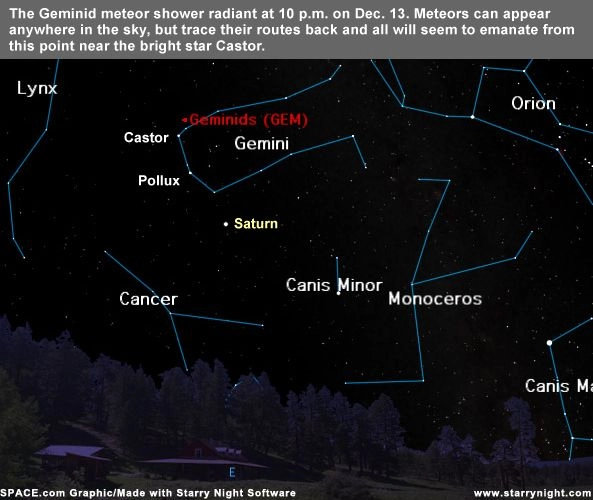
The Geminids get their name from the constellation of Gemini, the Twins. On the night of this shower's maximum, the meteors will appear to emanate from a spot in the sky near the bright star Castor in Gemini. [Sky Map ]
Typically strong
The Geminid meteors are usually the most satisfying of all the annual showers, even surpassing the famous Perseids of August. Studies of past displays show that this shower has a reputation for being rich both in slow, bright, graceful meteors and fireballs as well as faint meteors, with relatively fewer objects of medium brightness.
Geminids typically encounter Earth at 22 miles per second (35 kilometers per second), roughly half the speed of a Leonid meteor. Many Geminids are yellowish in hue. Some even appear to form jagged or divided paths.
The Earth moves quickly through this meteor stream. Rates increase steadily for two or three days before maximum. So over the weekend, viewers between midnight and dawn might see a shooting star every few minutes. The number of meteors drops off sharply after the peak. Renegade forerunners and late stragglers might be seen for a week or more before and after maximum.
Ideal conditions
The Geminids perform excellently in any year, but British meteor astronomer Alastair McBeath has expects a "superb year" in 2004. Last year's display was seriously compromised by bright moonlight, when a bright gibbous Moon came up over the horizon during the late evening hours and washed-out many of the fainter Geminid streaks.
But this year, the Moon will be at New phase Dec. 11. On the peak night, the Moon will be a skinny crescent, low in the west-southwest at dusk and setting before 6 p.m. That means the sky will be dark and moonless for the balance of the night, making for perfect viewing conditions.
According to McBeath, the Geminids are predicted to reach peak activity on Monday at 22:20 GMT, which is 5:20 p.m. EST. Locations from Europe and North Africa east to central Russian and Chinese longitudes are in the best position to catch the very crest of the shower, when the rates conceivably could exceed 120 per hour, or two every minute. [Predictions for Select Cities]
Maximum rates persist at only marginally reduced levels for some 6 to 10 hours, McBeath says, so other places, such as North America, should enjoy some fine Geminid activity as well.
When to watch
Indeed, under normal conditions on the night of maximum activity, with ideal dark-sky conditions, at least 60 to 120 Geminid meteors can be expected to burst across the sky every hour on the average. Light pollution greatly cuts the numbers, so city and suburban dwellers will see far fewer.
Generally speaking, depending on your location, Gemini begins to come up above the east-northeast horizon right around the time evening twilight is coming to an end. So you might catch sight of a few early Geminids as soon as the sky gets dark. There is a fair chance of perhaps catching sight of some "Earth-grazing" meteors.
Earthgrazers are long, bright shooting stars that streak overhead from a point near to even just below the horizon. Such meteors are so distinctive because they follow long paths nearly parallel to our atmosphere.


The Geminids begin to appear noticeably more numerous in the hours after 10 p.m. local time Monday, because the shower's radiant is already fairly high in the eastern sky by then. The best views, however, come around 2 a.m. Tuesday, when their radiant point will be passing very nearly overhead. The higher a shower's radiant, the more meteors it produces all over the sky.
How to prepare
This time of year, meteor watching can be a long, cold business. The late Henry Neely, who for many years served as a lecturer at New York's Hayden Planetarium, once had this to say about watching for the Geminids: "Take the advice of a man whose teeth have chattered on many a winter's night - wrap up much more warmly than you think is necessary."
Hot cocoa or coffee can take the edge off the chill, as well as provide a slight stimulus. It's even better if you can observe with friends. That way, you can keep each other awake, as well as cover more sky.
Give your eyes 15 minutes or more to adapt to the darkness before getting serious about meteor watching. And have something comfortable to sit on; a lounge chair will allow you to stare up for long periods without straining your neck.
Geminids stand apart from the other meteor showers in that they seem to have been spawned not by a comet, but by 3200 Phaeton, an Earth-crossing asteroid. Then again, the Geminids may be comet debris after all, for some astronomers consider Phaeton to really be the dead nucleus of a burned-out comet that somehow got trapped into an unusually tight orbit.
- How Meteor Showers Work
- Meteor Watching Tips
- The Power of a Shooting Star


Starry Night software brings the universe to your desktop. Map the sky from your location, or just sit back and let the cosmos come to you.

Joe Rao serves as an instructor and guest lecturer at New York's Hayden Planetarium. He writes about astronomy for The New York Times and other publications, and he is also an on-camera meteorologist for News 12 Westchester, New York.
"Back in 1985, I was teaching and directing the Rollins Planetarium at Young Harris College at the base of Georgia's highest mountain peak, Brasstown Bald (Yes, Georgia has mountains!).
"The 4784-foot mountain often served as my private observation spot at night, as it did on the night of December 13-14, 1985 during the Geminid meteor shower. I aimed my tripod-mounted Nikon FE-2 camera toward the celestial pole and stopped down the lens to f5.6 for a 60-minute exposure. Several meteors flashed by during the hour, but none were bright enough to record at f5.6.Two airplanes, headed for parts unknown, left their silent trails across the film. The silhouette of the tower housing the Information Visitors Center and observation deck is visible atop the peak, 200 feet above me.
"After the hour-long exposure, I placed my gloved hand over the 50 mm lens, carefully opened the aperture ring to f1.8, and waited for 5 minutes. I then removed my hand from in front of the lens for a final 30 second exposure to punctuate each star trail with a bright dot. As fate would have it, during that 30-second interval, the brightest Geminid fireball of the night shot right across the center of the image! My main concern was not bumping the tripod as I jumped up and down in excitement!
"The result, as you can see, is a striking portrait of a Geminid meteor."