





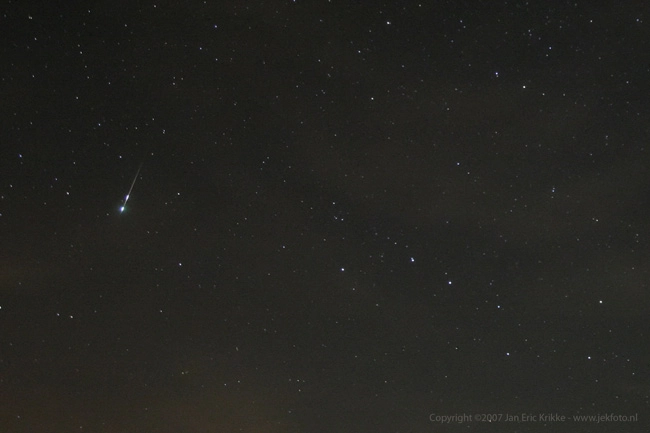
Anunexpected meteor shower popped up during the annual Perseids shower Aug.11-13, 2007. Among the fast-moving Perseids were several slow-moving meteorsfrom a shower called the "Kappa Cygnids," radiating from a pointbetween the bright stars of Vega and Deneb. Some meteors were as bright as thefirst quarter moon and flashed in multiple colors.
KoenMiskotte, a leading amateur astronomer of the Dutch Meteor Society, firstalerted us to the shower. Many Kappa Cygnids exhibited irregular light curves and end flares. Spanishastronomers Josep M. Trigo-Rodríguez of the Institute of Space Sciences (CSIC-IEEC)and José M. Madiedo of the University of Huelva reported that the brightmeteors had been recorded on all-sky cameras of the Spanish Meteor Network(SPMN) and activity of the Kappa Cygnidsappeared to peak around Aug. 13 00h UTC, during the peak of the Perseids, butlasted for several days.
At thetime, a group of 12 researchers were deployed over California and the Pacific Ocean in a Gulfstream GV jet to prepare for an observing campaign for the rare Aurigidmeteor shower two weeks later, on Sept. 1, 2007. Sure enough, while watchingthe video tapes that were recorded during this test flight, numerous slow KappaCygnid meteors were discovered.
Amazingly,for just trying, we already got something out of this practice campaign. TheKappa Cygnids had last erupted in 1993, and perhaps also in 1999, and the 2007return was completely unexpected. The new observations of the Kappa Cygnids mayshed light on the origin of this shower.
Unlike theAurigids, the Kappa Cygnids do not have a known parent body, and no predictionscan be made yet to forecast the next return. They move in short, 6 to 12-yearorbits and are much younger than the 2,000-year-old Aurigids.
August28 Lunar Eclipse
Last night,August 28, there was a lunar eclipsehere in California. Predictions were widely circulated when the Moon would moveinto the shadow of Earth. Sure enough, I watched, delighted to see the lastsliver of unobstructed sunlight disappear when the Moon, exactly on time, movedcompletely into the shadow. I spent the night taking pictures of the fadingMoon, watching the sky become even darker.
Will meteorshowers become as predictable as lunar eclipses in the future? Earlyastronomers in the ancient Orient and China predicted lunar eclipses afternoticing periodic patterns in their return. Precise predictions became possiblecenturies ago once Newton formulated the law of gravity. The application of Newton?s law to predicting meteor showers is something we have been able to do well onlyvery recently. In the past ten years we have had some success in predicting thereturn of unusual showers by calculating how the planets hustle the dust trailsin and out of Earth's path.
So far, theAurigid shower on September 1 is our most ambitious prediction. The meteorsdate from 2000 years ago, four times farther back in time than the previousrecord holder, the year 2000 Ursid outburst, which dated from the time ofColumbus.
Will theAurigid shower return as predicted between 4 and 5 PDT in the early Saturdaymorning of September 1? Will it be visible from western parts of the USA and Mexico? Again, we?re flying to observe based upon our predictions. Only by making theseobservations can we improve our methods, and make forecasting meteor showers asreliable as predicting eclipses.
Please joinus in making observations. We invite that the general public to submit digitalimages and camcorder pictures of the Aurigid meteors.
Moreinformation: http://aurigid.seti.org
- All About Meteors
- Top 10 Perseid Meteor Shower Facts
- New Gallery: 2006 Perseid Meteor Shower