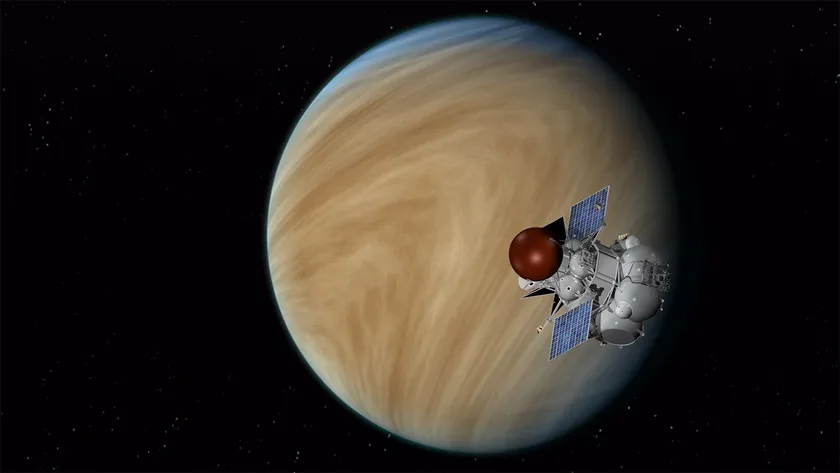
While the spectacle holds little significance for most astronomers, one researcher plans to use it as an opportunity to examine an unexplored region of our sister planet's atmosphere. The effort will also refine skills for probing the skies of planets beyond our solar system.
Venus last crossed the face of the Sun, an event known as a transit, in 1882.
The geometry is much like that of a solar eclipse: Venus (instead of the Moon) will be directly between Earth and the Sun. Because the two planets orbit the Sun in slightly different planes, this perfect alignment is rare. Transits of Mercury, on the other hand, are much more common.
Tuesday's transit will be visible across all of Europe and much of Asia and Africa. Many skywatchers in eastern portions of the United States will have a chance to see the final moments of the passage. Experts warn that proper viewing techniques must be employed, such as approved solar filters, self-made pinhole cameras or by projecting the event against a wall. [Viewing Tips]
No one should look directly at the Sun without a safe filter, as serious eye damage can result.
To get a good view, Timothy Brown of the National Center for Atmospheric Research is trekking to Spain's Canary Islands off the coast of Africa. There he will use a large telescope and a recently developed technique that should reveal chemicals in Venus' atmosphere by analyzing sunlight that passes through it.
Space missions have already provided a good view of the Venusian atmosphere. It is made mostly of carbon dioxide, so thick it shrouds our view of the surface. But there are other substances in the air there, and Brown said there is a void of data at between 40 and 53 miles (65 and 85 kilometers) above the scorching surface. So that's where he'll concentrate.
"I hope to make a substantial addition to knowledge of an atmospheric region not well observed in the past," Brown said. "But also the experiment will be a source of great inspiration and motivation for investigating the atmospheres of extrasolar planets."
Brown and colleagues developed the method to make the first discovery, in 2001, of an atmosphere around a planet orbiting another star. In that case, they couldn't even see the planet -- it had been discovered by noting the wobble it induced on its host star. When Venus crosses in front of the Sun for more than six hours, it will be readily visible - without a telescope -- as a tiny black dot on the solar surface, at least for those who plan a safe way of seeing it.
"This is among the rarest of astronomical events," says SPACE.com's Night Sky Columnist Joe Rao. "Between the years 2000 BC and 4000 AD there are only 81 Venusian transits."
The next one occurs in 2012.
Timetables for world and U.S. cities, safe viewing tips, and links to live webcasts of Tuesday's event are available at SPACE.com's Venus Transit Headquarters.