newsarama.com
advertisement


Los Alamos researcher Rod Whitaker checks an infrasound array station. Microphones are in the tentacles.
Pristine Yukon Meteorite A Rare Find
Meteors and Meteor Showers: How They Work
Scientists Gather To Debate Earth-Asteroid Collisions
Keeping Track of Dangerous Asteroids
Listening for Nukes: A Meteor Detection Project
By Robert Roy Britt
Senior Science Writer
posted: 07:00 am ET
24 May 2001

If anyone tries to secretly test a nuclear weapon, anywhere in the world, the U

If anyone tries to secretly test a nuclear weapon, anywhere in the world, the U.S. Department of Energy will know about it. Same goes for any large space rocks that try to sneak past our planet's natural defense system.

The technology that monitors both of these potentially hazardous events is amazingly simple. A handful of microphones positioned around the United States listen for a telltale atmospheric pressure wave, a phenomenon that circles the globe at a frequency too low for the human ear to detect.

A similar system is now under construction worldwide, designed to help monitor and enforce compliance with the Comprehensive Nuclear Test Ban Treaty. A recent study, however, questions whether the technology is up to the task.

The sensitive but simple detection system, which officials say can pinpoint the source of a nuclear blast by noting when the pressure wave arrives at each microphone, also routinely detects giant space rocks that slam into Earth's atmosphere, vaporizing and producing a similar pressure wave.

On April 23, researchers monitoring the set-up from the Los Alamos National Laboratory detected an explosion out over the Pacific Ocean. After comparing the data with other monitoring stations, they determined it was not a rogue nation setting off a bomb, but rather an object the size of a small car burning up as it raced through the atmosphere toward the planet.

Quite a show

The object plunged into the atmosphere several hundred miles (kilometers) west of the northern portion of Baja California. It's possible no one saw it. But that doesn't mean it wasn't there.

The explosion was equivalent to at least 6,000 tons of TNT, according to Los Alamos scientists Rod Whitaker and Doug ReVelle. Once a space rock enters our atmosphere, it is called a meteor. And based on the incoming meteor's energy and speed, the researchers figure it was at least 12 feet (3.6 meters) in diameter.

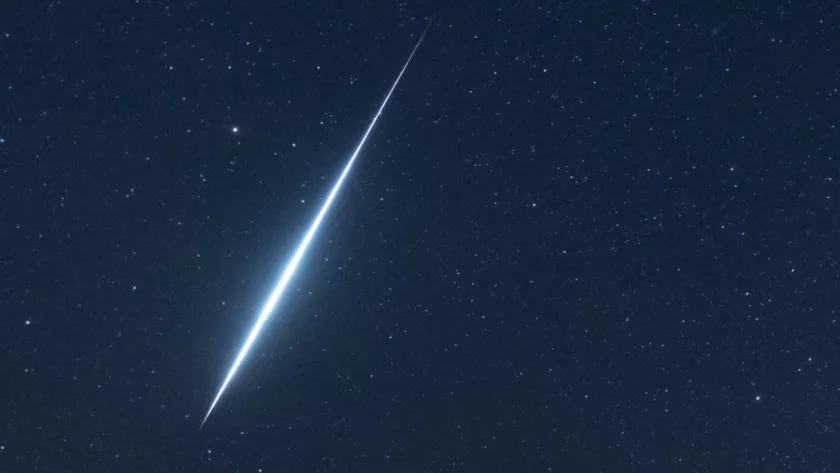
Whitaker and ReVelle say it would have created a very visible fireball in the sky, something scientists call a bolide.

"Had anyone seen the April 23 event, they would have seen quite a show," ReVelle said. "That meteor was one of the five brightest meteors that have ever been recorded."

The event, along with a similar one on August 25, 2000, was confirmed by U.S. Department of Defense (DOD) satellites. Whitaker and ReVelle told SPACE.com that DOD satellites are able to spot different characteristics in a meteor or nuclear explosion. "Nuclear explosions would leave radioactive debris, which could be picked up by radionuclide air samplers," they said.

It's raining rocks

ReVelle said that on the average, 10 or more meteors, each wider than the average person is tall, enter the atmosphere every year. Typically, they do not make it to the ground. Some do, however, and every hundred years or so researchers estimate that one large enough to cause local death and destruction reaches the planet.

So, of course, scientists who study asteroids appreciate the government's listening efforts.

"We are bombarded daily by smallish debris, but it is the larger chunks that can easily penetrate our atmospheric shield and cause physical damage on the Earth's surface," said Benny Peiser, a researcher at Liverpool John Moores University who studies how natural catastrophes might affect Earth and its inhabitants.

Peiser said the DOD and other researchers have routinely published detection data of atmospheric impacts since the end of the Cold War.

"This data is vital for assessing the impact rate and a better understanding of the overall impact hazard," he said. But he also noted that the information contributes to international stability by helping to distinguish space rocks from nuclear tests.

Leftover technology

During the 1960s, before satellites were common, the U.S. Air Force operated a network of infrasound stations, as they are called, as a first line of defense and to listen for nuclear-weapon tests.

The Los Alamos listening devices, four around the country, were installed in 1983. They remain, at least for now, the only infrasonic network left in full-time operation in the world. Because the system is simple, officials say it costs very little to maintain.

But it is highly sensitive, able to detect meteors as small as a baseball.

The sonic waves created by such a meteor, or a faraway nuclear explosion, are well below the range of human hearing, but are detectable as small changes in atmospheric pressure. The system is like a hypersensitive barometer used by meteorologists to note incoming storm fronts.

Cheap insurance

The Los Alamos listening devices would not provide advance warning of an incoming meteor. The pressure wave takes several minutes to hours to reach the stations. But the stations do have tremendous potential for detecting clandestine nuclear weapons tests, the researchers say.

Whitaker said other technologies, including satellites, sometimes miss events that the ground-based microphones pick up.

"Consequently, infrasound is inexpensive insurance for cost-effective monitoring, and it is something that's available to the entire international community," he said.

And, interestingly, nature's meteors help the Feds calibrate their nonproliferation technology efforts.

"Because those two [meteor] events were detected by our four arrays and by five other arrays operated by the International Monitoring System, we are able to use the space platform data to calibrate our instruments, and analyses, to make them better able to pinpoint the exact location where these events occurred," Whitaker said. "Every time we hear a bolide, we learn something about this technology and are better able to fine-tune it."

Nuke or meteor?

The International Monitoring System is a developing worldwide network of 321 monitoring stations that use various techniques to make sure no one violates the Comprehensive Nuclear Test Ban Treaty (CTBT), in which nations agree to ban all nuclear explosions.

Though the U.S. Senate has not ratified the signed treaty, many other nations have.

As part of the monitoring system, construction has begun on a global array of 60 infrasound listening devices. And about 100 stations using other techniques have been built.

But infrasound technology can also detect explosive volcanoes, meteorological events and even rocket launches and supersonic aircraft. It is therefore questionable how accurate it is in monitoring nuclear tests.

A pair of Dutch researchers got some surprising results when they set up a similar device. On a November night in 1999, a flash of light brightened the skies above northern Germany. In the Netherlands, Läslo Evers and Hein Haak detected the sonic boom associated with the explosion, but could not distinguish it from the expected signature of a nuclear explosion.

In January of this year, the researchers reported their results in the journal Geophysical Research Letters, suggesting that the devices might not be capable of distinguishing between a natural attack from space and a clandestine nuclear test.

Nonetheless, the worldwide monitoring plan moves forward.

Last month, a CTBT commission announced that the first infrasound station, in Germany, had been certified for use. The system was constructed deep in the Bavarian forest, which officials say will help cut down on wind noise that might fool the microphones. And each sensor is surrounded by a network of baffles to further block the wind.

More methods

Infrasound will not be the only technology used to enforce the treaty.

Some 170 seismic sensors and 11 underwater listening devices will be used as well, plus 80 devices that can detect radioactive debris. Information from all these sensors will funnel via satellite into the International Data Center in Vienna, where automated results are released two hours after the data rolls in.

A spokesperson at Los Alamos said the lab "has always maintained that infrasound is only one tool in the entire nonproliferation toolbox and probably should not be regarded as a standalone nonproliferation technology," but that it can help make other systems more effective.

The CTBT, adopted in 1996, has been signed by 160 nations, but ratified by only 76. An additional 33 have not signed on at all.

Arms control advocates had campaigned for the adoption of a test ban treaty since the early 1950s. The first one was adopted in 1963 -- a Partial Test Ban Treaty that banned nuclear tests in the atmosphere, underwater and in space.

Neither China nor France signed that first international test-ban treaty, and negotiations for stricter treaties have continued ever since.

Click here for more news and information about meteors.


CGA-03 Analog Meter Geiger Counter
$249.99
Explore More


Site Map | News | SpaceFlight | Science | Technology | Entertainment | SpaceViews | NightSky | Ad Astra | SETI | Hot Topics
Image Galleries | Videos | Reader Favorites | Image of the Day | Amazing Images | Wallpapers | Games | Community
about us | FREE Email Newsletter | message boards | register at SPACE.com | contact us | advertise with us | terms & conditions | privacy statement
DMCA/Copyright
  What is This?