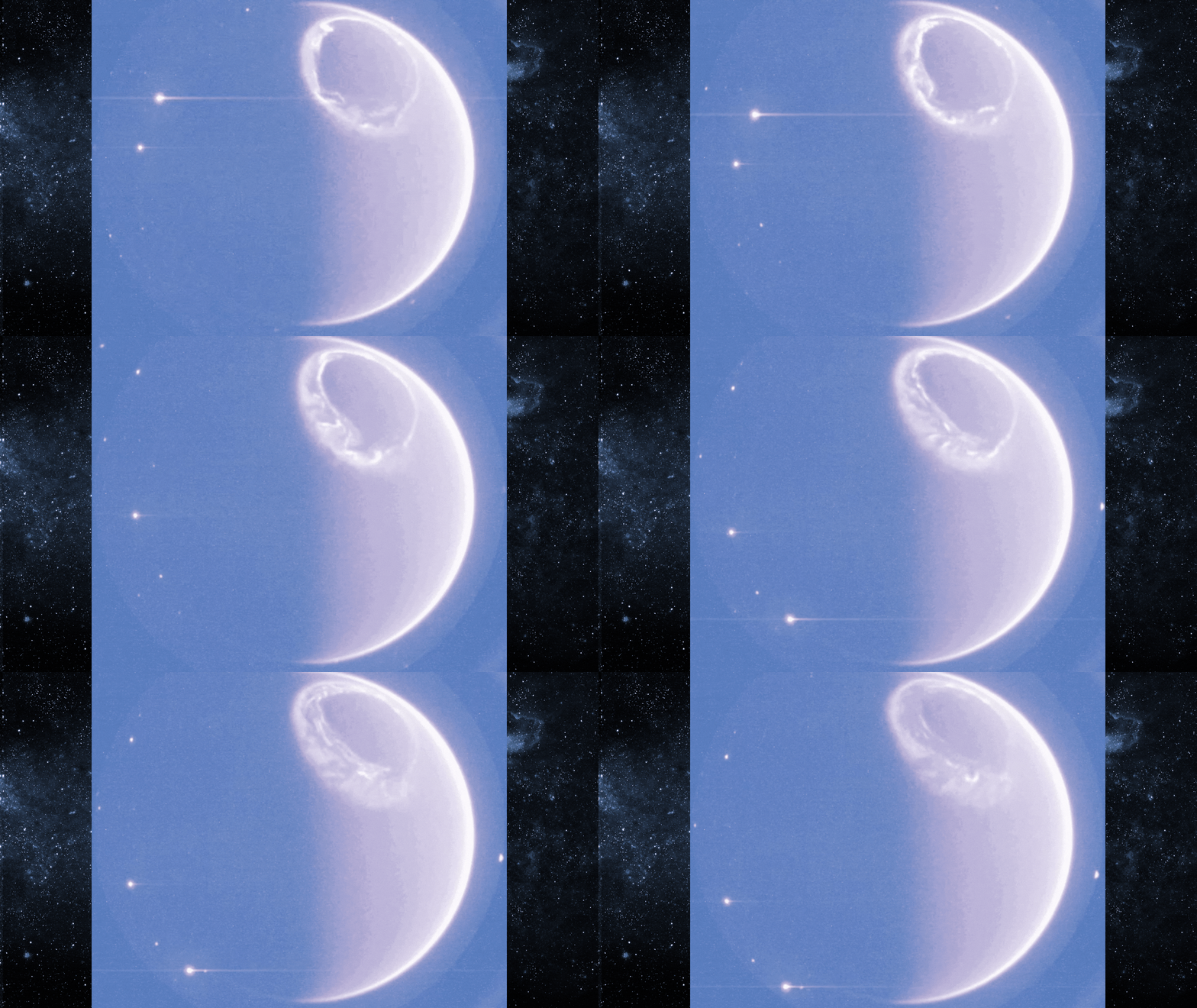
generated by space weather. They are born above Earth's polar regions and are routinely enjoyed from the surface by people at far northern or southern latitudes. Auroras typically occur at about 60 miles up (100 kilometers), when charged storm particles tickle air molecules.Sanity check
Scientists had a hard time believing astronauts who said they'd seen aurora that appeared to soar higher than the International Space Station, which orbits about 250 miles (400 kilometers) above the surface of the planet. Experts didn't figure there were enough molecules up there to do the trick.
But now the fleeting, ultra-high events have been imaged at more than 500 miles (800 kilometers) above the planet with a new Air Force satellite called the Solar Mass Ejection Imager.
"It's a mystery," Bernard Jackson, a solar physicist at the University of California, San Diego, said of the soaring auroras. "This is far higher than anyone had ever expected. It may be that nitrogen from the ionosphere is ejected into the higher altitudes during a coronal mass ejection."
A coronal mass ejection (CME) is a cloud of hot gas sometimes shot from the Sun during a solar flare. CMEs expand as they head through space. Upon reaching Earth anywhere from 18 hours to several days later, they fuel aurora and sometimes knock out satellites and threaten power grids on the surface.
Better view
Until recently, space storm forecasters had to rely on images of CMEs taken by NASA's SOHO spacecraft. But it sits about 1 million miles (1.5 million kilometers) from Earth and only sees a small region of the sky directly surrounding the Sun.
The new observations, made with a new satellite that orbits Earth about 500 miles high, recorded several recent CMEs as they enveloped the planet's magnetic field, Jackson told SPACE.com. The field emanates from the planet's poles, extends beyond the atmosphere, and protectively absorbs much of the shock of space storms.
The findings were announced Wednesday at a meeting of the American Geophysical Union.
Astronauts who've witnessed high-altitude auroras must now feel like airline pilots, who for years had said they saw lightning shooting from the tops of thunderstorms, teasing with the boundary of space. Scientists once thought those claims incredulous, too, until they photographed the high-altitude discharges, which are now called
.The near-space auroral displays are unrelated to jets and sprites.
For scientists the more interesting aspect of the new study was the newfound ability to image CMEs as they pass Earth, a stormy process that can last 24 hours or more.
"We are living inside the solar atmosphere, but up until now had no way to view it, so space forecasters couldnt be certain whether an ejection from the Sun would affect the Earth one to five days later or harmlessly pass us by," Jackson said. "Now that we can see these clouds as they travel through space outward from the Sun, we can map their trajectories."
The Solar Mass Ejection Imager was launched in January by the Air Force. It sees a CME by recording a faint scattering of sunlight caused by electrons in the onrushing cloud. A video of the observations is available