


Original story below
Update, Dec. 25, 9:47 p.m. ET: The risk of an impact by asteroid 2004 MN4 went up slightly on Saturday, Dec. 25. It is now pegged at having a 1-in -45 chance of striking the planet on April 13, 2029. That's up from 1-in-63 late on Dec. 24, and 1-in-300 early on Dec. 24.
Astronomers still stress that it is very likely the risk will be reduced to zero with further observations. And even as it stands with present knowledge, the chances are 97.8 percent the rock will miss Earth.
Update, Dec. 24, 10:19 p.m. ET: An asteroid that has a small chance of hitting Earth in the year 2029 was upgraded to an unprecedented level of risk Friday, Dec. 24. Scientists still stress, however, that further observations will likely show the space rock won't be on a collision course with the planet.
The risk rating for asteroid 2004 MN4 was raised Friday by NASA and a separate group of researchers in Italy.
The asteroid's risk rating a possible impact scenario on April 13, 2029 has now been categorized as a 4 on the Torino Scale. The level 4 rating -- never before issued -- is reserved for "events meriting concern."
The Dec. 24 update from NASA stated:
"2004 MN4 is now being tracked very carefully by many astronomers around the world, and we continue to update our risk analysis for this object. Today's impact monitoring results indicate that the impact probability for April 13, 2029 has risen to about 1.6 percent, which for an object of this size corresponds to a rating of 4 on the ten-point Torino Scale. Nevertheless, the odds against impact are still high, about 60-to-1, meaning that there is a better than 98 percent chance that new data in the coming days, weeks, and months will rule out any possibility of impact in 2029."
With a half-dozen or so other asteroid discoveries dating back to 1997, scientists had announced long odds of an impact -- generating frightening headlines in some cases -- only to announce within hours or days that the impact chances had been reduced to zero by further observations. Experts have said repeatedly that they are concerned about alarming the public before enough data is gathered to project an asteroid's path accurately.
Asteroid 2004 MN4 is an unusual case in that follow-up observations have caused the risk assessment to climb -- from Torino level 2 to 4 -- rather than fall.
An edited version of the 2004 MN4 story originally posted on SPACE.com at 9:58 a.m. ET on Dec. 24:
Scientists said Thursday that a recently discovered asteroid has a chance of hitting Earth in the year 2029, but that further observations would likely rule out the impact scenario.
The asteroid is named 2004 MN4. It was discovered in June and spotted again this month. It is about a quarter mile (400 meters) wide.
That's bigger than the space rock that carved meteor crater in Arizona, and bigger than one that exploded in the air above Siberia in 1908, flattening thousands of square miles of forest. If an asteroid the size of 2004 MN4 hit the Earth, it would do considerable localized or regional damage. It would not cause damage on a global scale.
Scientists stressed, however, that the rock would likely miss the planet.
Dread Factor: Why We Fear Ourselves More than Asteroids Asteroid Scare Prompts NASA to Formalize Response |
A statement was released by NASA asteroid experts Don Yeomans, Steve Chesley and Paul Chodas.
"The odds of impact, presently around 1-in-300, are unusual enough to merit special monitoring by astronomers, but should not be of public concern," the scientists said. "These odds are likely to change on a day-to-day basis as new data are received. In all likelihood, the possibility of impact will eventually be eliminated as the asteroid continues to be tracked by astronomers around the world."
The scientists project an asteroid's future travels based on observations of its current orbit around the Sun. On computer models, the future orbits are not lines but rather windows of possibility. The orbit projections for 2004 MN4 on April 13, 2029 cover a wide swath of space that includes the location where Earth will be. Additional observations will allow refined orbit forecasts -- more like a line instead of a window.
The asteroid will be easily observable in coming months, so scientists expect to figure out its path.
Most asteroids circle the Sun in a belt between Mars and Jupiter. But some get gravitationally booted toward the inner solar system.
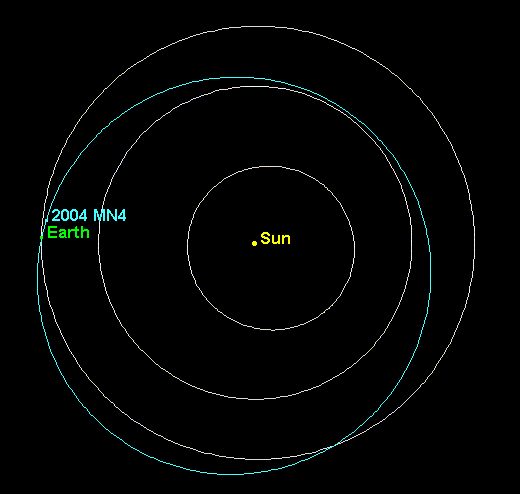
The 323-day orbit of 2004 MN4 lies mostly within the orbit of Earth. The asteroid approaches the Sun almost as close as the orbit of Venus. It crosses near the Earth's orbit twice on each of its passages about the Sun.
2004 MN4 was discovered on June 19 by Roy Tucker, David Tholen and Fabrizio Bernardi of the NASA-funded University of Hawaii Asteroid Survey. It was rediscovered on Dec. 18 from Australia by Gordon Garradd of the Siding Spring Survey. More than three dozen observations have been made, with more expected to roll in from other observatories this week.
It has been a busy stretch for asteroid scientists. Earlier this week, researchers announced that a small space rock had zoomed past Earth closer than the orbits of some satellites.
- Comet Visible in December Sky
- Exploding Asteroids: Satellites Monitor Threat to Earth
- First Strike or Asteroid Impact? The Urgent Need to Know the Difference
