


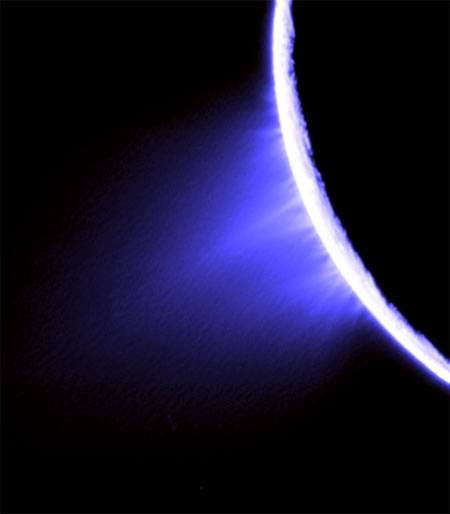
Astronomers have found the strongest evidence yet for an ocean beneath the icy shell of Saturn's Enceladus, suggesting it could join the exclusive club of watery moons in our solar system.
The salty water is likely feeding jets of water-ice that spurt from the moon's south polar region. Such plumes were first reported in 2005, and ever since, astronomers have suspected a liquid ocean might lie beneath the icy shell of Saturn's sixth largest moon.
Thenew finding, published in the June 25 issue of the journal Nature, could bumpthis diminutive world ? measuring 310 miles (500 km) in diameter (about thewidth of Arizona) ? into a class that includes Jupiter'sEuropa, Ganymede and Callisto.
Inaddition, the water and other key life ingredients such as organic materialfound in the plumes, could provide a suitable environment for lifeprecursors, said lead researcher Frank Postberg of the Max-Planck Institutefor Nuclear Physics in Heidelberg, Germany.
"I would say that the evidence for an Enceladus water reservoir provided by our research is as strong as the evidence for Europa's ocean," said study scientist Sascha Kempf, Cassini scientist on the Cosmic Dust Analyzer from the Max Planck Institute for Nuclear Physics.
Nicholas Schneider of the University of Colorado, Boulder, agrees the evidence is strong for an ocean beneath the Enceladus surface. However, he added, "I want more proof these [jets] are coming directly form the oceans." Schneider is the lead author of another study on Enceladus published in the same issue of Nature.
Supersonicjets
Four yearsago, an analysis of data from NASA's Cassini spacecraft at Saturn revealed the water-icejets that spurt from four fractures called tiger stripes, each extending some 75miles (120 km) across Enceladus's south polar region. The jets shoot thousandsof miles into space, with some of the ice grains and water vapor escaping themoon's gravity and ending up in Saturn's outermost ring, the E ring.
In fact,some of the authors on the new paper reported last year in Nature thatthe watervapor jets blast out much faster than the dust particles, with the vaporreaching speeds rivaling a supersonic jet ? about 650 to 1,100 mph (300 to 500meters per second). That finding suggested Enceladus had an ocean below itssurface.
Now,evidence points precisely to such a salty body of water. The results come fromdata collected by the Cosmic Dust Analyzer instrument aboard Cassini, whichshowed sodium salts within ice grains of Saturn's E ring.
Thecomposition of different sodium compounds and overall salt levels correspondwith what the scientists would expect if there were an ocean beneath the moon'sicy shell.
"Ifyou have liquid water in contact with a rocky core, then salts would be themost abundant dissolved compounds," Postberg told SPACE.com."The only way to get that much salt into water is to extract it fromrock."
Not the Atlantic
WhilePostberg and his colleagues are not sure about the size of this ocean, even ifit covered the southern hemisphere, the water body would be small compared withEarth's oceans. It would also be a little less salty than, say, the Atlantic or Pacific oceans, Postberg said.
And as faras swimming, a thick wetsuit would be in order, as the water would be close tofreezing, he said. (That's warmer than the moon's surface, which reflects 100percent of the sunlight striking it and plunges to minus 330 degrees Fahrenheit? minus 201 degrees Celsius.)
In anotherstudy, led by Schneider and published in the June 25 issue of Nature, researchers reportresults from ground-based observations of the vapor cloud in Saturn's E ring,rather than the ice grains. These observations didn't show any sodium in thevapor. The finding, however, doesn't exclude the possibility of an Enceladanocean.
Instead,the team argues that if the plume vapor does come from ocean water, the evaporationmust happen slowly deep underground, rather than as a violentgeyser erupting into space. That's because a violent saltwater geyser wouldeject sodium into the vapor cloud, and the results show no such sodium.
"The original picture of the plumes as violently eruptingYellowstone-like geysers is changing. They seem more like steady jets of vaporand ice fed by a large water reservoir," Postberg said. "However, we can?t decide yet if thewater is currently 'trapped' within huge pockets in Enceladus' thick ice crustor still connected to a large ocean in contact with the rocky core."
Postbergand his colleagues say such steady jets are either fed directly by an ocean-likebody of water or from reservoirs connected with that ocean.
Cassiniflybys planned for the fall could glean more information on the ocean-geyserlink, he said.
- Video - Enceladus' Cold Faithful
- Cassini's Greatest Hits: Images of Saturn
- Special Report: Cassini's Journey's
