


The origin of life and the habitability of worlds other than Earth are two of the biggest mysteries facing science today. Much research has been dedicated to these topics, but there is still a lack of definite answers.
Jan Hendrik Bredehöft from the UK's Open University has been considering habitability on other worlds. "I'm one of those guys who takes a piece of meteorite, grinds it up and finds out what the organic chemistry is in there," said Bredehöft.
Based on these types of studies, he has come to believe that habitable worlds can be split into four categories, each with varying likelihoods of being home to extraterrestrial organisms. This has great potential for assisting the search for life in the universe, particularly as technology is now progressing to the stage where direct imaging of extrasolar planets is possible. Bredehöft presented his ideas at Europlanet's latest Planetary Science Congress.
His four groups of habitable worlds are: Earth-like, Mars-Like, Europa-like and water-worlds.
Taking each of these in turn, he considered their potential for hosting complex life. Earth-like worlds are the first class, and a kind of "control" since we already know such worlds are capable of sustaining complex life. Earth-like worlds feature an appropriate atmosphere, liquid water, moderate temperature ranges, and stable climates.
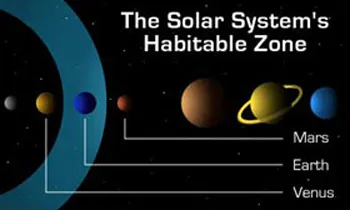
The second class of planets are those that were once much like Earth, such as Mars and Venus. "For some reason these planets left the classical habitable zone," said Bredehöft. "Mars became too dry, there's very little water left, at least not liquid water. Venus became just so enormously hot due to the greenhouse effect."
Still, Bredehöft believes there is some chance for life to exist on this type of world. He reasons that organisms could have developed when the planet was more hospitable, and this life could maintain a grip even through the hard times. "Once life has established itself it is really hard to kill off," said Bredehöft. "There have been absolutely devastating events in Earth's history that might have wiped out all kinds of life, but usually these served to further enhance biodiversity, rather than destroy it."
A chilly existence
Bodies that possess liquid water, but under an ice layer rather than on the surface, make up the third class of worlds.
Jupiter's moon Europa is a classic example from our own cosmic neighbourhood. Could there be life in places like this? Bredehöft's ideas here are particularly pertinent as often these worlds do not fit neatly into the conventional view of habitable zones. Europa, for example, lies beyond the solar system's temperature zone where water can remain as a liquid on a planet's surface.
However, there is still potential for life.
The traditional view of habitable zones thinks of a local star as being the prime energy source. But on icy worlds like Europa, other factors come into play, such as the gravitational pull of another planet. Worlds with liquid water hidden beneath icy layers could potentially be inhabited by simple organisms despite being far from the conventional habitable zone, so long as energy is provided in some other way.
Water-worlds
The fourth kind of habitable planets are made almost entirely of water. These hypothetical worlds would be Mercury to Earth-sized and would feature extensive oceans. Unlike oceans on Earth, the water on these types of planets would not be in contact with silicates or other rocks.
"These planets can either be completely made of water with high pressure ice at the core, or they can have bodies of liquid water that are separated from a silicate core by a thick layer of high pressure ice," said Bredehöft.
One theory for life's origin on Earth says organic material collected in shallow pools and then became concentrated by clinging to the surface of rocks. Eventually, this early life spread into the wider ocean. Another theory for life's origin is that the necessary chemistry occurred at hydrothermal volcanic vents. On water worlds, however, these scenarios are impossible. Therefore, Bredehöft thinks life is not likely to originate on such planets.
"The amount of water on such a planet would be so huge, you would need unbelievable amounts of carbon components concentrated together for a chance of life. It's far too diluted," said Bredehöft.
Considered opinions
After considering all the facts, Bredehöft said the best bet to find extraterrestrial ecosystems is to hunt for Earth-like planets, after all. However, he doesn't think Earth-like worlds will necessarily have advanced life.
"We don't know whether the level of complexity or the size of organisms living on Earth is essentially a logical outcome of evolution or whether it is just some fluke experienced here," said Bredehöft. "Is having talking intelligent beings on the surface of the planet the pinnacle of evolution? We just assume so because we like to see ourselves as something special."
With the rapid pace of development in planet-hunting technology, it is only a matter of time until we learn much more about exotic extrasolar planets and moons, and are able to glean vital information about their properties. Until then though, scientists like Bredehöft will continue to theorise about discoveries.
So in Bredehöft's carefully considered opinion, what kind of organisms are we most likely to find? "Probably something slimy," he said.
