Editor's Note: See our new 2009 Leonids Meteor Shower Viewer's Guide. The story below was published in 2008.
The
annual Leonid meteor shower put on some dramatic sky shows in 1999 and 2001,
but in recent years the event has been comparatively mundane.
Next
year could be another doozie.
Astronomers
now predict the 2009 Leonids could produce more than 500 shooting stars per
hour for skywatchers with clear skies in certain locations. Asia looks to have
the best seats, but North America might not be left out.
Such
a rate would be much less than the brilliant
displays a few years back, but still delightful to watch.
"On
Nov. 17, 2009, we expect the
Leonids to produce upwards of 500 meteors per hour," said Bill Cooke
of the NASA Marshall Space Flight Center. "That's a very strong
display."
Astronomers
from Caltech and NASA base their joint prediction on an outburst that occurred
this year, on Nov. 17, that they figure heralds even more intense activity next
November.
The
Leonids are created by bits of debris left behind by the repeat passages
through the inner solar system of comet 55P/Tempel-Tuttle. There are several
streams. This year, Earth passed through one laid down in the year 1466. Most
astronomers did not expect it to produce much.
But
observers in Asia and Europe counted as many as 100 meteors per hour, according
to a NASA statement today. That shows the 1466 stream is rich in
meteor-producing debris. And in 2009, our planet will pass through this stream
again, but this time closer to its center, where more material should be there
to slam into our atmosphere.
The
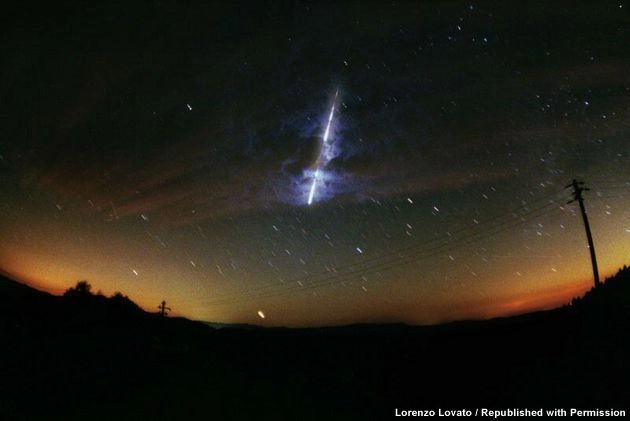
stuff, typically the size of a sand grain, vaporizes in the atmosphere. Some
pea-sized objects create dramatic
fireballs.
When
showers exceed 1,000 meteors per hour, they are called storms. This one is not
expected to reach that level.
The
timing: "We predict a sub-storm level outburst on Nov. 17, 2009, peaking
sometime between 21:34 and 21:44 UT," Cooke said. That favors observers in
Asia, although Cooke won't rule out a nice show over North
America when darkness falls hours after the peak. "I hope so," he
said. "It's a long way to Mongolia."