





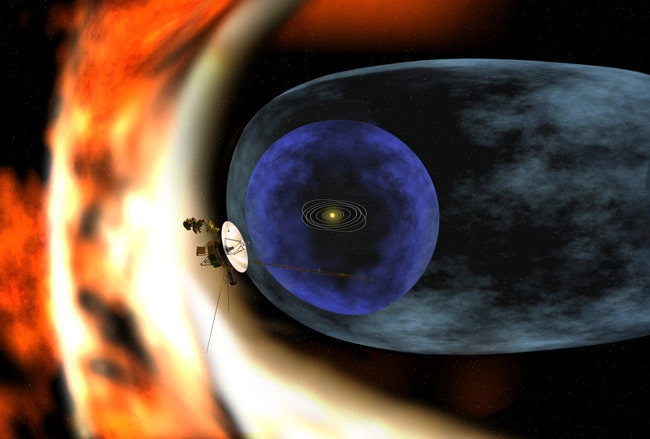
Voyager 2?s journey toward interstellar space has revealed surprising insights into the energy and magnetic forces at the solar system?s outer edge, and confirmed the solar system?s squashed shape.
Both Voyager 1 and Voyager 2 continue to send data to Earth more than 30 years after they first launched. During the 1990s, Voyager 1 became the farthest manmade object in space.
Each spacecraft has now crossed the edge of the solar system, known as termination shock, where the outbound solar wind collides with inbound energetic particles from interstellar space. The termination shock surrounds the solar system and encloses a bubble called the heliosphere.
?The solar wind is blowing outward trying to inflate this bubble, and the pressure from interstellar wind is coming in,? said Edward Stone, physicist and Voyager project scientist at Caltech in Pasadena, Calif. He and other researchers published a series of studies in the journal Nature this week that detail the Voyager findings.
This way and that
Voyager 2 reached the southern edge of the solar system 7.8 billion miles (84 AU) from the sun, closer than Voyager 1 which had reached the northern edge 8.7 billion miles (94 AU) from the sun. That confirms earlier suspicions about the heliosphere bubble being squashed at its southern region.
The reason for that asymmetrical shape rests with an interstellar magnetic field that puts more pressure on the southern region of the solar system — something that may change over 100,000 years as that magnetic field experiences turbulence, Stone said.
Comparing the Voyager 1 crossing in December 2004 with the Voyager 2 crossing in August 2007 allowed scientists to confirm that the second sibling actually crossed the termination shock and passed into the heliosheath, an outer layer of the heliosphere. But Voyager 2 also carries more working instruments that show the termination shock in full detail.
?We?re actually seeing the shock for the first time,? said John Richardson, principal scientist for Voyager?s Plasma Physics instrument at MIT in Cambridge, Mass.
Voyager 1?s plasma detector failed after it passed Saturn, so Voyager 2 provided the first glimpse of what happens to the solar wind?s energy as it slams into interstellar space. The solar wind travels outwards from the sun at supersonic speeds, and at temperatures near 17,540 degrees Fahrenheit (10,000 degrees Kelvin).
Scientists had predicted that the solar wind would simultaneously slow down and heat up to a temperature near 1.8 million degrees F (1 million degrees Kelvin), but instead found that it reached just 180,000 degrees F (100,000 degrees Kelvin) at the solar system boundary.
Hitching a ride
The solar wind?s missing energy ended up hitching a ride with interstellar intruders, Richardson said.
Neutral atoms that flowed in from outside the solar system became energized upon entering the heliosheath layer, and then ended up stealing 80 percent of the energy from the solar wind. Researchers have yet to puzzle out the significance of this.
An added mystery remains as to why the solar wind slows down early, as though anticipating running headlong into the termination shock. Researchers have begun looking into whether the solar wind somehow sheds energy ahead of time.
?Somehow the solar wind knows the shock is coming before it gets there, and theory says that shouldn?t be,? Richardson noted, adding that the solar wind speed drops from its supersonic speed of about 248 miles per second (400 km/s) to 186 miles per second (300 km/s) even before hitting the edge of the solar system. That speed falls more noticeably to about 93 miles per second (150 km/s) after the termination shock.
Even as researchers continue parsing the Voyager findings, both spacecraft plow onward toward deep space — and beyond all expectations of their original mission.
?My guess is five to seven years to reach interstellar space,? Stone said. ?There?s a very good chance that Voyager I will send the first data back from there.?
Editor?s Note: This story was updated on July 3 at 2:00 p.m. EDT.
- Gallery: Voyager?s Photo Legacy
- Top 10 Voyager Facts
- Voyager Probe Poised to Plunge into Interstellar Space