





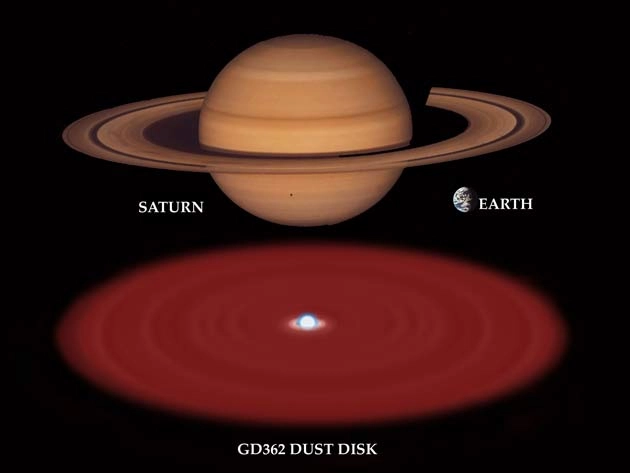
An ancient, near-death star with a disc of metal-rich dustorbiting around it has recently been discovered by astronomers. The dust'sorigin is a mystery, though, as it should have been sucked into the star withina few hundred years of the star's death.
Even though this anomaly is about 82 light-years away andseveral billion years old, astronomers think it could provide a preview of oursolar system's future when the Sun dies five to six billion years from now.
Between three and five billion years ago, GD 362 was a starmuch like our Sun, only seven times more massive. It takes a lot of energy tomaintain that much mass, and eventually GD 362's nuclear power plant ran out offuel and the star could no longer produce enough heat energy to keep its outer layersfrom crashing inward.
Once the fuel ran out, the star lost plenty of mass and heat,and shriveled into a white dwarf – the final stage of star evolutionwhere the star burns out and dies. Enough heat gets released during thisprocess to vaporize any surrounding dust, rocks, and planets, leaving behind adisc of dust. This dust usually gets sucked into the newly formed white dwarfand incinerated within a few hundred years.
But when GD 362 went through this process five billion yearsago, the dust never cleared up. And astronomers don't know how a dead starroughly the size of Earth has been able to sustain a disc the size of Saturn'srings for so long.
"Where the disc comes from is the $64,000 question,"Ben Zuckerman of UCLA told SPACE.com."However, we believe that it's from a planetary system around this star.Something – comets, asteroids, or planets – is getting ground upinto dust and being pulled into the star."
The dust surrounding a newly formed white dwarf contains lightelements – such as hydrogen and helium – and heavier elements– such as calcium, sodium, oxygen, iron, and magnesium.
Over the next few hundred years, the light elements and heavyelements separate like oil and water – the star's gravity pulls the heavyelements into its interior, leaving behind a hydrogen and helium atmosphere.
This happened to GD 362 too, but since then heavy elements havecontinued to find their way into the disc.
"Something's got to be replenishing these metals,"Zuckerman said. "The suggestion is maybe this white dwarf had planetsaround it, and the system was substantial enough that after billions of yearsof grinding, there's still enough material to feed the dust disc around thewhite dwarf."
This grinding up of planets or asteroids into dust can work twoways. Rocky objects zip around very fast near white dwarves. When they collidethey chip off planet confetti – the perfect material for making a heavyelement dust disc.
"Or you could just have a big object tossed in close tothe star. It goes into orbit and it will get torn apart by the gravity of thestar once it gets close enough," Zuckerman said.
This could happen here on Earth if one day the Moon one daydecided to drift closer. It's also probably how Saturn got its rings."It's possible they were formed by some object getting tossed in too closeto Saturn and it got torn apart by gravity," Zuckerman said.
Other ideas for how the dust could accumulate include cometsbreaking up near the star and aggregation of interstellar dust as the startravels through space. However, Zuckerman doesn't think comets alone couldsustain the disc and interstellar dust would probably just flow around thestar.
Some astronomers believe these observations – taken inthe mid-infrared spectrum during May, 2005 with the Gemini 8-meter Frederick C.Gillett Telescope on Hawaii's Mauna Kea – provide a look into the MilkyWay's future.
In five or six billion years, our own Sun will run out ofnuclear fuel and begin turning into a super-hot white dwarf star. At that time,any of the planets and asteroids revolving around it might get crunched up intoa giant dust disc.
"The parallel to our own solar system's eventual demise ischilling," said Eric Becklin of UCLA and leadinvestigator on the Gemini observations.
This isn't the first time astronomers have spotted a dustywhite dwarf. Back in 1987, Zukerman and his colleagueat UCLA Eric Becklin observed G29-38,a similarly dust-ringed white dwarf. But it's about 100 times less dusty thantheir newest find.
Last summer, Zuckerman observed about 100 white dwarves and foundthat about a quarter of them had metal in their atmospheres. Now he plans tosee if any of these have similar dust discs.
"If we don't detect metal rich dust around the other whitedwarves, we might have to revise our thinking [about the dust's origin],"Zuckerman said. "The comet impact model looked pretty good 10 years ago,but it doesn't look so good anymore. There's still alot of mystery"
These findings are detailed in the recent issue of the Astrophysical Journal.
This article is part of SPACE.com's weekly Mystery Monday series.
- Tales From the Stellar Grave: Born Again Planets
- Reborn Star Surprises Astronomers
- White Dwarf Sends Ripples Through Red Spider Nebula