





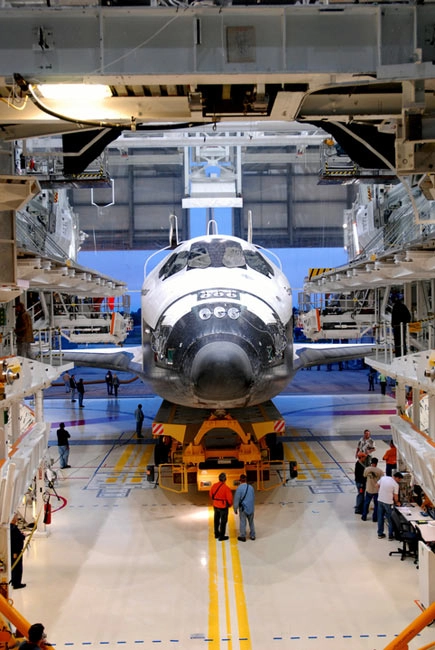
CAPE CANAVERAL, Fla. --NASA intends to resume on May 1 the orderly shutdown of the shuttle program, amove directed toward carrying out national space policy while safely flying ninemore missions by the end of next year.
Initiated in 2004, thestep-by-step shutdown was put on a temporary hold last year by Congress toensure that the new president had time to weigh in. That hold expires April 30,and PresidentBarack Obama has indicatedthat he intends to stay the course and retire the fleet in 2010.
"The plan all alonghas been that we would follow the course that already had been laid out andresume a slow and methodical phasedown of the shuttleprogram," NASA spokesman Mike Curie said. "We have to do this to meetthe budget allocations we have been given for this year and next year."
The action is required"to be sure we have the money needed to fly the remaining nine missionssafely," he said.
Several lawmakers with tiesto Kennedy Space Center have proposed extendingshuttle flights beyond 2010, but it is unlikely that action would be takenbefore April 30.
"You have heard me saythat hope is not an effective management tool on many occasions," ShuttleProgram Manager John Shannon told colleagues recently in a widely distributede-mail. "It is my position that we cannot continue to spend money toretain the capability to fly additional space shuttle missions, hoping thatsomeone will recognize the national assets we are giving up.
"We have to take ourdestiny in our own hands and manage within the limited budget we have beengiven and ensure that we will fly the full manifest and leave the InternationalSpace Station in the bestconfiguration possible."
U.S. Rep. Suzanne Kosmas,D-New Smyrna Beach, said she still is fighting to eliminate the "harddeadline" for shuttle retirement.
Kosmas also asked the HouseAppropriations Committee to provide NASA an extra $2 billion to keep theshuttle fleet flying and to accelerate the development of next-generationAres rockets and Orion spacecraft.
"I will fight at everyturn to give NASA the flexibility to fly the shuttle past 2010 in order tosafely complete the scheduled launches and retain the highly skilled work forceat Kennedy Space Center," Kosmas said.
U.S. Rep. Bill Posey,R-Rockledge, is standing behind bipartisan legislation that he introduced toessentially achieve the same goals.
"If we don't act to addressthe space gap, this path will lead to the government laying off thousands ofhighly skilled American workers and outsourcing their jobs to Russia," hesaid.
NASA estimates that about3,500 of 14,500 jobs at KSC will be lost after the shuttle fleet is retired.
Eleven months after the2003 Columbia accident, then-President George W. Bush directed NASA to completeconstruction of the International Space Station and retirethe shuttle fleet by Sept. 30, 2010.
He also directed NASA todevelop a new piloted spaceship by 2014, then returnAmerican astronauts to the moon by 2020.
The plan called for NASA topay Russia to launch American astronauts to the station during the gap betweenshuttle fleet retirement and the first piloted flights of that successor spacecraft.
NASA at that time laid outa plan to finish the station during a slow, deliberate shutdown of the $3billion-a-year shuttle program.
As the 2008 presidentialelection approached, Congress directed NASA to take no further action beforeApril 30 that would preclude shuttle flights beyond 2010.
The intent was to give anew administration a chance to review shuttle fleet retirement plans after theJan. 20 inauguration.
Obama, who still hasn't appointed aNASA administrator, weighed in with his budget blueprint in February. Itcalls for NASA to finish the station and retire the shuttle by the end of 2010.It authorizes NASA to fly one additional mission if it can be done "safelyand affordably" by the end of next year.
NASA plans a Hubble SpaceTelescope servicing mission in May. Eight more station missions -- includingthe extra flight -- are scheduled.
Congress still must fundthe additional mission.
- Video - NASA's Constellation Journey Begins: Part 1, Part 2
- End in Sight: Final Space Shuttle Missions Slated
- NASA's Shuttle Fleet Celebrates 25 Years of Spaceflight
Published underlicense from FLORIDA TODAY. Copyright ? 2009 FLORIDA TODAY. Noportion of this material may be reproduced in any way without the writtenconsent of FLORIDA TODAY.