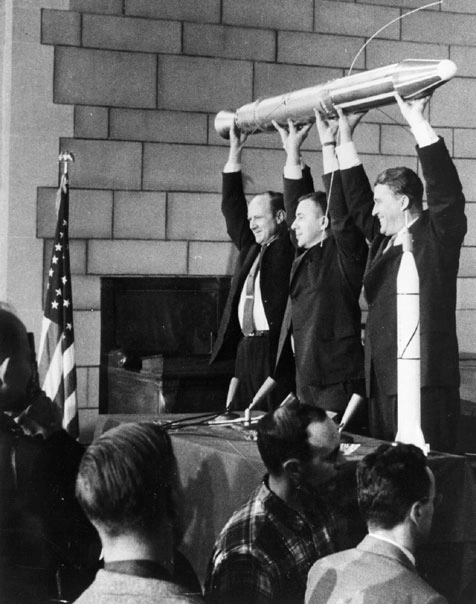
Fifty yearsago today, the 70-foot (21-meter) tall Juno 1 rocket, a modified Redstonemissile, launched the Explorer I satellite, marking the first U.S. builtpayload to enter Earth orbit. Three of the booster's four stages fell into theocean while the fourth, which was used to boost Explorer I's velocity, enteredorbit behind the satellite.
Explorer I - a 30-pound (13-kg), 7-foot (2-meter) satellite - was the thirdman-made moon to circle Earth, following the SovietUnion's Sputnik I and II spacecraft. It was the second satellitewith a payload, a small science package that was built to measure cosmic rays,which led to the detection of a radiation belt (the Van Allen belt, namedafter Dr.James van Allen, who designed and built the instrumentation).
Explorer I operated, sending back data to the ground, for just over 100 daysbefore its batteries died, but it wasn't until March 31, 1970, 12 years and twomonths after its launch, did the satellite disintegrate while reentering theatmosphere.
It was around that time, if not a few years earlier, did the museum that waserected near where thehistoric mission had its start began distributing small pieces of thegantry that supported Juno I on the pad as it prepared to launch Explorer I.
"The beginnings of this are sort of lost in legend, if you will,"explained James Banke, secretary of the U.S. Air Force Space & MissileMuseum Foundation. "No one, and we've asked around a little bit, evenamong those who run the museum itself, no one is really sure when itbegan."
"I can tell you that when I vacationed in Florida from growing up inMinnesota, that when I visited the museum in 1970-1971, that practice was goingon. I remember getting one of those cards," said Banke in an interviewwith collectSPACE.com.
The cards to which Banke refers present an "X" shaped piece of metal,sometimes with a residual coating of the launch gantry's red paint, attachedalongside a photo of Juno I on the pad and a description of the history behindthe small fragment. The title "Souvenir of America's First Satellite"stretches along the top of the cards.
"The material that is on there is from a mesh screen that used to coverand surround the elevator that was used to go up and down the gantry. That meshwas disposed of and one of the museum's volunteers thought, 'Hey, this might begood for fund raising,' and literally pulled it from the trash," recalledBanke. "We don't know who that was or when exactly he did that, but now,as we need to, we pull it back out and cut it into small little pieces to puton the cards."
The remainder of the gantry that launched Explorer I still exists, though it ispresently fenced off from the public at Cape Canaveral's Complex 26, Pad B. AtPad A, where Juno 1 lifted off on January 31, 1958, stands a Thor-Able rocket.
"The gantry has been completely pulled down. It just got to the pointwhere it was too unsafe to be standing erect anymore," said Banke."Pieces are lying on the ground."
The Foundation is considering its options with regards to restoring the gantry,but it is a matter of funding while balancing the needs of the other missilesand facilities under their care. There are no plans however, to use it to makemore souvenir cards. When the mesh runs out, so will the cards.
"It is a limited supply," said Banke. "There are only a few ofthese little screens of material left.
"I imagine we will have enough to last a few more years."
Even whenthe museum runs out souvenirs to distribute, their legacy will continue on atruly global scale.
"Ifyou wanted me to hazard a guess of how much money has been collected or howmany of these pieces are out there, I couldn't even begin to tell you. It hasto be in the thousands," estimates Banke.
An informalpoll conducted by collectSPACE.com of its readers quickly located morethan 100 of the fragments in private collections worldwide. Card owners cameforward from across the United States and spread to a number of Europeancountries and even "down under" to Australia.
"The spaceprogram from day one has helped shrink the world in ways we never thoughtpossible," Banke said.
Want your own piece of Explorer I's gantry? Continuereading to learn how to get one and view a gallery of the souvenircards found around the world.
- IMAGES: America's First Satellite - Explorer 1
- VIDEO: 50 Years in Space
- Top 10 Revelations of the Space Age
Copyright 2008 collectSPACE.com. All rights reserved.