





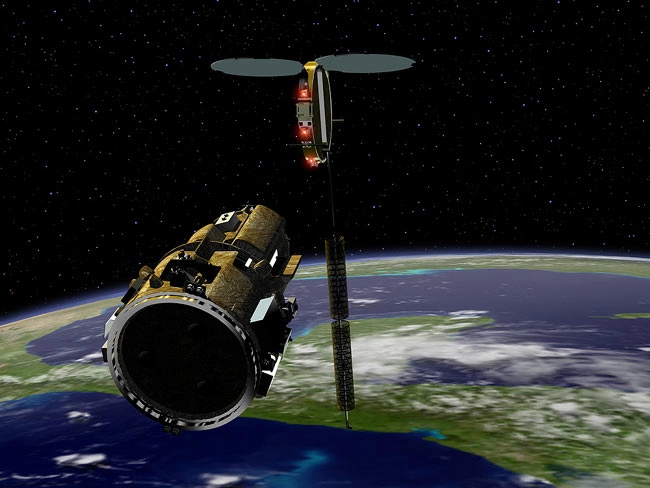
LOS ANGELES (AP) - Citingsensitive information, NASA said Friday it will not publicly release itsofficial report on the failure of a spacecraft during a mission to rendezvouswith a Pentagon satellite without human help.
DART spacecraft mishap contains details protected by theInternational Traffic in Arms Regulations, said space agency spokesman MichaelBraukus.
But NASA plans to release asummary of the report that will explain why DART did not complete its missionlast year, Braukus said. An initial analysis found the 800-pound spacecraftsuffered a fuel problem, but engineers did not detect a fuel leak.
The robotic Demonstrationfor Autonomous Rendezvous Technology spacecraft was launched from VandenbergAir Force Base, Calif., in April 2005 to perform an unprecedented rendezvouswith another satellite without human intervention.
DART successfully locatedits target and flew within 300 feet. But the project ended prematurely when thespacecraft shut down halfway into the 24-hour mission and failed to completeseveral automated tasks including circling the satellite and making closeapproaches.
Mission manager Jim Snoddypreviously said the spacecraft detected a fuel problem and navigational errorswith its on-board computers.
The $110 million projectwas meant to test the capability of robots to perform tasks currently done byastronauts. NASA envisions future applications such as the robotic delivery ofcargo to space stations and automated docking and repair between spacecraft inorbit.
A week after the mishap,NASA assembled a team to investigate. The space agency approved the team'sreport in February and has released the findings internally ''on specificrequest and 'as need basis,''' Braukus said. NASA is working with the team towrite the public summary omitting the sensitive information, he said.
The space agencydistributed a new public information policy last month specifying thatinformation protected by ITAR is considered ''sensitive but unclassified'' andthat unauthorized release to news organizations could result in prosecution ordisciplinary action.
DART was managed by NASA'sMarshall Space Flight Center in Huntsville, Ala.
- Fender Bender: NASA's DART Spacecraft Bumped Into Target Satellite
- NASA Tracks Navigation Errors, Fuel Shortage in DART Rendezvous Mission
- NASA's Robotic DART Mission Ends in Mishap