


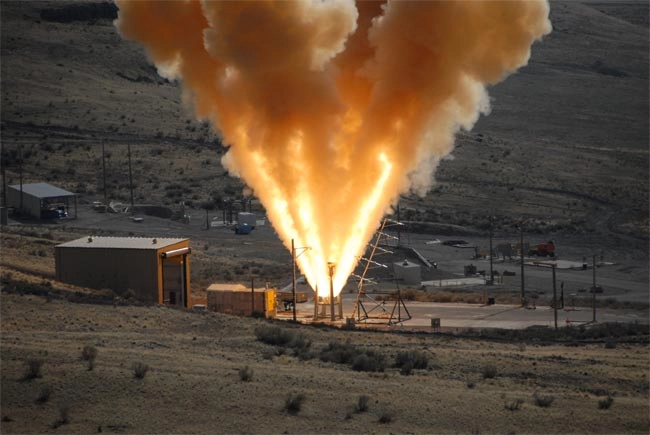
WASHINGTON? NASA and its contracting team conducted the first full-scale ground test ofthe U.S. space agency's Moon-bound Constellation program, test firing an abortmotor designed to whisk the Orion Crew Exploration Vehicle away from its Ares Ilauncher in an emergency.
The testtook place Nov. 20 at the Alliant Techsystems (ATK) Launch Systems facility inPromontory, Utah. The 5.1-meter abort motor fired for five-and-a-half seconds,consuming most of its propellant in the first three seconds and producing morethan a half-million pounds of thrust nearly instantaneously at ignition.
"Itperformed extremely well. The initial data looks very good," formerastronaut Charlie Precourt, ATK's vice president of launch systems, toldreporters during a teleconference following the static fire test.
ATK builtthe motor under subcontract to Orbital Sciences Corp. of Dulles, Va., which is responsible for the Orionlaunch-abort system. Lockheed Martin Space Systems of Denver is Orion's primecontractor.
BarryMeredith, NASA's launch abort system manager, praised ATK for "pullingtogether a very complex system and testing it exactly on the day they said theywould."
Meredithsaid the test marked "a major step forward in the development of the OrionCrew Exploration Vehicle and specifically the launch-abort system that isgoing to provide a safe and reliable method of moving the entire astronaut crewin the event of the emergency from the pad all the way up to [91.44 kilometers]of altitude."
NASA plansto conduct its first Constellationprogram flight test next spring at White Sands Missile Range in New Mexico. That test will feature a fully integrated launch-abort system with afull-sized mock-up of the Orion crew capsule.
- Video - Mock Orion Capsule Crashes to Earth
- Video - NASA's Constellation Journey Begins: Part 1, Part 2
- Video - Back to the Moon with NASA's Constellation