





Updated at 4:35 p.m. ET.
Some observers were treated to a light show last night whenthe Department of Defense destroyed a falling spy satellite.?
"I'm still having a hard time believing I actuallycaught the debris, but two others with us also saw a bright dot move fast fromwhat was to be the intercept position," Hawaii-based skywatcher RobRatkowski told SPACE.com.
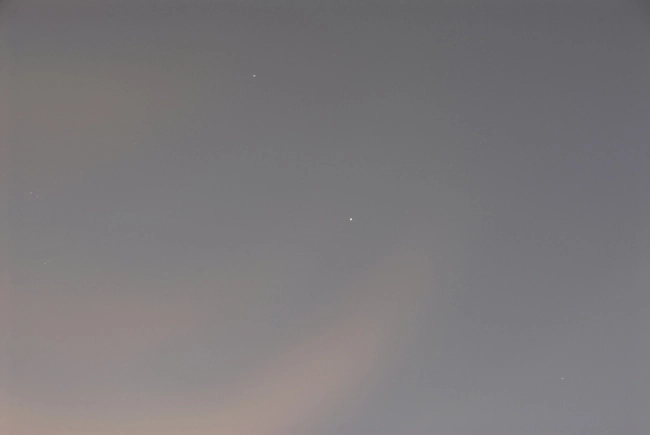
He observed a meteor shower of sorts when, apparently, bitsof debris from the broken-upsatellite burned up as they fell through Earth's atmosphere. Ratkowski, aprofessional photographer and astronomy enthusiast, took photos of what he sawfrom Maui, near where the U.S. Navy ship fired the missile thatintercepted the satellite.
Examining the evidence
"It wasn't until I got home and examined the imagesthat I started seeing more dots in the field of view," he said.
His photos were posted to the amateur satellite observer'smailing list, SeeSat-L.
By enhancing the contrast of oneimage an observer commenting on the mailing list counted 552"dots" in it, presumably each representing a bit of satellitematerial.
While the images have not been confirmed as actuallydepicting debris from the satellite, as opposed to stars or other objects, someposters to the site vouched for their likely authenticity.
"I've taken a lot of astrophotos and I don't think eventhe brightest stars would register in so short an exposure (1/500 second) withso small a telescope," Patrick Wiggins wrote.
Ratkowski also took an image of what he believes to be the vaportrail of hydrazine gas created when the satellite's liquid fuel spewed intothe vacuum of space. But this image was debated on the site.
"I can't imagine the vapour trail as a long line ? itshould be a cloud/'comet'?" wrote B. Gimle.
The satellite was interceptedby a Navy missile launched at 10:26 p.m. ET last night. Military officials saidthey think the missile successfully hitthe failing satellite, with a high probability that it struck the fueltank full of hydrazine, a chemical that would have been dangerous had it landedon Earth. The debris from the broken-up bus-sized satellite is probably too smallto be hazardous to humans, said a seniormilitary officer.
Other views
As the night went on the debris followed the ground path ofthe satellite's orbit and fell over the northwestern United States and Canada,giving observers there a show.
"At approx. 19:43 PDT ? a group of about 30 people, PGCentre members and public, witnessed what we assume was the demise of the spysatellite USA 193," wrote Brian Battersby of the Prince George Centre ofthe Royal Astronomical Society of Canada, in a message posted to SeeSat-L.
"Many debris trails were witnessed moving fromsouth-west to north-east at high altitude," Battersby wrote. "One wasespecially bright and long lasting. I can recall about 6 bright trails and 15fainter ones. The debris trails seemed to come in "waves" with thefirst wave being brighter than the debris that followed behind it. The trailsseemed to be in a fan shape with the trails being wider apart in the north-eastthan they were in the south-east."
Second chances
Observers who missed last night's show may get another chance.It's possible that viewers along the ground path of the satellite's remains maybe able to see debris as it falls through the atmosphere over the coming days,said Geoff Chester, public affairs officer for the U.S. Naval Observatory inWashington, D.C.
"Due to the relatively lowaltitude of the satellite at the time of the engagement, debris will begin tore-enter the earth?s atmosphere immediately," said a Department of Defensestatement. "Nearly all of the debris will burn up on reentry within 24-48hours and the remaining debris should re-enter within 40 days."
Marine General James Cartwright confirmed at a Pentagon news conference that debris from the satellite has been observed entering the atmosphere, but none has so far been seen to survive re-entry. He also said that a vapor cloud was spotted. He did not specify which observatories made these observations.
SPACE.com contacted a number of astronomicalobservatories but none reported attempting to observe the satellite last night,nor did they have plans for future observations of the debris.
"We didn?t observe the satellite destruction lastnight," said a spokesperson from the W. M. Keck Observatory in Mauna Kea,Hawaii, who declined to be named. "Our telescope cannot track somethingmoving that fast. To track an object moving that fast you need a much morenimble telescope."
- VOTE:Best Cosmic Duo to Destroy a Wayward Satellite
- SatelliteDebris Deemed Unhazardous
- How TheSatellite Was Destroyed
