


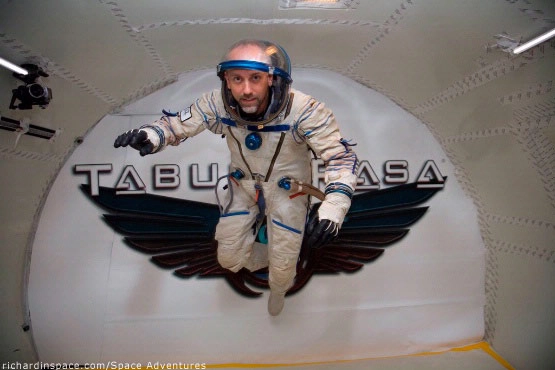
WASHINGTON-- When he was growing up in Houston, the son of an astronaut who lived in aneighborhood filled with astronauts and aerospace engineers, Richard Garriottalways assumed that he would fly in space. After all, it was an experience hisfather described in very fact-of-the matter terms as a "nominal" experience.
Garriott,now a multimillionairevideo game developer, will achieve his life-long goal of traveling intospace in October 2008, but it was not an easy road -- or inexpensive.
Garriott,46, is the son of NASA astronaut Owen Garriott, who participated in two spacemissions including the 1973 Skylab 3 mission that orbited the Earth for 59 daysand smashed the previous record for manned spaceflight duration. The youngerGarriott is scheduled to become the sixth payingspace tourist and the first offspring of an American astronaut to visitspace.
Growing upnear the Lyndon B. Johnson Space Center in Nassau Bay, Texas, Garriott?sneighbors on three sides were all astronauts. Everyone he knew was a NASAengineer in one way or another, so it seemed inevitable to him that he wouldgrow up and go to space.
"It was ashock to me that as I got older, there were lots of reasons why going intospace was such a rare commodity," Garriott said Tuesday in a media roundtableevent in Washington sponsored by the Space Foundation.
His pooreyesight alone was enough to disqualify him from a NASA space mission. So heunderstood early in life that if he were to go into space, it would not be as agovernment astronaut, it would be through a private enterprise.
Passionfor World Building
Garriott?spassion for computers and building worlds to explore within them made himwealthy from a young age. He developed his first video game when he was in highschool, one that generated $150,000 in personal revenue. He is also the creatorof the popular Ultima series of online games and has started and sold two videogame companies.
Garriottpaid $30 million for his trip to space tourism firm Space Adventures of Vienna,Va., a company for which he sits on the board of directors. A Russian Soyuzrocket will launch him up to the International Space Station where he willspend several weeks. Garriott is contemplating paying another $15 million to take a spacewalk.
In JanuaryGarriott will leave for Star City, Russia, where his mission training willbegin. He will learn spacecraft operation, survival and experimental trainingthere as well as undergo medical testing to ensure he is ready for space.
The hardestpart of his training will not be the physical rigors, he said. As a high-schoolcomputer prodigy, Garriott was permitted to develop his own self-taughtcomputer curriculum in lieu of the two-year foreign language requirement. Solearning his first foreign language, the Russian he will need to operate hisspace capsule, will be his greatest challenge.
Bondingwith Dad
The thrillof being one of the first 500 humans to leave the planet is not Garriott?s onlygoal. He is a true believer in the commercial value of manned spaceflight andwill be taking with him a series of experiments he hopes will generate profit.In one experiment his father helped design, protein crystals will be made inthe zero-gravity environment. The crystals form perfectly under theseconditions, and accurate images of their structures are extremely valuable topharmaceutical companies, he said.
"We're inthe search for more and more of these activities that are not just research,"Garriott said. "We're trying to find something that has resale value."
OwenGarriott is now serving as his son?s chief scientist for the mission, helpinghis son find and verify the best commercial and scientific research activitiesfor the mission.
"It's agreat father-son bonding time," the younger Garriott said. "We haven?t had thechance to really work closely together like this. So it?s very cool from myperspective that I?ve got one of the world?s leading experts close at hand whoalso happens to have such a deep personal relationship [with me]."
ExpertAdvice
Severalweeks ago Garriott had a conversation with astronautAlan Bean, who flew with Garriott?s father on Skylab 3. Bean emphasized howimportant he thinks it is for people who are not military pilots to go up andexperience space travel, as they will be well-suited when they return to talkabout space travel and how it can be expanded in an entrepreneurial way.
Bean alsotold Garriott he does not expect him to experience the emotional letdown someastronauts have felt after achieving their long-time goal of getting to space.Garriott has had similar conversations with all five previous space touristswho told him the same thing.
"Thefeedback I?m getting from those I consider close to me imply this is going todo nothing but add to my life experience," Garriott said.
Garriotsaid his father is separated enough from his time in NASA?s space program thathe now regards the experience as more than just a nominal.
"He clearlygets a much bigger gleam in his eye when he reflects on some of the earlypioneering work he had the chance to do."
Garriottis chronicling his spaceflight training and mission at his personal Web site: www.richardinspace.com.
- Future of Flight: Space Tourism, Investment and Technology
- VIDEO: Space Tourist Charles Simonyi Launches Into Orbit
- SPACE.com Video Interplayer: NASA's STS-122: Columbus Sets Sail for ISS