


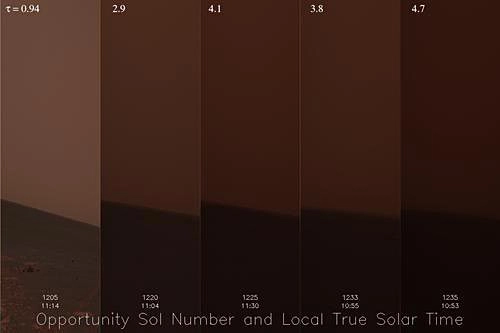
A globaldust storm at Mars continues to veil the two surface rovers and their solarpanels, but NASA officials reported today they expect the robots are capable ofweathering the tempest.
The situationgrew steadily worse after the first storm started in mid-June, leading to a globaldust shroud. But in recent days the situation has improved. Still, untilthe storm abates, the robots' operators on Earth will be on alert.
The roversrely on sunlight to charge their batteries and keep vital electronic partswarm. The space agency plans to keep the rovers on a low-energy diet for thetime being, transferring data from the Martian surface only once every threedays until the storm dies down.
"We arestill waiting out the storms, and we don't know how long they will last or howbad they will get," said John Callas, rover mission manager at NASA'sJet Propulsion Laboratory in Pasadena, Calif.
The roverSpirit now is weathering the dustiestsky it has ever recorded, though not as severe as what its twin, Opportunity, faced a week ago. NASA, however, has said Opportunity is still the mostvulnerable because of a heater switch that has been stuck in the "on"position since landing day in January 2004.
Each roverhas eight radioactive heaters in addition to electric heaters for keepingbatteries and electronics within safe operating temperatures. While theplutonium-powered heaters aid therovers' survival on low-power days and through extremely cold nights, theelectric heaters are also necessary.
- Mars Rovers' Top 10 Most Amazing Discoveries
- SPECIAL REPORT: Mars Rovers
- VIDEO: Mars Rover Team Ponders Mission's End