


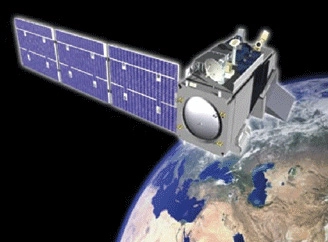
WASHINGTON -- A flight-demonstration sensor for thenext-generation of U.S. polar-orbiting weather satellites sustained damage duringtesting Oct. 11, but program officials said the mission's launch scheduleshould not be affected.
The sensor, dubbed the Cross-track Infrared Sounder, wasdamaged during acceptance testing at the Ft. Wayne, Ind., facilities of itsbuilder, ITT Corp. The sensor is part of the payload package aboard a precursorsatellite to the U.S. civil-military National Polar-orbiting OperationalEnvironmental Satellite System, or NPOESS.
The precursor mission, a multi-agency effort known as the NPOESSPreparatory Project (NPP), is scheduled to launch in September 2009.Government and industry program officials said the mishap, which occurred duringa vibration test meant to prove the instrument is tough enough to survivelaunch, appeared unlikely to delay NPP's liftoff.
U.S. Air Force Col. Dan Stockton, the NPOESS programdirector, acknowledged Oct. 19 in a brief written statement that theCross-track Infrared Sounder had been damaged and vowed that it would be fixed.
"Any problem of this nature is serious. We have deployedresources of the [Departments of Commerce and Defense] and NASA to work withthe contractor team to evaluate and fix the problem," Stockton said.
NPOESS is a joint effort of the Air Force and NationalOceanic and Atmospheric Administration, with NASA as the junior partner. NASA has thelead in the NPP mission. Andrew Carson, the NASA program executive for the NPPand NPOESS programs, told Space News in an Oct. 19 e-mail that if the NPPmission does fall behind schedule, the setback with the Cross-track InfraredSounder probably would not be to blame. He said the NPP's current launch date,a full three years later than originally planned, is driven primarily by howlong it takes to complete one of the spacecraft's other instruments, theVisible Infrared Imaging Radiometer Suite.
"Delivery of the Visible Infrared Imaging Radiometer Suiteis on the critical path for the launch of NPP in September 2009," Carson saidin his e-mail. The Cross-track Infrared Sounder "vibration failure review teamis taking a cautious, methodical approach to determine the root cause of thefailure. It is too early in the investigation to say how much redesign orrework will be necessary, however it is not expected that the delivery of the...flight unit will slip beyond the delivery of" the Visible Infrared ImagingRadiometer Suite.
That instrument, being built by El Segundo, Calif.-basedRaytheon Space and Airborne Systems, has been widely labeled the driving factorbehind the NPOESS cost and schedule problems leading up to the decision torestructure the program.
Sally Koris, a spokeswoman for NPOESS prime contractorNorthrop Grumman Space Technology of Redondo Beach, Calif., said in an Oct. 19e-mail that the test setback is expected to have minimal impact on completionof the NPP spacecraft.
"Based on the information we have at this time, we believethere is sufficient margin in the program's schedule to accommodate analysisand repair of the sensor prior to its required delivery date to NPP," Koriswrote. "Meanwhile, a flight-like... engineering development unit will be used totest and verify mechanical and electrical interfaces between the sensor and thespacecraft."
The NPP spacecraft is being built by Boulder, Colo.-basedBall Aerospace and Technologies Corp. under contract to NASA. Northrop Grummanis overseeing development of NPP's instruments since subsequent models will flyaboard the NPOESS satellites, which are slated to start launching in 2013.
Koris said in her e-mail that the Cross-track InfraredSounder "was undergoing a planned series of acceptance tests when it sustainedstructural damage in the instrument frame." She said review boards made up ofgovernment and industry personnel have been convened to investigate theincident and "determine if this is a manufacturing problem, a testconfiguration or test fixture problem, operator error or a design issue."
Bernice Borrelli, a spokeswoman for Rochester, N.Y.-basedITT Space Systems Division, said in an e-mail that the sensor developmentprogram "will incur a schedule movement but it will not impact the NPPschedule."
Ball Aerospace spokeswoman Roz Brown said Oct. 19 that priorto the testing incident Ball expected to take delivery of the sounder Jan. 3and begin integrating it with the NPP spacecraft bus around Jan. 10. She saidBall Aerospace also does not expect the setback to impact NPP's launch schedulebut was awaiting NASA's assessment of the situation.