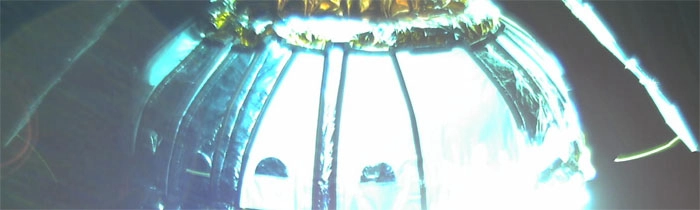
The
Genesis-1 module orbiting the Earth not only transmits its temperature,
integrity, power levels and overall health--it also signals entrepreneurial
zeal and private sector spunk.
As
a pathfinder demonstrator spacecraft, the Genesis-1 mission marks the birth of
a long-term vision to build and orbit space structures for commercial and
public use. Footing
the bill on this business venture--now gauged at upwards of a $75 million outlay--is
Robert Bigelow. He is owner of the Budget Suites of America Hotel Chain among
other endeavors and is the module mogul of Bigelow Aerospace in North Las Vegas, Nevada.
Last
week's launch of the Genesis-1 atop a Russian and Ukrainian booster is a step "to
transform the dream of a robust human presence in space into a reality,"
Bigelow has said. Still, there's also need for a reality check on that
promissory note.
Orbital excellence
SPACE.com
asked prominent leaders in various space fields to appraise Bigelow's down
payment on the future.
"This
is as close as it gets to entrepreneurial orbital excellence ... funded by
private Bigelow dollars and an operating, subscale, test space station
on-orbit," said Burt Rutan, head of Scaled Composites in Mojave, California.
Rutan
and his team are busy building suborbital space transportation for the flying
public--a fleet of SpaceShipTwo vessels and carrier motherships. He said that he
heartily congratulates Bigelow...as do many of the other "little guys" in the new
industry.
"Pioneers
like this are what it takes to get out of our three-decades-long period of no
progress toward opening the frontier for the people," Rutan explained. "Go, Bob!
Go!"
Access, demand and platform
Bigelow's
stick-to-it space entrepreneurship was saluted by Scott Hubbard, former director
of NASA's Ames Research Center and now a visiting scholar at Stanford University and Carl Sagan chair at the SETI Institute in Mountain View, California.
Hubbard
has been working with a team of seven Stanford Master of Business
Administration (MBA) graduate students to evaluate the business case for the
emerging space industry.
"In
my analysis of the emerging entrepreneurial space industry there are three key
elements to create a market ... low cost space access, demand from the
marketplace and a platform in low Earth orbit," Hubbard said.
In
this triad of access, demand and platform, Hubbard noted, the Bigelow team has
taken a giant step toward demonstrating private sector capability in the third
element. "And I suspect Bigelow has some clever ideas about stimulating
demand."
Delivering on promises
Making
public space travel a reality will require putting together a lot of separate
pieces, including a reliable and affordable transportation system and an
orbital outpost as a destination, suggested John Logsdon, Director of the Space
Policy Institute within the Elliott School of International Affairs at George Washington University in Washington, D.C.
The
launch of Genesis-1, Logsdon continued, is an important milestone along that
path. "It is refreshing to see a private sector venture that is delivering on
its promises," he said.
Bigelow
Aerospace obtaining an export license for their module technology is
significant, spotlighted Jerry Grey, Director, Science and Technology Policy
for the American Institute of Aeronautics and Astronautics (AIAA).
Grey
said that there's no uniqueness about a private-sector payload--hundreds of
commercial satellites have been orbited--many with export licenses for Russian
launchers. There is significance in showcasing an expandable structure in
space, he added.
"But
such structures are not unique," Grey explained. "NASA had done several
experiments on inflatables in space," he said, "although not very successfully ...
and there are many designs that have not as yet flown."
However,
Bigelow's success does deserve high marks, Grey emphasized, "in view of
the few successes in space entrepreneurship to date ... as compared to, say,
computers and other electronic system entrepreneurs."
Glance back in time
Bigelow's Genesis-1 and the
firm's plan for larger expandable vessels spur some to evoke back-to-the-future
facts.
For instance, in the early 1980s, a private U.S. firm--Space Industries, Inc.--wanted to move forward on an Industrial Space Facility
(ISF). While not an inflatable habitat, it was to be a free-flying facility
that ran on its own and would crank out electronic materials, pharmaceuticals,
and other specialty goods. Crews would visit the ISF to reap its bounty of
made-in-space products. The idea dead-ended.
Taking
a glance back in time, inflatables in space have been considered
for years, observed Roger Launius, Chair of the Smithsonian Institution's
Division of Space History at the National Air and Space Museum in Washington, D.C.
In terms of inflatable predecessors, he added, the Goodyear Aircraft
Corporation in 1961 designed a 24-foot two-person inner tube-like inflatable
space station.
Challenges yet to be overcome
Several
concepts for inflatable space stations followed in the 1960s, Launius said, but
concerns about micrometeoroid strikes and other qualms prompted their
abandonment.
Additionally,
experts at NASA's Langley Research Center came up with a concept to put
together a series of six rigid modules that were connected by inflatable
passageways coming off a central non‑rotating hub, thus making another
sort of hub‑and‑spoke design. That NASA Langley structure would
self-deploy after being tossed into orbit atop a huge Saturn V rocket.
In
the 1990s inflatables returned to the space engineering vocabulary and several
concepts were pursued both at NASA and in the private sector, Launius said.
"I
am delighted that this one [Genesis-1] has now flown," the space historian told
SPACE.com. "It is a step forward. When matched with launch technologies
that would make it accessible...it might help open Earth orbit for a much broader
range of participants. I hope so, but there are still a lot of challenges yet
to be overcome. I am both impressed and hopeful that it will signal the
beginning of orbital space tourism," Launius said.
NASA: Get out of the way reality
A
space policy retrofire--back some 20 years ago to President Ronald Reagan's push
to encourage private investment in space--is tied to and enabling Bigelow's
quest, along with others, in the present-day private-sector space realm.
That's
the view of Robert Brumley, former chairman of Reagan's commercial space
working group and also former general counsel for the U.S. Department of
Commerce.
"Bigelow
has proven that, against all odds, a business plan can succeed," Brumley said.
The next issue, he advised, is the private space group's ability to achieve
scale and scope...identifying habitat customers...and how this capacity can best be
used for downstream products and services. For this, the ball is in Bigelow's
court.
For
NASA, it has taken two decades--along with the tragic loss of shuttle Challenger
and Columbia crews--for the space agency to look at itself and realize a key,
get out of the way truth, Brumley said.
"The
engineers, astronauts, and others inside NASA know that their future, if they
are going to have a future, is going to depend heavily on a transition from a
government-owned and operated program to a commercially supported program,"
Brumley stated. NASA can't stand in the way, he added, as either a regulator, a
manager, or as a competitor.
"The
institution now realizes that they have to think like consumers, as purchasers
of services ... not owners and controllers of design, engineering and hardware,"
Brumley said.