





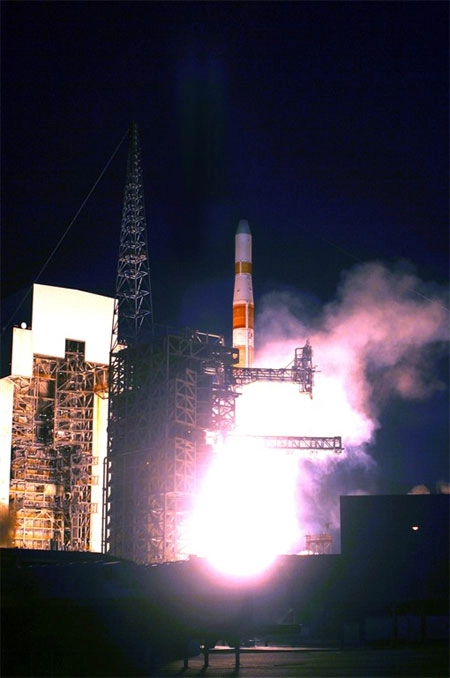
A new spy satellite iscircling Earth after a spectacular sendoff Tuesday evening, marking the firsttime such a clandestine national security spacecraft has launched aboard America's modern breed of rockets.
Boeing's next-generationDelta 4 rocket fired away from the infamous Space Launch Complex 6 atVandenberg Air Force Base in Californiajust after sunset for the 54-minute ascent into orbit.
This inaugural West Coastflight of the Evolved Expendable Launch Vehicle program began at 8:33 p.m.local time (11:33 p.m. EDT; 0333 GMT). The liftoff was delayed 19 minutes dueto strong winds blowing across the hilly launch base.
Powered skyward by itshydrogen-fueled main engine and twin strap-on solid rocket motors, the Delta 4created a brilliant trail visible across a wide swath. Spaceflight Now readersthroughout California and even Mexico reported spotting the launch.
Crews working on thesecretive mission had been waiting years to see the rocket go. The booster wasassembled on the pad in 2003, only to have its launch date slip repeatedly dueto delays readying the payload. And liftoff plans last October were scrapped aday before launch over concerns with fuel sloshing in the upper stage.
Worries about clouds andstrong winds Tuesday threatened to keep the rocket grounded again. But theclouds parted and winds eased enough to let the Delta 4 fly from its renovatedpad on the first countdown attempt, a remarkable achievement sure to eraselingering frustrations about the previous postponements.
The rocket flew south overthe Pacific Ocean, soared above the tip of South America, then crossed theextreme southern Atlantic before passing south of Africa and starting itsnorthward trajectory over the Indian Ocean. Less than an hour after the flightbegan, the second stage motor released the top-secret National ReconnaissanceOffice payload while flying just east of Madagascar.
The National ReconnaissanceOffice is the U.S. government agency responsible fordeveloping and operating the country's fleet of spy satellites. The NRO keepsdetails about its spacecraft hush-hush, and the Delta 4 cargo was no exceptionto that rule.
But information made publicabout the launch implied the satellite was headed for a highly elliptical,highly inclined orbital perch often called a Molniya-style orbit.
Sky watchers around theworld have made a hobby of tracking mystery spacecraft and using the Internetto trade viewing tips. Canadian Ted Molczan, a respected satellite observer,says past experience could indicate the possible use for the craft launched bythe Delta 4.
"I estimate that thisrocket configuration can place in excess of 4,000 kg into a Molniya orbit. The U.S. has used such orbits since the early 1970s forcommunications and SIGINT (signals intelligence) satellites," Molczansaid.
Tuesday's flight was the14th for an EELV rocket since 2002. But all previous launches had occurred fromCape Canaveral, Florida, and none had carried a National Reconnaissance Office spysatellite.
The EELV program wascreated a decade ago by the Air Force to spark the creation of cheaper, lesscumbersome U.S. rockets to haul satellites intospace, replacing older designs like the Titan 4. Boeing's Delta 4 and LockheedMartin's Atlas 5 rocket families were born to answer the military's call.
Both companies havelaunched various versions of the rockets with commercial, NASA and Air Forcesatellite payloads from complexes on the East Coast. And they have built launchpads on the West Coast at Space Launch Complex 6 for Delta 4 and SLC-3 East forAtlas 5.
Now, Vandenberg haswitnessed its maiden EELV blastoff at last.
"Assured access tospace is vital to our country. Bringing EELV to the West Coast is a nextstep," Lt. Col. David Goldstein, the Air Force launch director andcommander of the 4th Space Launch Squadron, said in an interview.
"I see it's a majorstep for our country ... because we have to have that access from both coastsbecause of the types of orbits that are used."
The Vandenberg launch siteallows rockets to fly southward for delivery of spacecraft into orbit aroundEarth's poles for coverage over most of the planet's surface. Cape Canaveral is best suited for launches headedeastward to reach equatorial orbits.
"Over the next coupleyears we're going to have a few Atlas launches and a few more Delta launches,and they're all vital to our national security. In my mind, it's a huge stepforward to be able to get EELV launched off of the West Coast," Goldsteinsaid.
"This first Delta 4launch from Vandenberg is an important achievement for Boeing and our NRO andAir Force customers," said Dan Collins, vice president of Boeing LaunchSystems. "Today we successfully validated launching the Delta 4 fromSLC-6, providing the Air Force and the nation with the first operational WestCoast launch site for the EELV program.
"With this launch, theDelta team has fulfilled all the EELV requirements outlined by the Air Force.We have a full family of launch vehicles, including a flight-proven, heavy-liftvehicle, a domestically produced first stage engine and now fully operationallaunch sites on both coasts."
Plans call for a secondDelta 4 launch from Vandenberg in November to deliver the DefenseMeteorological Satellite Program's DMSP-17 weather satellite into polar orbit.
The first West Coast Atlas5 is stacked on its pad for liftoff in January carrying a classified NROpayload.
Lockheed Martin hasretrofitted its existing Atlas pad to accommodate the larger, more powerfulAtlas 5. However, the California home of Delta 4, commonly calledSlick Six, has a unique history.
The site's star-crossedlegacy began with construction in the 1960s for the Air Force's Manned OrbitingLaboratory space station project. But that program was cancelled before thefirst launch.
Then came visions ofmilitary space shuttle launches to polar orbit. Billions of dollars were spentrebuilding the pad in the 1980s for liftoffs of the winged spaceplane. TheChallenger accident and the Pentagon's transfer of its satellites from theshuttle to unmanned rockets put Slick Six back into mothball status beforehosting a single launch.
Lockheed Martin's tinyAthena booster made four flights from the pad in the 1990s, yet only oneenjoyed full mission success for both the rocket and satellite.
The new era of Delta 4started with pad modification work in 2000. Now, there's a successful launch tocelebrate.