WASHINGTON, D.C. - A former NASA astronaut will call on the U.S. Congress to evaluate an asteroid with a small chance of hitting Earth in 2036 and suggest lawmakers consider a space mission to monitor the object, SPACE.com has learned.
Russell Schweickart arrives here today to make his case. He'll also ask Congress to assign to a government agency the responsibility of protecting the public from space rocks.
The call to action stems from an orbiting hunk of stone that for a few days around Christmas had scientists on the edges of their seats.
The asteroid, named 2004 MN4, was found last year. It orbits the Sun but crosses the path of Earth. In December, preliminary observations showed it might strike in 2029, according to NASA scientists. It briefly had the highest odds ever assigned to a possible collision. Further investigation ruled out the 2029 impact scenario, but scientists cannot yet rule out an impact in 2036.
The odds of a collision in 2036 are about 1-in-10,000, Schweickart says.
In fact, there are several scenarios between 2034 and 2065 in which 2004 MN4 has even smaller odds of striking. Schweickart and other scientists stress, however, that future observations are likely to reduce all these odds to zero.
Time to act
Meanwhile, Schweickart thinks the time to act is now.
SPACE.com was provided a copy of the paper Schweickart will present. In it, he carries out an informal analysis of the situation. He notes that the asteroid will be mostly out of view from 2006 to 2012. When it re-emerges, fresh observation will likely reduce the 2036 impact chance to zero, he said.
"However, there is a slim chance that we will not be able to draw this conclusion and that an impact will still be possible," he writes.
"One of the first things I'm calling for is validation and checking of the analysis I've gone through and the conclusions that fall out of my work," Schweickart told SPACE.com.
Schweickart heads up the B612 Foundation, which since 2003 has advocated for more research and action to protect Earth from stray asteroids.
Call to action
Should his analysis prove correct after formal study, Schweickart says serious consideration should be given to first placing a radio transponder on the asteroid in order to better track its whereabouts.
The former Apollo astronaut will take his message to Congressional lawmakers and detail his concerns at the International Space Development Conference being held here this week by the National Space Society, a space advocacy organization.
Astronomers agree that sooner or later Earth will be struck by a damaging asteroid. While one could sneak up on us any day, the overwhelming odds are that any potential significant impact will be known years in advance.
NASA has been charged by Congress with finding potentially hazardous space rocks. Yet only last year, after a separate brief scare, did officials formalize lines of communication between NASA's top brass and the astronomers who find and monitor space rocks.
Still, there are no formal lines of communication between NASA and the White House to handle an imminent threat. And there is no U.S. agency to which the issue of protection of the public and property from the impact of near-Earth asteroids is assigned, Schweickart points out. Who would decide on whether and how to deflect an incoming threat? What agencies would be mobilized to deal with an impact?
The U.S. Congress should take action and assign that responsibility, he said.
"In general, I am calling upon them is to address the overall issue of responsibility for near-Earth object activity in the U.S. government, which does not exist right now," Schweickart said.
Close brush
Asteroid 2004 MN4 was discovered through the efforts of NASA's Spaceguard Survey.
The object is estimated to be roughly 1,000 feet (320 meters) in diameter. Were it to hit the planet, it would not cause global devastation but would generate considerable local or regional damage, experts say.
"This is not a marginal asteroid," Schweickart said.
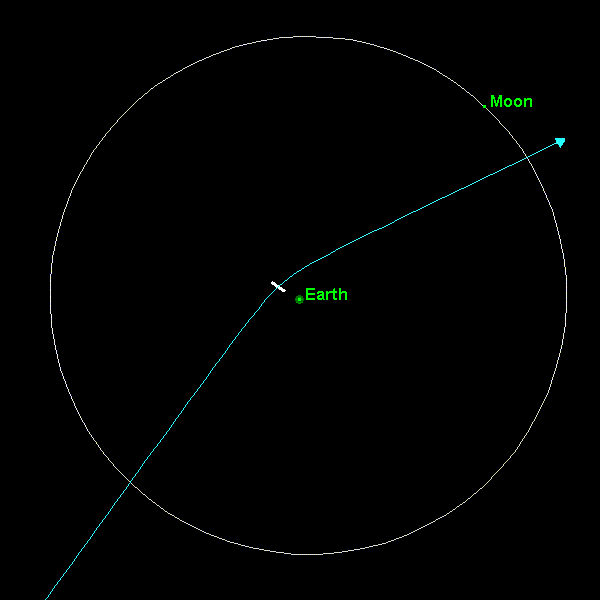
On April 13, 2029, 2004 MN4 will be about 22,600 miles (36,350 kilometers) from Earth's center. That is just below the altitude of geosynchronous satellites.
The extremely rare event will be visible from certain parts of Earth.
The flyby will change the orbit of the asteroid and create "a low, but real possibility" that it will return to hit Earth seven years later on April 13, 2036, Schweickart advised.
There are no formal plans in place, at NASA or elsewhere, for destroying or deflecting an incoming asteroid. But if it needs to be nudged off course, you don't wait until after 2029, Schweickart explained. By then it will take far more energy to deflect the rock, he said.
"We've got to start taking some action right now...to give us accurate enough information...so that we could make a rationale decision whether or not it needs to be deflected. That's the key," Schweickart said.
If the object were indeed found to have Earth's name on it, or even a ten percent chance of hitting, Schweickart figures it would be prudent to mount a deflecting mission, which might cost a billion dollars.
"Given the devastation that would occur, everyone would want to commit to a deflection mission," Schweickart said. In fleshing out his preliminary analysis, an estimated "path of risk" has been plotted out.
| Tsunami Animations Steven Ward, a geophysicist at the University of California, Santa Cruz, has simulated the possible consequences of an ocean impact by asteroid 2004 MN4 in 2036. |
Tsunami Animations Steven Ward, a geophysicist at the University of California, Santa Cruz, has simulated the possible consequences of an ocean impact by asteroid 2004 MN4 in 2036. |
Tsunami Animations | Steven Ward, a geophysicist at the University of California, Santa Cruz, has simulated the possible consequences of an ocean impact by asteroid 2004 MN4 in 2036. |
| Tsunami Animations Steven Ward, a geophysicist at the University of California, Santa Cruz, has simulated the possible consequences of an ocean impact by asteroid 2004 MN4 in 2036. |
Tsunami Animations | Steven Ward, a geophysicist at the University of California, Santa Cruz, has simulated the possible consequences of an ocean impact by asteroid 2004 MN4 in 2036. |
|
| Tsunami Animations | |||
Steven Ward, a geophysicist at the University of California, Santa Cruz, has simulated the possible consequences of an ocean impact by asteroid 2004 MN4 in 2036. |
Simulations of land-based impacts can be estimated at an online catastrophe calculator.
Since Earth is 70 percent ocean, any possible impact might logically be a splashdown. Schweickart lays out one scenario -- again, the odds of such a result are very small -- in which 2004 MN4 hits the Pacific Ocean, about 680 miles (1,100 kilometers) off the Southern California coast. The entire western coastline of the United States would experience a devastating tsunami, resulting in billions of dollars worth of damage, Schweickart says.
Course of action is clear
In his paper to be presented this Friday at the National Space Society meeting, Schweickart suggests spending roughly $300 million to dispatch a robotic scientific mission to 2004 MN4. The probe's duty would be to park a radio transponder on the asteroid. Additionally, the mission would relay back to Earth the asteroid's vitals, such as its surface and interior properties.
"This information is in itself invaluable, both for scientific knowledge and for the design of systems necessary to perform an asteroid deflection, whenever it becomes necessary," Schweickart notes.
The accuracy of optical and radar tracking of the asteroid, he said, is likely to be inadequate to make a timely decision to redirect the path of the worrisome space rock if, indeed, such a deflection should be needed.
Given data from the radio transponder, scientists would be able to conclude by 2014 that the asteroid whether the asteroid has a decent chance of hitting or not, Schweickart figures.
"Either way...our course of action is clear," he said. "We either plan another series of cocktail parties to watch the asteroid go by in 2036 -- as we will have done in 2029 -- or we mount the most important space mission in human history."
SPACE.com's Robert Roy Britt contributed to this report.
- Catastrophe Calculator: Estimate Asteroid Impact Effects Online
- 2004 MN4 Underscores Planetary Defense Mission
- 2004 MN4 to be Naked-Eye Visible
- The Odds of Dying