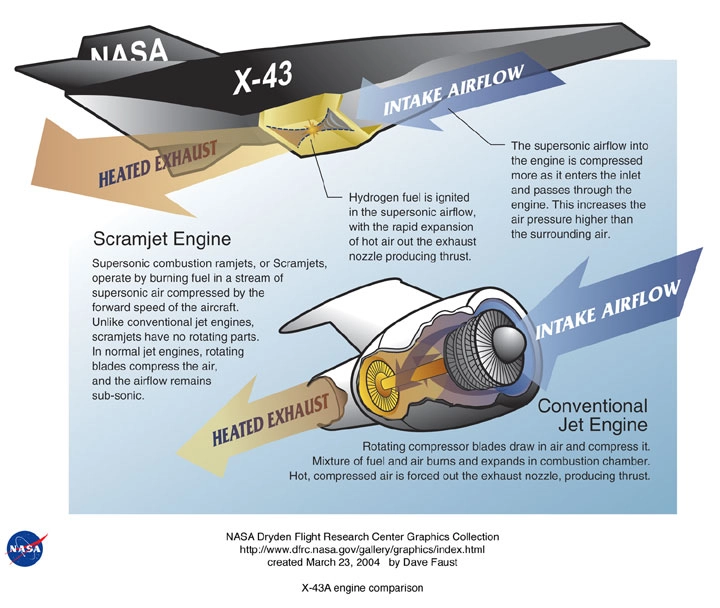
LOS ANGELES (AP) -- In March, NASA launched an experimental jet that reached a record-setting speed of about 5,000 mph. Now researchers want to leave that milestone in the dust.
NASA's third and last X-43A ''scramjet'' is set to streak over the Pacific Ocean on Monday at 7,000 mph for 10 or 11 seconds -- or 10 times the speed of sound.
The first X-43A flight failed in June 2001 when the booster rocket used to accelerate it to flight speed veered off course and had to be destroyed. The second flight in March was a success, reaching Mach 6.83 -- nearly 5,000 mph -- and setting a new world speed record for a plane powered by an air-breathing engine.

The last hypersonic X-43A will try, weather permitting, to break that record by making its advanced supersonic combustion ramjet perform at a level that can't even be tested on the ground, project officials said Wednesday from NASA's Dryden Flight Research Center at Edwards Air Force Base, Calif.
"What we're trying to do is really get to the reality of flight -- find out what does work, what doesn't work. So there is risk in this program," said Vince Rausch, Hyper-X program manager at NASA's Langley Research Center in Virginia.
"We fully anticipate that we've reduced that risk to acceptable levels but you never are sure, especially in doing something for the first time, going Mach 10, until we actually fly."
Just 12 feet long and 5 feet wide, the unmanned X-43A is mounted on the nose of a Pegasus rocket that will be carried aloft to 40,000 feet by NASA's B-52 research aircraft and released. The Pegasus rocket will ignite and carry the X-43A to an altitude of 110,000 feet and a speed of about Mach 10, then release it for its brief powered flight.
The X-43A will then become a glider and perform maneuvers until it splashes down into the ocean.
That will be the end of the X-43A project, which has cost more than $230 million and has no immediate follow-on program.
"I have mixed emotions about this mission," said Joel Sitz, project manager for X-43A flight research at Dryden. "I'm very excited about next week. I'm also a little bit sad about seeing the end of the program. It's like watching your son go off to college."
Scramjet technology may be used in developing hypersonic missiles and airplanes or reusable space launch vehicles, with a potential for offering speeds of at least Mach 15. Unlike rockets, scramjets wouldn't have to carry heavy oxidizer necessary to allow fuel to burn because they can scoop oxygen out of the atmosphere.