





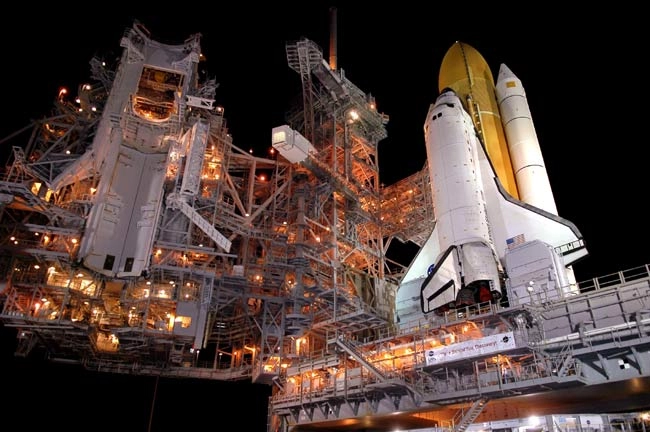
HOUSTON - With the Discovery orbiter sittingatop its launch pad and a potential liftoff date five weeks away, seven astronautsare looking toward a mission they hope will mark NASA's return to shuttleflight.
"It's timeto go back to fly," said veteran astronaut Eileen Collins, commander of Discovery'sSTS-114 mission. "We're 95 percent complete with our training."
The STS-114 spaceflight would cap more than two years ofwork by NASA mission managers and engineers to boost shuttle safety and preventanother accident like that which resulted in the loss of the Columbia orbiter and its seven-astronaut crewin 2003.
The Columbia orbiter wasstruck by external tank foam insulation during launch which damaged its wingand caused it to break up over Texasduring reentry.
"We miss the Columbiacrew and we miss our fellow astronauts," Collins said. "We will be rememberingthem on our spaceflight."
Collins and her STS-114 crewmates are currently set tolaunch no earlier than May 15 on a mission bound for the International SpaceStation (ISS). Discovery rolled upto its launch pad early Thursday.
A busy schedule
NASA andthe STS-114 crew still face some much-needed tasks before Discovery can liftoff its launch pad and return to space.
On Friday, the crew will undergo a 12-hour simulationspanning two days of their spaceflight, Collins said, adding that next weekSTS-114 mission specialists Soichi Noguchi andStephen Robinson will once again don spacesuits and plunge into a giant pool torehearse the three spacewalks they will conduct during Discovery's spaceflight.
Shuttlemission managers are also planning a test later this month to check theintegrity of Discovery's redesigned external fuel tank by pumping it with theliquid oxygen/liquid hydrogen fuel the shuttle burns during launch. A terminalcountdown test is slated for the end of the month, Collins said.
Meanwhile,an independent oversight group charged with evaluating NASA's return to flighteffort is still waiting on additional data before it can sign off on the spaceagency's launch plans.
TheStafford-Covey Return to Flight Task Force has passed NASA on seven of the 15recommendations submitted by Columbiaaccident investigators as imperative issues to be addressed before the nextlaunch. Of the eight remaining, several hover near closure.
Collinssaid her crew has met with the Stafford-Covey group several times to brief itsmembers on NASA's return to flight work.
"Their work is not done yet, in fact, our work is not doneyet," said Collins, adding that NASA still must complete debris and designverification reviews for Discovery's flight. "If we ever get to the point wherea recommendation is not filled in anyone's mind, we are not going to fly untilwe are ready to fly."
Shuttle safety
NASA officials have repeatedly said Discovery's flight willbe among, if not the, safest mission ever to fly.
Engineers have redesigned portions of shuttle external fueltanks to prevent the type of foam shedding that doomed Columbia. An emergency plan tohouse the crew aboard the International Space Station has been sketched out inthe off chance Discovery suffers critical damage during the mission.
The STS-114 flight will carry a 50-foot (15-meter) orbitalboom tipped with instruments to scan sensitive areas of Discovery's thermalprotection system for damage. Astronauts aboard the space station will alsophotograph the thermal protection tiles and panels as the orbiter flips around,exposing its belly to the ISS during approach.
Meanwhile, Noguchi and Robinson will test two methods ofrepairing the tiles and reinforced carbon carbon(RCC) panels that protect orbiters from the searing heat of reentry as part oftheir first spacewalk. A third repair technique to plug small holes in RCCpanels will be demonstrated inside Discovery, while the two men wear spacesuitgloves.
Those tests, and others, are required before NASA can besure its thermal protection repair methods will be effective in an emergency,STS-114 astronauts said.
"I believe we still need to wait and do more testing to getmore data on some repair techniques," Collins said.
However, STS-114 flight director Paul Hill told reportersthat the location of a particular damage point could govern whether missionmanagers would consider using one of the current repair methods.
"I do see a scenario where we could make a repair," Hillsaid.
For example, a small knick in an area where damage may notbe critical could be repaired as a measure to boost mission safety, he added.
"We never thought it would be possible to repair thisvehicle in space," said STS-114 mission specialist Charlie Camarda."But yet I still feel, and I'm very hopeful, that these systems will be matureand beyond mature in the not too distant future."
Collins said she and her crew plan to enter quarantine aboutseven days before their flight and fly to Kennedy Space Center about four daysbefore launch.
"We have got to get this shuttle to fly again and completethis major goal of completing the space station," Collins said.
- Special Report: NASA's Return to Flight
| Row 0 - Cell 0 |
