





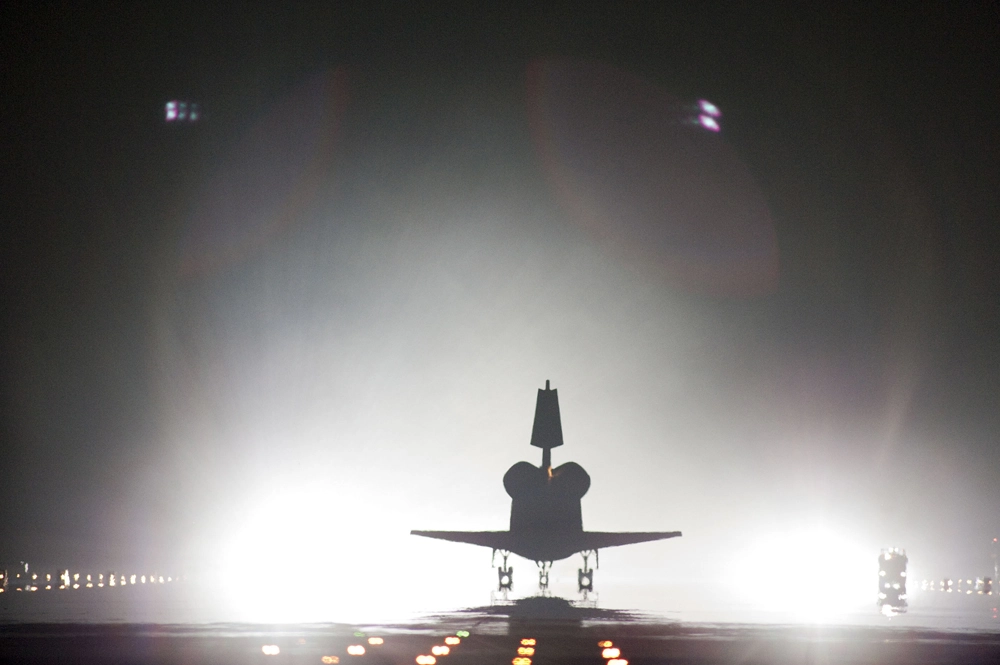
After 30 years, NASA's storied space shuttle program comes to a close in 2011.
NASA's three flying shuttles, Discovery, Atlantis and Endeavour are each flying their final mission this year. Along with NASA's two other shuttles, the Challenger and Columbia vehicles lost in tragic accidents, the shuttle program has flown an amazing 135 flights to low-Earth orbit and played a pivotal role in the construction of the International Space Station.
Take a look at NASA's full list of every shuttle mission.
2011

STS-135 (Planned): Atlantis' Final Flight and Final Space Shuttle Mission
Launch Target: July 8, 2011
Space Shuttle: Atlantis
Mission Number: STS-135 (135th space shuttle flight)
Launch Launch Window: 10 minutes
Launch Pad: 39A
Mission Duration: 12 days
Spacewalks: 1 (by ISS crew)
Landing Site: KSC
Inclination/Altitude: 51.6 degrees/122 nautical miles
Primary Payload: 37th station flight (ULF7), mu
Atlantis will carry the Raffaello multipurpose logistics module to deliver supplies, logistics and spare parts to the International Space Station. The mission also will fly a system to investigate the potential for robotically refueling existing spacecraft and return a failed ammonia pump module to help NASA better understand the failure mechanism and improve pump designs for future systems.
Crew will consist of Chris Ferguson, commander; Doug Hurley, pilot; Rex Walheim and Sandy Magnus, both mission specialists.

STS-134: Endeavour's Final Flight
Space Shuttle: Endeavour
Primary Payload: Alpha Magnetic Spectrometer and ELC-3
Launched: May 16, 2011, 8:56 a.m. EDT
Launch Pad: 39A
Landing: June 1, 2011, 2:35 a.m. EDT
Landing Site: Kennedy Space Center, Fla.
Mission Duration: 16 days
Inclination/Altitude: 51.6 degrees/122 nautical miles
STS-134 Commander Mark Kelly and his crew of five blasted off Launch Pad 39A on space shuttle Endeavour from NASA's Kennedy Space Center in Florida, May 16, 2011, at 8:56 a.m. EDT.
Headed for the International Space Station, the agency's youngest shuttle made its final flight delivering the Alpha Magnetic Spectrometer-2 (AMS) and critical supplies, including two communications antennas, a high-pressure gas tank and additional parts for the Dextre robot.
Pilot Greg H. Johnson, Mission Specialists Mike Fincke, Drew Feustel, Greg Chamitoff and Roberto Vittori with the European Space Agency rounded out the crew. This was the first shuttle flight for Fincke, a veteran space flier, and Vittori, who is the last international astronaut to fly aboard a shuttle. Four spacewalks were performed

STS-133: Shuttle Discovery's Final Flight
Space Shuttle: Discovery
Primary Payload: 35th station flight (ULF5), EXPRESS Logistics Carrier 4 (ELC4), Permanent Multi-Purpose Module (PMM)
Launched: 4:53:24 p.m. EST, Feb. 24, 2011
Landing: 11:57:17 a.m. EST, March 9, 2011
Landing Site: KSC
Mission Duration: 12 days, 19 hours, 4 minutes and 50 seconds
Inclination/Altitude: 51.6 degrees/122 nautical miles
STS-133 Commander Steve Lindsey, Pilot Eric Boe and Mission Specialists Alvin Drew, Steve Bowen, Michael Barratt and Nicole Stott delivered a new module and an external stowage platform to the International Space Station as well as equipment and supplies.
During space shuttle Discovery’s almost nine days at the station, Bowen and Drew performed two spacewalks for maintenance work and installation of new components.This was the 35th shuttle mission to the station and the final flight of Discovery.
2010

STS-132
Launched: 2:20 p.m. EDT, May 14, 2010
Landing: 8:48 a.m. EDT, May 26, 2010
Space Shuttle: Atlantis
Mission Number: STS-132 (132nd space shuttle flight)
Launch Launch Window: 10 minutes
Launch Pad: 39A
Mission Duration: 11 days, 18 hours, 29 minutes, 9 seconds
Landing Site: KSC
Inclination/Altitude: 51.6 degrees/122 nautical miles
Primary Payload: 34th station flight (ULF4), Integrated Cargo Carrier (ICC), Mini Research Module (MRM1)
Space shuttle Atlantis launched on its final planned mission to deliver an Integrated Cargo Carrier and a Russian-built Mini Research Module to the International Space Station. STS-132 was the 32nd mission for Atlantis.
Crew consisted of Commander Ken Ham, Mission Specialists Garrett Reisman and Michael Good, Pilot Tony Antonelli, and Mission Specialists Piers Sellers and Steve Bowen.

STS-131
Launched: 6:21 a.m. EDT, April 5, 2010
Landing: 9:08 a.m. EDT, April 20, 2010
Space Shuttle: Discovery
Mission Number: STS-131 (131st space shuttle flight)
Launch Launch Window: 10 minutes
Launch Pad: 39A
Mission Duration: 15 days, 2 hours, 47 minutes, 10 seconds
Landing Site: KSC
Inclination/Altitude: 51.6 degrees/122 nautical miles
Primary Payload: 33rd station flight (19A), Multi-Purpose Logistics Module
Commander Alan Poindexter led the STS-131 mission to the International Space Station aboard space shuttle Discovery. James P. Dutton Jr. served as the pilot. Mission Specialists were Rick Mastracchio, Clayton Anderson, Dorothy Metcalf-Lindenburger, Stephanie Wilson and Japan Aerospace Exploration Agency astronaut Naoko Yamazaki.
Discovery delivered a multi-purpose logistics module filled with science racks that were transferred to laboratories on the International Space Station.
STS-131 was the 33rd shuttle mission to the station.

STS-130
Launched: 4:14 a.m. EST, Feb. 8, 2010
Landing: 10:20 p.m. EST, Feb. 21, 2010
Space Shuttle: Endeavour
Mission Number: STS-130 (130th space shuttle flight)
Launch Launch Window: 10 minutes
Launch Pad: 39A
Mission Duration: 13 days, 18 hours, 6 minutes, 24 seconds
Landing Site: KSC
Inclination/Altitude: 51.6 degrees/122 nautical miles
Primary Payload: 32nd station flight (20A), Tranquility Node 3, Cupola
Commander George Zamka led the STS-130 mission to the International Space Station aboard Endeavour. Terry Virts served as the pilot. Mission Specialists were Nicholas Patrick, Robert Behnken, Stephen Robinson and Kathryn Hire. Virts completed his first trip to space.
Endeavour delivered a third connecting module — the Tranquility node — to the station and a seven-windowed cupola to be used as a control room for robotics. The mission featured three spacewalks.
STS-130 was the 32nd shuttle mission to the station.
2009

STS-129
Launched: 2:28 p.m. EST, Nov. 16, 2009
Landing: 9:44 a.m. EST, Nov. 27, 2009
Space Shuttle: Atlantis
Mission Number: STS-129 (129th space shuttle flight)
Launch Launch Window: 10 minutes
Launch Pad: 39A
Mission Duration: 10 days, 19 hours, 16 minutes, 13 seconds
Landing Site: KSC
Inclination/Altitude: 51.6 degrees/122 nautical miles
Primary Payload: 31st station flight (ULF3), EXPRESS Logistics Carrier 1 (ELC1), EXPRESS Logistics Carrier 2 (ELC2)
Commander Charlie Hobaugh led the STS-129 mission to the International Space Station aboard space shuttle Atlantis. Barry Wilmore served as the pilot. Mission specialists were Robert Satcher, Michael Foreman, Randy Bresnik and Leland Melvin. Wilmore, Satcher and Bresnik made their first trips to space.
The mission returned station crew member Nicole Stott to Earth. STS-129 was the final space shuttle crew rotation flight to or from the space station.
Atlantis delivered parts to the space station, including a spare gyroscope. The mission featured three spacewalks.
STS-129 was the 31st shuttle mission to the station.

STS-128
Launched: 11:59 p.m. EDT, Aug. 28, 2009
Landing: 8:53 p.m. EDT, Sept. 11, 2009
Space Shuttle: Discovery
Mission Number: STS-128 (128th space shuttle flight)
Launch Launch Window: 10 minutes
Launch Pad: 39A
Mission Duration: 13 days, 20 hours, 54 minutes
Landing Site: EDW
Inclination/Altitude: 51.6 degrees/122 nautical miles
Primary Payload: 30th station flight (17A), Leonardo Multi-Purpose Logistics Module, Lightweight Multi-Purpose Experiment Support Structure Carrier
Commander Rick Sturckow led the STS-128 mission to the International Space Station aboard space shuttle Discovery with Kevin Ford serving as pilot. Also serving aboard Discovery were mission specialists Patrick Forrester, José Hernández, John "Danny" Olivas, Christer Fuglesang, Nicole Stott and Timothy Kopra.
Stott remained on the station as an Expedition 20 flight engineer replacing Timothy Kopra. Kopra returned home aboard Discovery as a mission specialist.
Discovery carried the Leonardo Multi-Purpose Logistics Module containing life support racks and science racks. The Lightweight Multi-Purpose Experiment Support Structure Carrier was also launched in Discovery's payload bay.
This was Discovery's 37th mission to space and the 30th mission of a space shuttle dedicated to the assembly and maintenance of the International Space Station.

STS-127
Launched: 6:03 p.m. EDT, July 15, 2009
Landing: 10:48 a.m. EDT, July 31, 2009
Space Shuttle: Endeavour
Mission Number: STS-127 (127th space shuttle flight)
Launch Launch Window: 10 minutes
Launch Pad: 39A
Mission Duration: 15 days, 16 hours, 45 minutes
Landing Site: KSC
Inclination/Altitude: 51.6 degrees/122 nautical miles
Primary Payload: 29th station flight (2J/A), Kibo Japanese Experiment Module Exposed Facility (JEM EF), Kibo Japanese Experiment Logistics Module, Exposed Section (ELM-ES)
Mark L. Polansky commanded the shuttle Endeavour for STS-127. Douglas G. Hurley served as the pilot. Mission specialists were Christopher J. Cassidy, Thomas H. Marshburn, David A. Wolf and Julie Payette, a Canadian Space Agency astronaut.
The mission delivered Timothy L. Kopra to the station as a flight engineer and science officer and returned Japanese astronaut Koichi Wakata to Earth.
Endeavour set sail on its 23rd mission with the Kibo Japanese Experiment Module Exposed Facility and Experiment Logistics Module Exposed Section. The facility provides a type of "front porch" for experiments in the exposed environment, and a robotic arm that is attached to the Kibo Pressurized Module and is used to position experiments outside the station. The mission included five spacewalks.
STS-127 was the 29th shuttle mission to the International Space Station.

STS-125
Launched: 2:01 p.m. EDT, May 11, 2009
Landing: 11:39 a.m. EDT, May 24, 2009
Space Shuttle: Atlantis
Mission Number: STS-125 (126th space shuttle flight)
Launch Launch Window: Approximately 40 minutes
Launch Pad: 39A
Mission Duration: 12 days, 21 hours, 37 minutes
Landing Site: Edwards Air Force Base, Calif.
Inclination/Altitude: 28.5 degrees/304 nautical miles
Primary Payload: Hubble Space Telescope Servicing Mission 4
Veteran astronaut Scott D. Altman commanded the final space shuttle mission to Hubble. Retired Navy Capt. Gregory C. Johnson served as pilot. Mission specialists included veteran spacewalkers John M. Grunsfeld and Michael J. Massimino and first-time space fliers Andrew J. Feustel, Michael T. Good and K. Megan McArthur.
Atlantis’ astronauts repaired and upgraded the Hubble Space Telescope, conducting five spacewalks during their mission to extend the life of the orbiting observatory. They successfully installed two new instruments and repaired two others, bringing them back to life, replaced gyroscopes and batteries, and added new thermal insulation panels to protect the orbiting observatory. The result is six working, complementary science instruments with capabilities beyond what was available and an extended operational lifespan until at least 2014.

STS-119
Launched: March 15, 2009, 7:43 p.m. EDT
Landing: March 28, 2009, 3:14 p.m. EDT
Space Shuttle: Discovery
Mission Number: STS-119 (125th space shuttle flight)
Launch Launch Window: 10 minutes
Launch Pad: 39A
Mission Duration: 12 days, 19 hours, 29 minutes, 33 secs
Landing Site: KSC
Inclination/Altitude: 51.6 degrees/122 nautical miles
Primary Payload: 28th station flight (15A), S6 truss segment
Air Force Col. Lee Archambault led the crew of STS-119, and Navy Cmdr. Tony Antonelli served as the pilot. The mission specialists for the flight were NASA astronauts Joseph Acaba, John Phillips, Steve Swanson, Richard Arnold and Japan Aerospace Exploration Agency astronaut Koichi Wakata.
Wakata remained on the station, replacing Expedition 18 Flight Engineer Sandra Magnus, who returned to Earth with the STS-119 crew. He is serving as a flight engineer for Expeditions 18 and 19.
STS-119 is the 28th shuttle mission to the International Space Station. Discovery also carried the S6 truss segment to the orbital outpost.
2008

STS-126
Launched: Nov. 14, 2008, 7:55 p.m. EST
Landing: Nov. 30, 2008, 4:25 p.m. EST
Space Shuttle: Endeavour
Mission Number: STS-126 (124th space shuttle flight)
Launch Launch Window: 10 minutes
Launch Pad: 39A
Mission Duration: 15 days, 20 hours, 29 minutes, 37 secs
Landing Site: Edwards Air Force Base, Calif.
Inclination/Altitude: 51.6 degrees/122 nautical miles
Primary Payload: 27th station flight (ULF2), Multi-Purpose Logistics Module (MPLM)
Veteran space flier Navy Capt. Christopher J. Ferguson commanded the STS-126 mission aboard Endeavour that delivered equipment to the International Space Station that will enable larger crews to reside aboard the complex. Air Force Lt. Col. Eric A. Boe served as the pilot. The mission specialists were Navy Capt. Stephen G. Bowen, Army Lt. Col. Robert S. Kimbrough, Navy Capt. Heidemarie M. Stefanyshyn-Piper and NASA astronauts Donald R. Pettit and Sandra H. Magnus.
Magnus remained on the station, replacing Expedition 17/18 Flight Engineer Gregory E. Chamitoff, who returned to Earth with the STS-126 crew.
Endeavour carried a reusable logistics module that held supplies and equipment, including additional crew quarters, additional exercise equipment, equipment for the regenerative life support system and spare hardware.
STS-126 was the 27th shuttle mission to the International Space Station.

STS-124
Launched: May 31, 2008, 5:02 p.m. EDT
Landing: June 14, 2008, 11:15 a.m. EDT
Space Shuttle: Discovery
Mission Number: STS-124 (123rd space shuttle flight)
Launch Launch Window: 10 minutes
Launch Pad: 39A
Mission Duration: 13 days, 18 hours, 13 minutes, 7 secs
Landing Site: KSC
Inclination/Altitude: 51.6 degrees/122 nautical miles
Primary Payload: 26th station flight (1J), Kibo Pressurized Module, Japanese Remote Manipulator System
Navy Cmdr. Mark E. Kelly commanded the STS-124 shuttle mission to deliver the Pressurized Module and robotic arm of the Japanese Experiment Module, known as "Kibo" (hope), to the International Space Station. Navy Cmdr. Kenneth T. Ham served as the pilot. Mission specialists included NASA astronauts Karen L. Nyberg; Air Force Col. Ronald J. Garan Jr.; and Air Force Reserve Col. Michael E. Fossum. Japan Aerospace Exploration Agency (JAXA) astronaut Akihiko Hoshide also served as a mission specialist.
Astronaut Gregory E. Chamitoff flew to the station as a mission specialist on STS-124.
The STS-124 mission was the second of three flights that will launch components to complete the Kibo laboratory. The mission included three spacewalks. The lab's logistics module, which was installed in a temporary location during STS-123, was attached to the new lab.
STS-124 was the 26th shuttle mission to the International Space Station.

STS-123
Launched: March 11, 2008, 2:28 a.m. EDT
Landing: March 26, 2008, 8:39 p.m. EDT
Space Shuttle: Endeavour
Mission Number: STS-123 (122nd space shuttle flight)
Launch Launch Window: 10 minutes
Launch Pad: 39A
Mission Duration: 15 days, 18 hours
Landing Site: KSC
Inclination/Altitude: 51.6 degrees/122 nautical miles
Primary Payload: 25th station flight (1J/A), Kibo Logistics Module, Dextre Robotics System
A veteran space flier, Navy Capt. Dominic L. Gorie, commanded the STS-123 shuttle mission to deliver the Japanese Kibo Logistics Module and the Canadian Dextre robotics system to the International Space Station. Air Force Col. Gregory H. Johnson served as pilot. Mission specialists included Richard M. Linnehan, Air Force Maj. Robert L. Behnken, Navy Capt. Michael J. Foreman and Japan Aerospace Exploration Agency astronaut Takao Doi. STS-123 was the first spaceflight for Johnson, Behnken and Foreman.
The mission delivered NASA astronaut Garrett Reisman to the station and returned European Space Agency astronaut Léopold Eyharts to Earth.
STS-123 was the 25th shuttle mission to the International Space Station.

STS-122
Launched: Feb. 7, 2008, 2:45 p.m. EST
Landing: Feb. 20, 2008, 9:07 a.m. EST
Space Shuttle: Atlantis
Mission Number: STS-122 (121st space shuttle flight)
Launch Launch Window: 10 minutes
Launch Pad: 39A
Mission Duration: 13 days
Landing Site: KSC
Inclination/Altitude: 51.6 degrees/122 nautical miles
Primary Payload: 24th station flight (1E), Columbus Laboratory
A veteran space flier, Navy Cmdr. Stephen N. Frick, commanded the STS-122 shuttle mission to deliver the European Space Agency's Columbus Laboratory to the International Space Station. Navy Cmdr. Alan G. Poindexter served as pilot. Mission specialists included Air Force Col. Rex J. Walheim, Stanley G. Love, Leland D. Melvin and European Space Agency astronaut Hans Schlegel. Poindexter, Love and Melvin made their first spaceflight on this mission.
Expedition 16 Flight Engineer Daniel Tani, who flew to the space station on the STS-120 mission, returned home with the STS-122 crew. STS-122 delivered European Space Agency astronaut Léopold Eyharts to the complex.
STS-122 was the 24th shuttle mission to the International Space Station.
2007

STS-120
Launched: Oct. 23, 2007, 11:38 a.m. EDT
Landing: Nov. 7, 2007, 1:01 p.m. EST
Space Shuttle: Discovery
Mission Number: STS-120 (120th space shuttle flight)
Launch Launch Window: 10 minutes
Launch Pad: 39A
Mission Duration: 15 days, 2 hours, 23 minutes
Landing Site: KSC
Inclination/Altitude: 51.6 degrees/122 nautical miles
Primary Payload: 23rd station flight (10A), U.S. Node 2
STS-120 was the 23rd shuttle mission to the International Space Station, and launched an Italian-built U.S. multi-port module for the station.
Retired Air Force Col. Pamela A. Melroy commanded the STS-120 mission which took the Harmony Node 2 connecting module to the station. Melroy, a veteran shuttle pilot, was the second woman to command a shuttle. Marine Corps Col. George D. Zamka served as pilot. The flight's mission specialists were Scott E. Parazynski, Army Col. Douglas H. Wheelock, Stephanie D. Wilson and Paolo A. Nespoli, a European Space Agency astronaut from Italy. Zamka, Wheelock and Nespoli were making their first spaceflight.
Expedition 15/16 Flight Engineer Clayton Anderson returned to Earth from the space station aboard shuttle mission STS-120. That flight carried his replacement, Daniel Tani, to the station.

STS-118
Launched: Aug. 8, 2007, 6:36 p.m. EDT
Landing: Aug. 21, 2007, 12:33 p.m. EDT
Space Shuttle: Endeavour
Mission Number: STS-118 (119th space shuttle flight)
Launch Launch Window: 10 minutes
Launch Pad: 39A
Mission Duration: 12 days, 17 hours, 55 minutes
Landing Site: KSC
Inclination/Altitude: 51.6 degrees/122 nautical miles
Primary Payload: 22nd station flight (13A.1), S5 Truss
Space Shuttle Endeavour's STS-118 mission was the 22nd shuttle flight to the International Space Station. It continued space station construction by delivering a third starboard truss segment.
U.S. Navy Commander Scott J. Kelly commanded the seven-person crew of STS-118. U.S. Marine Corps Colonel Charles O. Hobaugh was Endeavour's pilot. Veteran astronauts Richard A. Mastracchio and Dr. Dafydd (Dave) Williams of the Canadian Space Agency returned to space for their second missions. Barbara R. Morgan, Tracy E. Caldwell, Ph. D., and Benjamin Alvin Drew rounded out the crew as mission specialists.

STS-117
Launched: June 8, 2007, 7:38 p.m. EDT
Landing: June 22, 2007, 3:49 p.m. EDT
Space Shuttle: Atlantis
Mission Number: STS-117 (118th shuttle flight)
Launch Launch Window: 10 minutes
Launch Pad: 39A
Mission Duration: 14 days
Landing Site: Edwards Air Force Base, Calif.
Inclination/Altitude: 51.6 degrees/122 nautical miles
Primary Payload: 21st station flight (13A), S3/S4 Truss
Frederick Sturckow, a Marine colonel, commanded STS-117. The mission delivered the second and third starboard truss segments (S3/S4) and another pair of solar arrays to the space station. Pilot Lee Archambault, an Air Force colonel, joined Sturckow in the shuttle’s cockpit. Mission specialists James Reilly II, Ph.D., Patrick Forrester, Steven Swanson, Ph.D., and John D. Olivas, Ph.D., rounded out the crew. STS-117 was the 21st shuttle mission to the International Space Station.
Expedition 15 Flight Engineer Sunita L. Williams returned to Earth from the space station aboard shuttle mission STS-117. That flight carried Expedition 15/16 Flight Engineer Clayton C. Anderson to the station.
2006

STS-116
Launched: Dec. 9, 2006, 8:47 p.m. EDT
Landing: Dec. 22, 2006, 5:32 p.m. EDT
Space Shuttle: Discovery
Mission Number: STS-116 (117th shuttle flight)
Launch Launch Window: 10 minutes
Launch Pad: 39B
Mission Duration: 12 days, 20 hours, 45 minutes
Landing Site: KSC
Inclination/Altitude: 51.6 degrees/122 nautical miles
Primary Payload: Twentieth station flight (12A.1), P5 Truss, SPACEHAB
During Space Shuttle Discovery’s mission to the International Space Station, the STS-116 crew continued construction of the outpost adding the P5 spacer truss segment during the first of four spacewalks. The next two spacewalks rewired the station’s power system, preparing it to support the station’s final configuration and the arrival of additional science modules. A fourth spacewalk was added to allow the crew to retract solar arrays that had folded improperly.
Discovery also delivered a new crew member and more than two tons of equipment and supplies to the station, most of which were located in the SPACEHAB cargo module. Almost two tons of items no longer needed on the station returned to Earth with STS-116.
Crew consisted of Commander Mark Polansky, Pilot William Oefelein, Mission Specialists Robert Curbeam, Joan Higginbotham, Nicholas Patrick and Christer Fuglesang of the European Space Agency, and incoming station Flight Engineer Sunita Williams.

STS-115
Launched: Sept. 9, 2006, 11:15 a.m. EDT
Landing: Sept. 21, 2006, 6:21 a.m. EDT
Space Shuttle: Atlantis (OV-104)
Mission Number: STS-115 (116th shuttle flight)
Launch Pad: 39B
Mission Duration: 12 days
Landing Site: KSC
Inclination/Altitude: 51.6 degrees/122 nautical miles
Primary Payload: Nineteenth station flight (12A), P3/P4 arrays
The STS-115 crew delivered and installed the P3/P4 truss structure on the International Space Station. Three spacewalks were carried out to put the new P3/P4 truss in service. Spacewalkers Joe Tanner, Heidemarie Stefanyshyn-Piper, Dan Burbank and Steve MacLean connected power cables and activated gear readying the P3/P4 and its unfurled solar arrays for power generation.
The STS-115 and Expedition 13 crews utilized both shuttle and station robotic arms, Canadarm and Canadarm2, during installation activities. After two return to flight missions, STS-115 represents a return to major assembly of the International Space Station.
Brent W. Jett, Jr. and Christopher J. Ferguson served as commander and pilot, respectively.

STS-121
Launched: July 4, 2006, 2:38 p.m. EDT
Landing: July 17, 2006, 9:15 a.m. EDT
Space Shuttle: Discovery (OV-103)
Mission Number: STS-121 (115th shuttle flight)
Launch Pad: 39B
Mission Duration: 13 days
Landing Site: KSC
Inclination/Altitude: 51.6 degrees/122 nautical miles
Primary Payload: Eighteenth station flight (ULF1.1)
The crew of Space Shuttle Discovery tested new equipment and procedures that increase the safety of space shuttles during the STS-121 mission to the International Space Station. It also performed maintenance on the space station and delivered supplies, equipment and a new Expedition 13 crew member to the station.
This mission carried on analysis of safety improvements that debuted on the Return to Flight mission, STS-114, and built upon those tests.
Crew consisted of Commander Steven W. Lindsey, Mission Specialist Piers J. Sellers, Pilot Mark E. Kelly, Mission Specialists Thomas Reiter, Lisa M. Nowak, Stephanie D. Wilson and Michael E. Fossum.
2005

STS-114 Return to Flight
Mission: International Space Station Assembly Flight LF1
Space Shuttle: Discovery
Launch Pad: 39B
Launched: July 26, 2005, 10:39:00 a.m. EDT
Landing Site: Edwards Air Force Base, Calif.
Landing: Aug. 9, 2005, 5:11:22 a.m. PDT
Mission Duration: 13 days, 21 hours, 32 minutes and 48 seconds
Discovery's seven-member Return to Flight crew arrived at the International Space Station on July 28. The crewmembers' primary objectives were to test and evaluate new safety procedures and conduct assembly and maintenance tasks on the Station. A late addition to the timeline tasked the crew with first ever on-orbit repair of the Shuttle heat shield.
Two crewmembers, Steve Robinson and Soichi Noguchi, ventured outside the Shuttle three times on spacewalks.
Crew consisted of Commander Eileen Collins, Pilot James Kelly, Mission Specialists Charles Camarda, Wendy Lawrence, Soichi Noguchi, Stephen Robinson and Andrew Thomas.
2003

STS-107
Mission: Space Research
Space Shuttle: Columbia
Launch Pad: 39A
Launched: Jan. 16, 2003, 9:39 a.m. CST
Mission Duration: 15 days, 22 hours, 20 minutes
Columbia and crew lost during entry 16 minutes before landing Feb. 1, 2003
Orbit Altitude: 150 nautical miles
Orbit Inclination: 39 degrees
Columbia broke up during re-entry over East Texas at about 9 a.m. EST, February 1, 2003, 16 minutes prior to the scheduled touchdown at Kennedy Space Center, Fla. A seven-month investigation followed, including a four month search across Texas to recover debris.
The STS-107 crewmembers — Commander Rick Husband, Pilot Willie McCool, Mission Specialists Michael Anderson, Dave Brown, Laurel Clark and Kalpana Chawla and Payload Specialist Ilan Ramon of Israel — were returning home after a successful 16-day scientific research mission.
2002

STS-113
Mission: International Space Station Flight 11A
Space Shuttle: Endeavour
Launch Pad: 39A
Launched: Nov. 23, 2002, 6:50 p.m. CST
Launch Window: 5-10 minutes
EVAs: 3 spacewalks
Landing: Dec. 7, 2002, 1:37 p.m. CST
Mission Duration: 13 days, 18 hours, 47 minutes
Orbit Altitude: 122 nautical miles
Orbit Inclination: 51.60 degrees
During a 14-day mission in November and December 2002, Space Shuttle Endeavour and its crew extended the International Space Station's backbone and exchanged the Expedition Five and Six crews. With Commander Jim Wetherbee and Pilot Paul Lockhart at the controls, Endeavour docked with the station Nov. 25 to begin seven days of station assembly, spacewalks and crew and equipment transfers.
STS-113 was the 16th shuttle mission to the station. It continued the station's outward expansion with the delivery of the P1 (P-One) Truss. Mission Specialists John Herrington and Michael Lopez-Alegria performed three spacewalks to activate and outfit the P1. Also, the STS-113 and both Expedition crews transferred about 1,969 kilograms (4,340 pounds) of cargo between the shuttle and station.
STS-113 delivered the Expedition Six crew -- Commander Ken Bowersox, NASA ISS Science Officer Don Pettit and Flight Engineer Nikolai Budarin -- to the station for a four-month increment. The Expedition Five crew -- Commander Valery Korzun, Flight Engineer Sergei Treschev and NASA ISS Science Officer Peggy Whitson -- returned to Earth aboard STS-113, ending an 185-day stay in space.
STS-113 was the 19th flight of Endeavour and the 112th shuttle mission. The landing was the first time a mission ended on the fourth day of landing attempts.

STS-112
Mission: International Space Station Flight 9A
Space Shuttle: Atlantis
Launch Pad: 39B
Launched: Oct. 7, 2002, 2:46 p.m. CDT
Launch Window: 5 minutes
Landing: Oct. 18, 2002, 10:44 a.m. CDT
Mission Duration: 10 days, 19 hours, 58 minutes
Orbit Altitude: 122 nautical miles
Orbit Inclination: 51.6 degrees
The STS-112 crew, Commander Jeff Ashby, Pilot Pam Melroy and Mission Specialists Sandy Magnus, Piers Sellers, David Wolf and Fyodor Yurchikhin continued the on-orbit construction of the International Space Station with the delivery of the S-1 (S-One) Truss. The S1, the third piece of the station's 11-piece Integrated Truss Structure, was attached to the starboard end of the S0 (S-Zero) Truss on Flight Day 4. The STS-112 crew performed three spacewalks to outfit and activate the new component. The crew also transferred cargo between the two vehicles and used the shuttle's thruster jets during two maneuvers to raise the station's orbit.
STS-112 was also the first shuttle mission to use a camera on the External Tank. The color video camera provided a live view of the launch to flight controllers and NASA TV viewers.

STS-111
Mission: International Space Station Flight UF-2
Space Shuttle: Endeavour
Launch Pad: 39A
Launched: June 5, 2002, 4:23 p.m. CDT
Launch Window: 5 minutes
EVAs: 3 spacewalks
Landing: June 19, 2002, 12:58 p.m. CDT
Mission Duration: 13 days, 20 hours, 35 minutes
Orbit Altitude: 122 nautical miles
Orbit Inclination: 51.60 degrees
The International Space Station received a new crew and a new platform for its robotic arm when STS-111 visited in June 2002. STS-111, which was the 14th shuttle mission to visit the orbital outpost, launched June 5 and landed June 19.
STS-111 delivered the Expedition Five crew to the station and returned the Expedition Four crew to Earth. Space Shuttle Endeavour also delivered and the Mobile Base System, or MBS. The STS-111 astronauts also performed three spacewalks. Among the objectives completed during the spacewalks was permanent installation of the MBS onto the station and replacement of a wrist roll joint on the station's robotic arm. The STS-111 crew also unloaded supplies and science experiments from the Leonardo Multi-Purpose Logistics Module, which made its third trip to the orbital outpost.
Crew consisted of Commander Kenneth Cockrell, Pilot Paul Lockhart, Mission Specialists Franklin Chang-Diaz and Philippe Perrin.

STS-110
Mission: International Space Station Flight 8A
Space Shuttle: Atlantis
Launch Pad: 39B
Launched: April 8, 2002, 3:44 p.m. CDT
Launch Window: Less than 5 minutes
EVAs: 4 spacewalks
Landing: April 19, 2002, 11:27 a.m. CDT
Mission Duration: 10 days, 19 hours, 42 minutes
Orbit Altitude: 122 nautical miles
Orbit Inclination: 51.60 degrees
Space Shuttle Atlantis' flight to the International Space Station included several milestones. First, STS-110 delivered the S0 (S-Zero) Truss — the first of nine pieces that will make up the station's external framework that will eventually consist of nine pieces and stretch 109 meters (356 feet).
STS-110 Mission Specialist Jerry Ross became the first human to be launched into space seven times. With the two spacewalks that he performed, he tightened his grip on the most U.S. spacewalks (nine) and spacewalking time — 58 hours, 18 minutes.
The mission had other spacewalk milestones. This was the first time that the station's robotic arm was used to maneuver spacewalkers around the station, and it was the first time that all of a shuttle crew's spacewalks were based out the station's Quest Airlock.
Crew consisted of Commander Michael J. Bloomfield, Pilot Stephen N. Frick, Mission Specialists Jerry L. Ross, Steven L. Smith, Ellen Ochoa, Lee M. E. Morin and Rex J. Walheim.

STS-109
Mission: Hubble Space Telescope Servicing
Space Shuttle: Columbia
Launch Pad: 39A
Launched: March 1, 2002, 5:22 a.m. CST
Launch Window: 62 minutes
EVAs: 5 spacewalks
Landing: March 12, 2002, 3:32 a.m. CST
Mission Duration: 10 days, 22 hours, 10 minutes
Orbit Altitude: 308 nautical miles
Orbit Inclination: 28.5 degrees
The STS-109 crew — Altman, Carey and Mission Specialists Nancy Currie, John Grunsfeld, Rick Linnehan, Mike Massimino and Jim Newman — successfully completed the mission's objectives of servicing the Hubble Space Telescope. The upgrades and servicing by the crew leaves Hubble with a new power unit, a new camera and new solar arrays. This was the fourth shuttle mission dedicated to servicing Hubble. The next is scheduled for 2004.
This was Columbia's 27th flight and its first since 1999 after undergoing modifications.
2001

STS-108
Mission: International Space Station Flight UF-1
Space Shuttle: Endeavour
Launch Pad: 39B
Launched: Dec. 5, 2001, 4:19 p.m. CST
Launch Window: Less than 5 minutes
EVAs: 1 spacewalk Dec. 10, 2001
Landing: Dec. 17, 2001, 11:55 a.m. CST
Mission Duration: 11 days, 19 hours, 36 minutes
Orbit Altitude: 122 nautical miles
Orbit Inclination: 51.6 degrees
STS-108 was the 12th shuttle flight to visit the International Space Station andthe first since the installation of the Russian airlock called Pirs on the station. Endeavour delivered the Expedition Four crew — Commander Yury Onufrienko and Flight Engineers Carl Walz and Dan Bursch — to the orbital outpost. The Expedition Three crew — Commander Frank Culbertson, Pilot Vladimir Dezhurov and Flight Engineer Mikhail Tyurin — returned to Earth on Endeavour.
While at the station, the crew conducted one spacewalk and attached the Raffaello Multi-Purpose Logistics Module to the station so that about 2.7 metric tons (3 tons) of equipment and supplies could be unloaded. The crew later returned Raffaello to Endeavour's payload bay for the trip home.
During STS-108, NASA honored the victims of the Sept. 11 terrorist attacks by sending nearly 6,000 small U.S. flags into orbit on Space Shuttle Endeavour as part of the "Flags for Heroes and Families" campaign.
The Student-Tracked Atmospheric Research Satellite for Heuristic International Networking Experiment, also called STARSHINE 2, was deployed from Endeavour's payload bay one day before landing.
Crew consisted of Commander Dominic L. Gorie, Pilot Mark E. Kelly, Mission Specialists Linda M. Godwin and Daniel M. Tani.

STS-105
Mission: International Space Station Flight 7A.1
Space Shuttle: Discovery
Launch Pad: 39A
Launched: Aug. 10, 2001, 4:10 p.m. CDT
Launch Window: Less than 5 minutes
EVAs: 2 spacewalks
Landing: Aug. 22, 2001, 1:23 p.m. CDT
Mission Duration: 11 days, 21 hours, 13 mins
Orbit Altitude: 122 nautical miles
Orbit Inclination: 51.6 degrees
Space Shuttle Discovery spent 12 days in orbit, with eight of those days docked to the International Space Station. While at the orbital outpost, the STS-105 crew attached the Leonardo Multi-Purpose Logistics Module, transferred supplies and equipment to the station, completed two space walks and deployed a small spacecraft called Simplesat.
Discovery delivered the Expedition Three crew — Commander Frank Culbertson, Pilot Vladimir Dezhurov and Flight Engineer Mikhail Tyurin — for its extended stay aboard the space station. It returned to Earth with Expedition Two crewmembers Commander Yury Usachev and Flight Engineers Jim Voss and Susan Helms who had spent about five months living on the station.
Crew consisted of Commander Scott Horowitz, Pilot Rick Sturckow, Mission Specialists Daniel Barry and Patrick Forrester.

STS-104
Mission: International Space Station Flight 7A
Space Shuttle: Atlantis
Launch Pad: 39B
Launched: July 12, 2001, 4:04 a.m. CDT
Launch Window: Less than 5 minutes
EVAs: 3 spacewalks
Landing: July 24, 2001, 10:39 p.m. CDT
Mission Duration: 12 days, 18 hours, 35 minutes
Orbit Altitude: 240 nautical miles
Orbit Inclination: 51.6 degrees
Space Shuttle Atlantis spent 13 days in orbit, eight of those days docked with the International Space Station. While at the orbital outpost, the STS-104 crew delivered the Quest Airlock and installed it on the station's Unity Node.
Crew consisted of Commander Steven Lindsey, Pilot Charles Hobaugh, Mission Specialists Michael Gernhardt, James Reilly and Janet Kavandi.

STS-100
Mission: International Space Station Flight 6A
Space Shuttle: Endeavour
Launch Pad: 39A
Launched: April 19, 2001, 1:41 p.m. CDT
Launch Window: 10 minutes
EVAs: 2 spacewalks
Landing: May 1, 2001, 11:11 a.m. CDT
Mission Duration: 11 days, 21 hours, 30 minutes
Orbit Altitude: 173 nautical miles
Orbit Inclination: 51.6 degrees
Endeavour and its crew spent almost 12 days on orbit, eight of which were spent in joint operations with the International Space Station crew. Endeavour's crew delivered and installed a new robotic arm and helped to transfer equipment and supplies between vehicles.
The International Space Station's three Command and Control Computers began to exhibit problems during Endeavour's visit. After flight controllers determined that the hard drive on one Command and Control Computer had failed, space station Flight Engineer Susan Helms swapped it with another onboard computer. After reloading software, all three computers booted up normally. Endeavour brought the failed computer back to Earth for more testing.
Crew consisted of Commander Kent Rominger, Pilot Jeffrey Ashby, Mission Specialists Chris Hadfield, Scott Parazynski, John Phillips, Umberto Guidoni and Yuri Lonchakov.

STS-102
Mission:International Space Station Flight 5A.1
Space Shuttle: Discovery
Launch Pad: 39B
Launched: March 8, 2001, 5:42 a.m. CST
Launch Window: less than 5 minutes
EVAs: 2 spacewalks
Landing: March 21, 2001, 1:31 a.m. CST
Mission Duration: 12 days, 19 hours, 49 minutes
Orbit Altitude: 173 nautical miles
Orbit Inclination: 51.6 degrees
Space Shuttle Discovery spent almost 13 days in orbit, with nearly nine of those days docked to the International Space Station. While at the orbital outpost, the STS-102 crew attached the Leonardo Multi-Purpose Logistics Module, transferred supplies and equipment to the station, and completed two space walks.
Discovery delivered the Expedition Two crew — Commander Yury Usachev and Flight Engineers Jim Voss and Susan Helms — for its extended stay aboard the space station. It returned to Earth with Expedition One Commander Bill Shepherd, Flight Engineer Sergei Krikalev and Soyuz Commander Yuri Gidzenko, who had spent 4.5 months living on the station.
Crew consisted of Commander James Wetherbee, Pilot James Kelly, Mission Specialists Andrew S. W. Thomas and Paul Richards.

STS-98
Mission: International Space Station Flight 5A
Space Shuttle: Atlantis
Launch Pad: 39A
Launched: Feb. 7, 2001, 5:13 p.m. CST
Launch Window: less than 5 minutes
EVAs: 3 spacewalks
Landing: Feb. 20, 2001, 2:33 p.m. CST
Mission Duration: 12 days, 21 hours, 20 minutes
Orbit Altitude: 177 nautical miles
Orbit Inclination: 51.6 degrees
Space Shuttle Atlantis spent almost 13 days in orbit, with seven of those days docked to the International Space Station. While at the orbital outpost, the STS-98 crew delivered and activated the U.S. Laboratory named Destiny and completed three space walks.
Arrival of the Destiny Lab brought the space station's mass to about 101.6 metric tons (112 tons), surpassing that of the Russian Mir space station for the first time.
Installation of the new U.S. Laboratory named Destiny greatly increased the habitable volume of the space station. The cylindrical module is 8.5 meters (28 feet) long and 4.3 meters (14 feet) in diameter.
Crew consisted of Commander Kenneth Cockrell, Pilot Mark Polansky, Mission Specialists Robert Curbeam, Thomas Jones and Marsha Ivins.
2000

STS-97
Mission: International Space Station Flight 4A
Space Shuttle: Endeavour
Launch Pad: 39B
Launched: Nov. 30, 2000, 9:06 p.m. CST
Launch Window: less than 5 minutes
EVAs: 3 spacewalks
Landing: Dec. 11, 2000, 5:03 p.m. CST
Mission Duration: 10 days, 19 hours, 57 minutes
Orbit Altitude: 177 nautical miles
Orbit Inclination: 51.6 degrees
During its 11-day mission, the crew of Space Shuttle Endeavour on mission STS-97 saw the International Space Station spread its wings — giant solar arrays that quintupled the station's electrical power.
The 73-meter (240-foot) long solar array structure — attached and unfolded by Endeavour's international crew of five — is the longest human-made object ever to fly in space.
Endeavour also was the first space shuttle to visit an inhabited International Space Station.
Crew consisted of Commander Brian Duffy, Pilot Pamela A. Melroy, Mission Specialists Koichi Wakata, Leroy Chiao, Peter J. K. Wisoff, Michael Lopez-Alegria and William S. McArthur.

STS-92
Mission: International Space Station Flight 3A
Space Shuttle: Discovery
Launch Pad: 39A
Launched: Oct. 11, 2000, 6:17 p.m. CDT
Launch Window: 5 minutes
EVAs: 4 spacewalks
Landing: Edwards Air Force Base, Calif.,
Mission Duration: 12 days, 21 hours, 43 minutes
Orbit Altitude: 177 nautical miles
Orbit Inclination: 51.6 degrees
STS-92 took its place in history Oct. 11, 2000, when Space Shuttle Discovery launched from the Kennedy Space Center, Fla., to begin the 100th flight of the space shuttle program.
During STS-92, the crew delivered and installed the Z1 Truss and Pressurized Mating Adapter 3 to the International Space Station.
Onboard were seven astronauts — Commander Brian Duffy, Pilot Pam Melroy and Mission Specialists Leroy Chiao, Bill McArthur, Koichi Wakata, Jeff Wisoff and Mike Lopez-Alegria. Wakata represented the National Space Development Agency of Japan, or NASDA, for the second time in his career. During STS-72 in 1996, he became the first NASDA astronaut to fly as a mission specialist aboard the space shuttle.

STS-106
Mission: International Space Station Flight 2A.2b
Space Shuttle: Atlantis
Launch Pad: 39B
Launched: Sept. 8, 2000, 7:46 a.m. CDT
Launch Window: 2 1/2 minutes
Landing: Sept. 20, 2000 2:56 a.m. CDT
Mission Duration: 11 days, 19 hours, 10 minutes
Orbit Altitude: 177 nautical miles
Orbit Inclination: 51.6 degrees
Space Shuttle Atlantis spent nearly 12 days in orbit during September 2000, seven of which were spent docked with the International Space Station.
The international crew of seven included Commander Terry Wilcutt, Pilot Scott Altman and Mission Specialists Richard Mastracchio, Edward Lu, Boris Morukov and Yuri Malenchenko. Cosmonauts Morukov and Malenchenko represented the Russian Space Agency.
While in orbit, the STS-106 crew successfully prepared the International Space Station for the arrival of the first permanent crew. Lu and Malenchenko performed a space walk to connect power, data and communications cables to the newly arrived Zvezda Service Module and the station.

STS-101
Mission: International Space Station Flight 2A.2a
Space Shuttle: Atlantis
Launch Pad: 39A
Launched: May 19, 2000, 5:11 a.m. CDT
Launch Window: 5 minutes
EVAs: 1 spacewalk
Landing: May 29, 2000, 1:20 a.m. CDT
Mission Duration: 9 days, 20 hours, 9 minutes
Orbit Altitude: 173 nautical miles
Orbit Inclination: 51.6 degrees
The seven-member crew included Commander James Halsell, Pilot Scott Horowitz and Mission Specialists Mary Ellen Weber, Susan Helms, Yury Usachev, James Voss and Jeff Williams. For Usachev — representing the Russian Space Agency — Voss and Helms, the short visit to the station was a preview of the much longer time they would spend aboard the outpost as the Expedition Two crew in 2001.
While docked with the space station, the crew refurbished and replaced components in both the Zarya and Unity Modules. Voss and Williams performed a 6.5-hour space walk the day after docking to install a Russian Strela cargo boom on the outside of Zarya. They also replaced a faulty radio antenna and performed several other tasks in advance of space walks on future station assembly missions.
On STS-101, Atlantis flew as the most updated space shuttle ever, outfitted with a new "glass cockpit" and other state-of-the-art upgrades to key systems, including more than 100 new modifications incorporated during a 10-month period at Boeing's Palmdale, Calif., shuttle factory in 1998.

STS-99
Mission: Shuttle Radar Topography Mission
Space Shuttle: Endeavour
Launch Pad: 39-A
Launched: Feb. 11, 2000, 11:44 a.m. CST
Launch Window: 2 hours, 2 minutes
Landing: Feb. 22, 2000, 5:22 p.m. CST
Mission Duration: 11 days, 5 hours, 38 minutes
Orbit Altitude: 126 nautical miles
Orbit Inclination: 57 degrees
The main objective of STS-99 was to obtain the most complete high-resolution digital topographic database of the Earth.
The Shuttle Radar Topography Mission, or SRTM, was an international project spearheaded by the National Imagery and Mapping Agency and NASA, with participation of the German Aerospace Center, DLR. SRTM consisted of a specially modified radar system that flew onboard the space shuttle during STS-99. This radar system gathered data that produced unrivaled 3-D images of the Earth's surface.
When the radar was retracted, more than 222 hours of around-the-clock radar mapping operations had been completed. This extremely large amount of information is enough to fill more than 20,000 CDs.
Crew consisted of Commander Kevin R. Kregel, Pilot Dominic L. Pudwill Gorie, Mission Specialists Janet L. Kavandi, Janice E. Voss, Mamoru Mohri and Gerhard P. J. Thiele.
1999

STS-103
Mission: Hubble Space Telescope Servicing
Space Shuttle: Discovery
Launch Pad: 39B
Launched:Dec. 19, 1999, 6:50 p.m. CST
Launch Launch Window: 42 minutes
EVAs:3 spacewalks
Landing:Dec. 27, 1999, 6:01 p.m. CST
Mission Duration: 7 days, 23 hours,10 minutes, 47 seconds
In December 1999, Space Shuttle Discovery spent eight days in orbit on a mission to service the Hubble Space Telescope. Two teams of space walkers spent more than 24 hours conducting extravehicular activities, or EVAs, installing new equipment and performing other maintenance tasks to upgrade the space-based observatory.
The seven-member crew was commanded by Curtis Brown and piloted by Scott Kelly. Jean-Francois Clervoy was the primary robotic arm operator, and the four space walkers were Mike Foale, John Grunsfeld, Claude Nicollier and Steve Smith. Clervoy and Nicollier represented the European Space Agency.

STS-93
Mission: Chandra X-Ray Observatory Deployment
Space Shuttle: Columbia
Launch Pad: 39B
Launched: July 22, 1999, 11:31 p.m. CDT
Launch Window: 116 minutes
Landing: July 27, 1999, 10:20 pm CDT
Mission Duration: 4 days, 22 hours, 50 minutes
The purpose of the five-day mission was to deploy the Chandra X-Ray Observatory.
However, when Columbia reached orbit, it was 11 kilometers (7 miles) short of its target. This was due to premature main engine cutoff an instant before the scheduled cutoff. Columbia eventually reached its proper altitude and continued its mission.
On Flight Day 1, the shuttle crew successfully deployed Chandra. The observatory was propelled into orbit by a two-stage Inertial Upper Stage, or IUS.
During the rest of the mission the crew activated secondary payloads and experiments, including the Southwest Ultraviolet Imaging System which was used to capture ultraviolet imagery of Earth, the Moon, Mercury, Venus and Jupiter.
With the launch of STS-93 on July 22, 1999, Col. Eileen Collins became the first woman to command a space shuttle mission.
Commander Eileen M. Collins, Pilot Jeffrey S. Ashby, Mission Specialists Steven A. Hawley, Catherine G. Coleman and Michel Tognini.

STS-96
Mission: International Space Station Flight 2A.1
Space Shuttle: Discovery
Launch Pad: 39B
Launched: May 27, 1999, 5:50 a.m. CDT
Launch Window: 5-10 minutes
EVAs: 1 spacewalk
Landing: June 6, 1999, 1:03 a.m. CDT
Mission Duration: 9 days, 13 hours, 19 minutes
Orbit Altitude: 210 nautical miles
Orbit Inclination: 51.6 degrees
Space Shuttle Discovery and the STS-96 crew visited the new International Space Station for six days of docked activities. This flight represented the first shuttle docking to the fledgling space outpost.
The first major task for the shuttle astronauts was preparing for, then performing, a spacewalk to outfit the Zarya and Unity Modules and the mating adapter to which they are attached. Afterwards, the crew focused on transferring nearly 1,360 kilograms (3,000 pounds) of equipment from the shuttle to the ISS for use by future station crews.
Crew consisted of Commander Kent V. Rominger, Pilot Rick D. Husband, Mission Specialists Ellen Ochoa, Tamara E. Jernigan, Daniel T. Barry, Julie Payette and Valery Ivanovich Tokarev.
For more space shuttle missions, please see:
Space Shuttle Mission Chronology: Part 2 — 1995-1998
