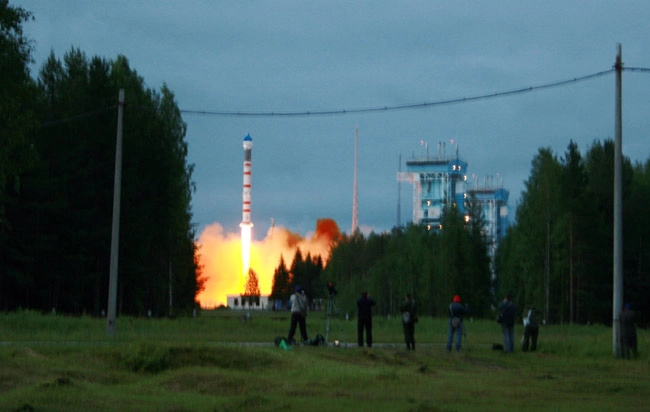
A German radarreconnaissance satellite vaulted into space from a Russian launch site Monday,beginning a mission to collect high-resolution imagery of nearly every locationon Earth for up to ten years.
The craft is the secondmember of a five-satellite fleet of military spy satellites under development byGermany. A large X-band radar dish antenna on each satellite can gather preciseimages through clouds and darkness.
The constellation usessynthetic aperture radar technology, which sends radio beams toward the ground.The pulses are reflected back into space from Earth's surface, and a receiveron the satellite collects the data.

Specialists on the groundcan turn the data into detailed images for use by the German Defense Ministry.Officials project the satellite's images will allow analysts to see objectssmaller than one meter, or about three feet.
SAR-Lupe 2 was launchedaboard a Kosmos 3M rocket at 1938:41 GMT (3:38:41 p.m. EDT) from the PlesetskCosmodrome in northern Russia. After about a half-hour of powered flight, therocket left the 1,700-pound spacecraft in a Sun-synchronous orbit at analtitude of about 300 miles.
The blastoff was postponed24 hours from Sunday due to unfavorable upper level winds, project officialssaid in a statement.
Plans call for thespacecraft to deploy its radar antenna in a couple of days, and the Germanmilitary will take control of the satellite in a few weeks to begin imagingoperations.
The satellite was built bylead contractor OHB-System, a company based in Bremen, Germany. A group ofEuropean aerospace companies manufactured the craft's radar system.
The SAR-Lupe fleet's firstsatellite was launched in December and remains healthy, according toOHB-System.
Three additional satellitesfor the system will be launched in four-month intervals over the next year.Officials expect the constellation to be at full strength by the end of nextyear.
The SAR-Lupe program ispart of a joint agreement between Germany and France to share data from eachnation's spy satellite system.
- VIDEO: Europe's New Space Plane
- GALLERY: Twenty Great Rocket Launches
- All About Satellites
Copyright 2007 SpaceflightNow.com,all rights reserved.
