


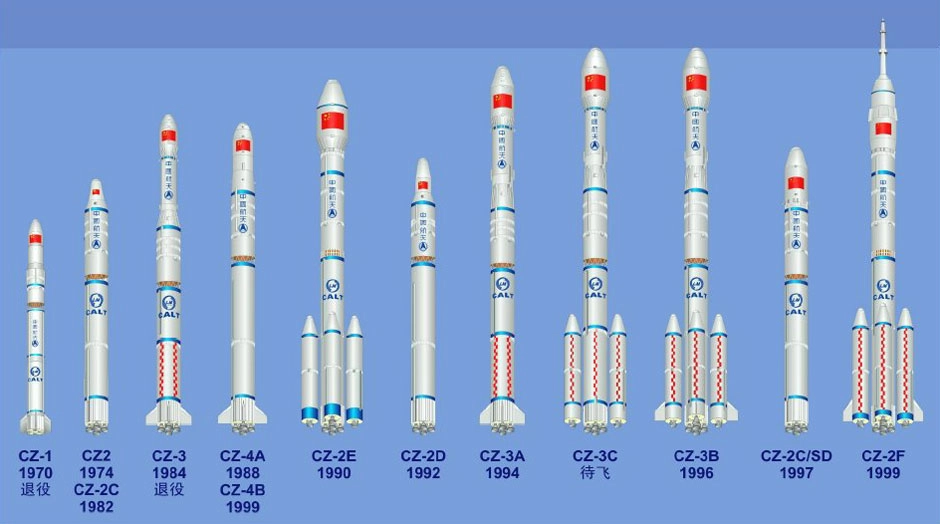
Breaking a 13-year streakof successful launches, a Chinese Long March rocket failed to deliver anIndonesian communications satellite to its planned orbit Monday.
Carrying the Palapa Dtelecommunications satellite, a Long March 3B rocket blasted off fromthe Xichang launch base in southwestern China at 0928 GMT (5:28 a.m. EDT)Monday.
The three-stage launcher,boosted by four liquid-fueled strap-on engines, flew as expected during thefirst few minutes of the flight.
But a failure occurred about20 minutes after liftoff as the third stage was scheduled to ignite for itssecond burn of the mission, according to the official state-run Xinhua newsagency.
The third stage is poweredby two YF-75 engines fueled by a mix of liquid hydrogen and liquid oxygen,according to China Great Wall Industry Corp., the international marketing armof the country's launch industry.
The engines apparentlycompleted the first of two burns to place the rocket and Palapa D into aparking orbit.
Xinhua reported the thirdstage encountered problems during the second ignition, but it was not clear ifthe engines failed to fire or shut down early.
"Experts areinvestigating," the Xinhua report said.
The 41-foot-long thirdstage produces about 35,000 pounds of thrust in flight, first to send payloadsinto low-altitude parking orbits and then to propel spacecraft into egg-shapedgeosynchronous transfer orbits.
The stage, which is alsoused on other LongMarch rockets, has never been responsible for a launch failure beforeMonday, according to Chinese launch records.
According to U.S. militarytracking data, Palapa D is circling Earth on a path with a high point of about13,150 miles, a low point of approximately 130 miles and an inclination ofaround 22 degrees.
Palapa D's planned orbitwas not published before launch. It is unclear whether the satellite will beable to reach its operational station 22,300 miles above Earth ingeosynchronous orbit.
The satellite was built byThales Alenia Space of France for Indosat, an Indonesian telecommunicationsfirm.
Palapa D's C-band andKu-band communications payloads were designed to cover a swath of territorystretching from Australia to India. The satellite had a life expectancy of 15years.
Television broadcasters andcorporate customers were expected to use Palapa D's communications capacity.
The satellite was orderedas a replacement for the aging Palapa C2 spacecraft launched in 1996. Palapa C2is expected to cease operations in 2011.
Indosat officials said in2007 they invested between $200 million and $300 million for construction andlaunch of the satellite.
Monday's launch marked the12th flight of a Long March 3B rocket, which had successfullylaunched 10 times since its debut mission suffered a deadly accident in1996.
Attempting to launch a U.S.communications satellite, the rocket flew off course moments after liftoff andcrashed into a nearby village, killing Chinese civilians.
Since a different launchfailure later in 1996, all Long March rocket variants had amassed 75straight flawless flights in a streak spanning almost 13 years.
China's workhorse rocketfamily includes seven derivatives to launch a wide variety of payloads, rangingfrom commercial and military satellites to scientific probes and pilotedShenzhou missions.
Monday's anomaly could deala blow to China's aspirations to gain agreater share of the global launch industry. The Long March 3B is thecountry's primary launcher for commercial missions.
- New Video - NASA Test Launches Inflatable Heat Shield
- Chinese Astronauts Complete First Spacewalk
- Video - Astronaut Escape Ship Blasts Off
Copyright 2009 SpaceflightNow.com,all rights reserved.