





This story was updated at 9:31 a.m. EST.
DARMSTADT. Germany -- Europe's Huygens descent probe will deliver its promised data on Saturn's moon, Titan, despite the loss of one of two communications lines with which the probe communicated with NASA's Cassini Saturn orbiter, U.S. and European scientists said Jan. 15.


Sleepless science
"I haven't slept in 30 hours and we're working hard to process the data," said Martin Tomasko, principal investigator for Huygens' Descent Imager/Spectral Radiometer (DISR), speaking alongside other Huygens science team leaders during the briefing. "This is the view that you'd have if you were standing on Titan."
Tomasko unveiled a color image of a previously released view of Titan's rocky surface as caught by the DISR instrument during Huygens' landing. The orange hue of Titan, he said, was recorded by spectrometers aboard the instrument, he said.
Sounds generated from the microphone and radar sensors of the Huygens Atmospheric Structure Instrument (HASI) gave researchers a chance to hear the probe's its plunge through Titan's atmosphere.
Droning winds can be heard in one sound clip recorded by Huygens' microphone during descent. In another, radar echoes rise in pitch and intensity as the Huygens gets closer to Titan's surface.
"It was impossible to transmit the entire soundtrack," said HASI principal investigator Marcello Fulchigoni, adding that the sounds he released today were reconstructed from snippets by researchers. "But we have the principal fragments of these sounds."
The communications glitch will mean that doppler wind data from Huygens will need to be pieced together from the many ground telescopes that were trained on Huygens during its two and one-half-hour descent to Titan's surface on Jan. 14.
But that data will be available given the global response of radio astronomers to Huygens, said Leonid Gurvits, head of the team that coordinated the 18 primary telescopes in Australia, China, Japan, the United States and Europe. "We will get the same scientific result, it will just take a little longer," Gurvits said.
Tomasko added that 350 images during descent and continuing after Huygens' landing were received on the one working communications channel -- half the crop that would have been harvested had both lines been functioning.
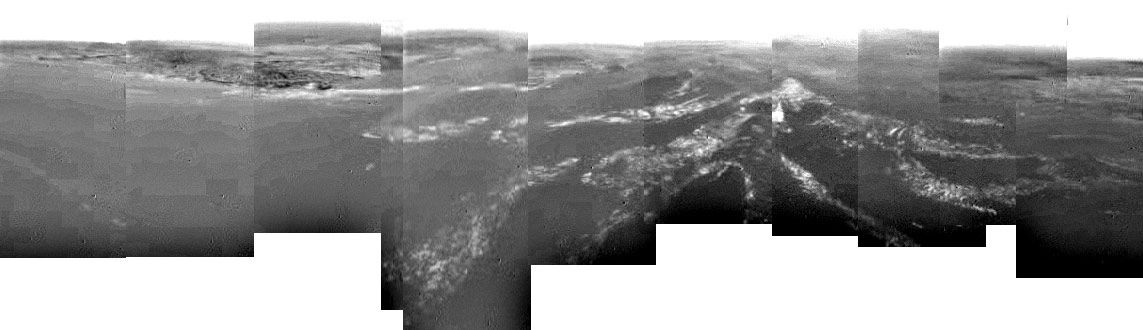
"We do have holes sin our panoramic mosaics," Tomasko said after showing one striking panorama stitched together the night of Jan. 14-15 by science teams. But Tomasko said the images that have been received will keep scientists working for months. "Given time, we will be able to learn some very interesting things about this mysterious world that has been veiled to our view."
SPACE.com Staff Writer Tariq Malik contributed to this report from New York City.
Touchdown on Titan: Huygens Probe Hits its Mark
