





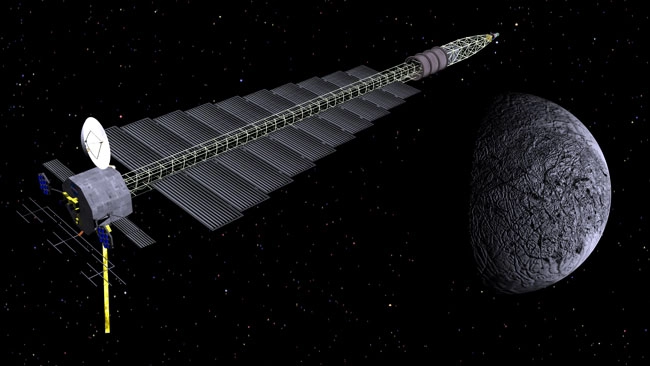
The head of NASA'snuclear push says a scientific mission to the inner solar system -- perhaps tothe moon, Mars or an asteroid -- will be used to demonstrate a new propulsionsystem in place of a mission to Jupiter's icy moons.
But the Jupiter trip isonly delayed, not canceled, Ray Taylor said. It could fly in 2017, a few yearslater than the demonstration mission.
In the meantime,"we have a range of options being looked at in the analysis," hesaid. "They're all in the inner solar system . . . and they're all shortermission duration."
Nuclear power has beendeemed important for the exploration vision that would send astronauts back tothe moon and on to Mars, though Taylor said it wasn't clear yet whether nuclearpropulsion would be used for a human Mars mission. Analyses within the agencyare ongoing, he said.
Meetings in Cocoa onTuesday, featuring Taylor and other officials, will allow the public to commenton the nuclear initiative.
A recent report by theGovernment Accountability Office (formerly the General Accounting Office)suggested NASA was smart to put off the complex Jupiter mission.
It also said the agencymight have trouble defining the project's technical requirements and costestimates by this summer. That's when a review determines which mission willdemonstrate the nuclear propulsion system developed by NASA's ProjectPrometheus.
Taylor said the agencywas looking at alternatives to the Jupiter mission in October, before a draftof the GAO report was handed to NASA. After NASA got the report, the agency's2006 budget request deferred the Jupiter mission, citing "concerns overcosts and technical complexity."
Even if it's not clearhow future human missions will be powered, nuclear propulsion could beinvaluable for scientific missions such as the Jupiter Icy Moons Orbiter.
Though deep-spacemissions have flown by bodies in the outer planets, they have not been able toorbit a moon that distant because of a lack of power. That far from the sun,solar power doesn't help much.
JIMO is supposed tostudy one of Jupiter's moons, Europa, which has anicy crust thought to conceal oceans potentially hospitable to life.
"Now the scientistsknow that Europa is extremely high priority,extremely important from a science standpoint," Taylor said. ". . .They need to have much more up-close operation. In other words, they need to bein orbit."
Nuclear power would lendinstruments more juice, too, potentially giving a spacecraftbetter radar and other capabilities.
NASA is looking at arange of technologies for a nuclear-
powered drive, Taylor said. Electric thrusters would be larger versions of somethat have flown already. A reactor system would be new.
It's challenging to testsuch a system on Earth, especially for a trip as ambitious as the Europa mission, said former Project Prometheus director andconsultant Alan Newhouse, who left NASA in December.
A mission to the outerplanets might have to run a decade or more, Newhousesaid. "How do you prove you can make it run 10 years when you haven't evenbuilt it?" he said.
That challenge is onereason NASA decided to choose a different mission.
Taylor said the agencyagreed with the GAO's recommendations.
"The good thing isthat we have a very disciplined technical and businessanalysis process," he said.
Published under license from FLORIDATODAY. Copyright ? 2005 FLORIDA TODAY.No portion of this material may be reproduced in any way without the writtenconsent of FLORIDA TODAY.
