





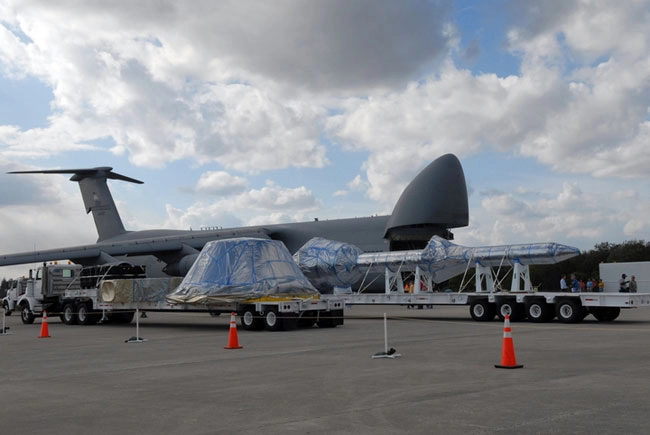
CAPE CANAVERAL -Aerodynamically exact mock-ups of NASA's Orion spacecraft and a launch abortsystem arrived at Kennedy Space Center on Wednesday, marking a key milestone inwork toward launch this year of the first Ares I test flight.
The $360 million mission - dubbed Ares I-X- will show critics whether first-stage flight control systems will keep theslender "single-stick" rocket on course and intact during flight.
The rocket's parachuterecovery system and the system that separates its first and second stages willbe tested.
The flight also will showwhether launch-inducedvibrations might shake the rocket enough to damage critical systems orinjure an astronaut crew.
"One good test isworth a thousand expert opinions," NASA deputy mission manager Jon Cowartsaid.
Tentatively set forlaunch July 11, the mission will be the first of four test flights slatedto be carried out under a $1.8 billion contract to develop the rocket's firststage: a five-segment solid rocket booster.
It also will be the firstdemonstration of a critical piece of a new U.S.space transportation system set to replace the shuttle, sending astronautsto orbit by 2015 and the moon by 2020.
The Ares I-X test flightwill employ a four-segment shuttle booster topped with a dummy fifth segmentand mock-ups that simulate the mass and outer mold line of an Ares I secondstage, Orion spacecraft and launch abort system.
An Air Force C5 Galaxyaircraft arrived at KSC with the Orion command module and launch abort systemsimulators secured in its expansive cargo hold. The hardware joined segments ofthe rocket's upper stage simulator in the KSC Vehicle Assembly Building.
Four solid rocket boostersegments that will power the Ares I-X first stage are expected to be deliveredfrom an ATK plant in Utah in late February.
NASA will decidein mid-March whether to keep the Ares I-X mission launch in July or push itback until summer or fall.
The Ares I-X mission willlaunch from pad 39B. But NASA is keeping that pad "shuttle-ready" incase a mission to rescue a Hubble Space Telescope servicing crew is required inMay.
NASA would have to launchboth the Hubble servicing flight and the rescue mission, if required, from pad39A to maintain the July 11 launch date for Ares I-X.
- Video - NASA's Constellation Journey Begins: Part 1, Part 2
- End in Sight: Final Space Shuttle Missions Slated
- Scuttling Shuttle: Big Challenges for NASA's New Spaceship
Publishedunder license from FLORIDA TODAY. Copyright ? 2009 FLORIDA TODAY.No portion of this material may be reproduced in any way without the writtenconsent of FLORIDA TODAY.