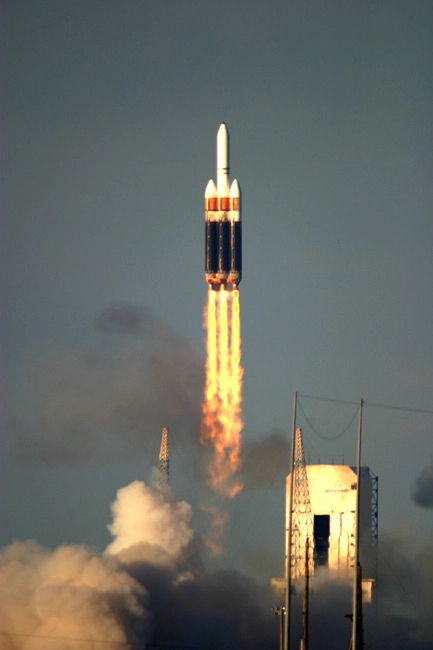
Errant readings from sensors inside the inauguralBoeing Delta 4-Heavy rocket triggered the premature shutdown of its three mainengines during ascent last month, causing a massive underspeed that thevehicle's upper stage could not overcome and resulting in a final orbit lowerthan planned, the U.S. Air Force said Friday. A team investigating results ofthe test launch are confident the problem can be resolved.
Thethree hydrogen-fueled Common Booster Cores were ignited during the finalseconds of the December 21 countdown, generating 1.9-million pounds of thrustto propel the 23-story rocket away from pad 37B at Cape Canaveral Air ForceStation, Florida.
About50 seconds into flight, the center booster's main engine throttled back to 58percent thrust as a fuel conservation effort. The starboard and port boosterscontinued to operate at their maximum power setting of 102 percent thrust, eachguzzling a ton of propellant per second.

Thestrap-on boosters were scheduled to fire until T+plus 4 minutes, 5 seconds whenthe Rocketdyne-made RS-68 engine on each stage would cut off. About threeseconds later, the 15-story starboard and port boosters, which provided thevast majority of thrust during the first four minutes of flight, would peelaway from the center stage and tumble into the Atlantic Ocean below.
Butthe reconstruction of data received from the rocket shows the engines shut down8 seconds early after sensors temporarily indicated "dry" fuelconditions despite the stages having plenty of propellant remaining toaccomplish the scheduled firing time. The sensors returned to "wet"readings after the shutdown sequence was already activated.
Oncethe outer boosters were shed, the center stage's RS-68 engine revved back tofull throttle. Although the booster was identical to the outer strap-on stages,carrying the same propellant supply and enginepackage, it employed a more conservative fuel consumption strategy by thelower-throttle setting for the past three minutes and saved enough propellantto operate almost 90 seconds longer.
Butthe same sensor "phenomenon" repeated on the center booster, causingits engine to shut down 9 seconds prematurely, the Air Force said.
Afterthe center booster had been jettisoned, the Delta 4-Heavy rocket's upper stagefound itself with a speed deficit of 1,500 feet/second due to the earlyshutdowns of the main engines. The upper stage ignited for the first of threefirings planned over the 6-hour mission to geosynchronous orbit.
Thatfirst burn of the Pratt & Whitney RL10 upper stage engine was supposed tolast seven minutes to reach an initial parking orbit around Earth where a pairof university-built nanosatellites would be released into space. The rocketmotor was designed to extend its firing time to compensate for any performanceshortfalls experienced by the Common Booster Cores, and it did that. But even through the stage fired much longer than planned it stillfailed to reach a stable orbit, deploying the nanosats into a suborbitaltrajectory that took them into the atmosphere before completing a lap aroundthe planet.
Theupper stage then reignited for its second scheduled burn, shaping the rocket'strack into a highly elliptical egg-shaped geosynchronous transfer orbit. It wasin this orbit that the vehicle coasted for five hours to reach the high point about 19,600nautical miles above the planet where the final engine blast would occur.
Thisfiring should have lasted three minutes to circularize the orbit. However, thestage's precious fuel supply was greatly impacted by the extended maneuversbattling back from the Common Booster Core problem. The stage ran out of fuelabout two-thirds of the way through the burn, leaving the instrumentedsatellite simulator payload -- the rocket's main cargo for this test flight --with an orbit featuring a high point of 19,600 nautical miles (36,400 km), lowpoint of 9,600 nautical miles (19,000 km) and inclination of 13.5 degrees. Theorbit's low point was 10,000 miles off the target and inclination was 3.5degrees higher than planned.
Rocketmaker Boeing and its Air Force customer are conducting a planned two-monthpost-flight review of data obtained during the Delta 4-Heavy's demonstrationmission. The military bought the test launch to put the rocket through a fullrehearsal before critical national security satellites begin flying on the bigvehicle.
Despitemissing the targeted orbit, Boeing and the Air Force consider the launch asuccess since all events during test mission occurred and the rocket completedthe entire 6-hour flight.
"Theoverall purpose of this mission was to demonstrate the capability of the Delta4-Heavy ground and flight systems. The mission profiles were selected to stressthe system and reduce the risk to flying an operational mission. This is asclose as space systems come to a flight test," said Col. John Insprucker,Evolved Expendable Launch Vehicle program director at the Air Force's Space andMissile Systems Center.
Tounravel the problem with the RS-68 engines shutting down too soon, Boeing andthe Air Force, supported by The Aerospace Corporation, have established anAnomaly Investigation Team to determine the root cause of the anomaly.
"Thegoal is to understand and mitigate the risk of this premature shutdown fromoccurring on an operational mission," the Air Force said in a statementFriday.
"Alldata is being reviewed, a sequence of events has been constructed, and a FaultTree analysis has begun to categorize the potential root causes to includepropulsion, avionics, and flight environments, etc. This investigation has adeliberate process to ensure no potential causes are missed, and is getting theproper attention at all levels of the Air Force; however, it is difficult tosay how long the investigation will take to complete.
"Thereare several findings, so far," the statement continued.
- "First, the initial flight data indicates the Common Booster Cores shut down prematurely and left the second stage approximately 1500 ft/sec short of the planned velocity.
- "Second, analysis indicates there was sufficient propellant left in the boosters to achieve the mission velocity if not for the premature shutdown. This indicates the vehicle has the necessary performance to achieve the mission as designed. The RS-68 engine performance appears to be healthy.
- "Third, the engine shutdown sensors appeared to operate properly; however, the sensors temporarily indicated 'dry' approximately eight seconds before expected for the strap-ons, and then returned to 'wet' after triggering the shutdown sequence. The same phenomenon was repeated on the center booster core nine seconds before expected. Preliminary data checks show the flight software and control system reacted to the engine shutdown sensors properly.
"The second stage was programmed to compensate for afirst stage velocity deficit if required, and it did this successfully until itexpended its propellant reserves. The stage flew flawlessly through all threeRL-10 engine burns and a large number of maneuvers, achieving a record-setting1,115 seconds of burn time. Other than the early Common Booster Core shutdown,the launch, six-hour mission and payload deployment appeared nominal.
"TheAir Force chose to reduce risk to operational flights by conducting this'all-up' demonstration. Given the repetitive nature of the anomaly on all threeCommon Booster Cores, the team is confident this anomaly will be resolved priorto an operational Heavy mission," the Air Force statement said.
Twooperational Delta 4-Heavy rocket launches were planned for 2005. What, if any,impact the investigation will have on those launch dates is not clear. AnAugust liftoff is scheduled to carry the final Defense Support Program craftthat detects enemy missile launches and nuclear weapon detonations from space.A secret National Reconnaissance Office payload is slated to fly on the secondoperational Heavy mission in December.