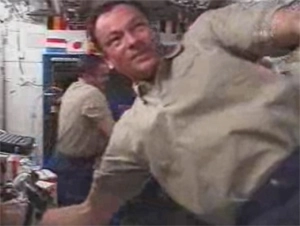
NAME: Michael E. Lopez-Alegria (Captain, U.S.Navy)
NASA Astronaut
PERSONALDATA: Born May 30,1958, in Madrid, Spain,and grew up in Mission Viejo, California. Married to the formerDaria Robinson of Geneva, Switzerland. They have one son.Michael enjoys sports, traveling and cooking, and is interested in national andinternational political, economic and security affairs. His parents aredeceased. Daria's parents, Professor Stuart and Margareta Robinson, reside in Geneva.
EDUCATION: Graduated from Mission Viejo High School,Mission Viejo, California, in 1976; received a bachelor ofscience degree in systems engineering from the U.S. Naval Academy in 1980; anda master of science degree in aeronautical engineering from the U.S. NavalPostgraduate School in 1988. Graduate of Harvard University'sKennedy School of Government Program for Senior Executives in National andInternational Security. Speaks Spanish, French and Russian.

ORGANIZATIONS: Member, Association of NavalAviation, Society of Experimental Test Pilots, and Association of SpaceExplorers.
EXPERIENCE: Following flight training,Lopez-Alegria was designated a Naval Aviator on September 4, 1981. He served asa flight instructor in Pensacola, Florida, until March 1983 andthen as a pilot and mission commander of EP-3E aircraft.
In 1986 hewas assigned to a two-year cooperative program between the Naval PostgraduateSchool in Monterey,California, and the U.S. Naval Test PilotSchool in Patuxent River, Maryland.
His finaltour before being assigned to NASA was at the Naval Air Test Centeras an engineering test pilot and program manager. He has accumulated more than5,000 pilot hours in over 30 different aircraft types.
NASAEXPERIENCE:Lopez-Alegria reported for training to the Johnson Space Center (JSC) in August1992.
Followingone year of training and designation as an astronaut, he was first assigned tobe the Astronaut Office technical point of contact to various Space Shuttleproject elements, then to the Kennedy Space Centerwhere he provided crew representation on orbiter processing issues and supportduring launches and landings.
Followinghis first space flight he served as NASA Director of Operations at the Yuri GagarinCosmonaut TrainingCenter, Star City, Russia.After his second mission, he led the newly formed ISS Crew Operations branch ofthe Astronaut Office.
Uponcompletion of his third spaceflight, he was assigned as the technical assistantto JSC's EVA Office. Lopez-Alegria has logged over 42 days in space, circledthe Earth 674 times, and performed 5 EVAs totaling 34 hours.
He isassigned to command Expedition14 and will serve as the NASA station science officer during a six-monthtour of duty aboard the International SpaceStation. Expedition 14 is scheduled for launchaboard a Russian Soyuz spacecraft in September 2006.
SPACEFLIGHT EXPERIENCE:STS-73 Columbia(October 20 to November 5, 1995) was launched from and returned to land at theKennedy Space Center, Florida.
STS-73 wasthe second United States Microgravity Laboratory mission and focused onmaterials science, biotechnology, combustion science, the physics of fluids,and numerous scientific experiments housed in the pressurized Spacelab module.Lopez-Alegria served as the flight engineer during the ascent and entry phasesof flight, and was responsible for all operations of the "blue" shift on orbit.
STS-92Discovery (October 11-24, 2000) was launched from the Kennedy Space Center,Florida and returned to land at Edwards Air Force Base, California.
During the13-day flight, the seven-member crew attachedthe Z1 Truss and PressurizedMating Adapter 3 to the International SpaceStation using Discovery's robotic arm and performed four spacewalks toconfigure these elements. Lopez-Alegria totaled 14 hours and 3 minutes of EVA(extravehicular activity) time in two spacewalks.
STS-113Endeavour (November 23-Dec 7, 2002) was the 16th shuttle missionto visit the InternationalSpace Station. Mission accomplishments included the delivery of the ExpeditionSix crew, the delivery, installationand activationof the P1Truss, and the transfer of cargo from Endeavour to the ISS. During themission Lopez-Alegria performed three EVAs totaling 19 hours and 55 minutes.STS-113 brought home the ExpeditionFive crew from their 6-month stay aboard the station.
Lastupdated: 2006
- Mission Endeavour: STS-113 Story and Multimedia Archive
- STS-92 Collection of SPACE.com stories
- Complete Space Shuttle Mission Coverage
- Complete ISS Expedition 14 Mission Coverage