


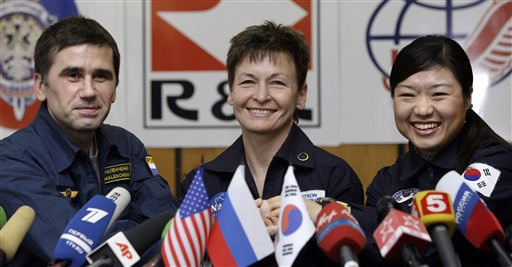
SEOUL, South Korea (AP) — South Korea's first astronaut has beenhospitalized with back and neck pain apparently caused by the unexpectedlysteep descent of her Russian space capsule when it returned to Earth, officialssaid Wednesday.
Yi So-yeonwas taken to a hospital Tuesday due to the pain after she canceled a meetingwith President Lee Myung-bak, according to the state-run Korea AerospaceResearch Institute, where she works as a bioengineer.
The ScienceMinistry said in a statement Wednesday that preliminary tests showed Yisuffered a minor injury to her neck muscles and bruised her spinal column.
Theministry said there was no serious health problem but will determine laterwhether to allow her to resume public activities after conducting more tests.
Jung Ki-young,head of the air force-affiliated Aerospace Medical Center where Yi is hospitalized, refused to publicly disclosedetails of her health, according to the ministry statement.
EarlierWednesday, an KARI official said her pain may be the result of the spacecraft'ssteeper-than-usual descent when it landed April 19. A technical glitchapparently caused the capsule to land about 420 kilometers (260 miles) from itstarget on Kazakhstan's barren steppe.
"Weare looking at various possible reasons for her pain," the official saidon condition of anonymity, citing institute policy.
Thethree-person crew in the Soyuz capsule was subjected to forces of about eighttimes Earth's gravity for up to two minutes. Normal Soyuz returns have G-forcesof about five.
Russia's Interfax news agency said thecapsule entered the atmosphere improperly, with its hatch first instead of withits heat shields leading the way. As a result, the hatch suffered significantdamage and the capsule's antenna burned up.
South Korea's Science Ministry said Russianauthorities were expected to announce the cause of the flawed landing by theend of May.
On Monday,Yi told a news conference after returning to South Korea that she had been suffering some back pain since the landingbut that Russian X-ray tests showed her condition was satisfactory.
"Ithink I'll be fine after taking a rest," she said.
The SouthKorean government paid Russia US$20 million (euro13 million) forher flight to the international space station.
- VIDEO: ISS Commander Peggy Whitson Takes Charge
- NEW IMAGES: NASA's STS-123 Shuttle Mission in Pictures
- VIDEO: Europe's First ISS Cargo Ship Arrives