


This story was updated at 12:51 p.m. EDT.
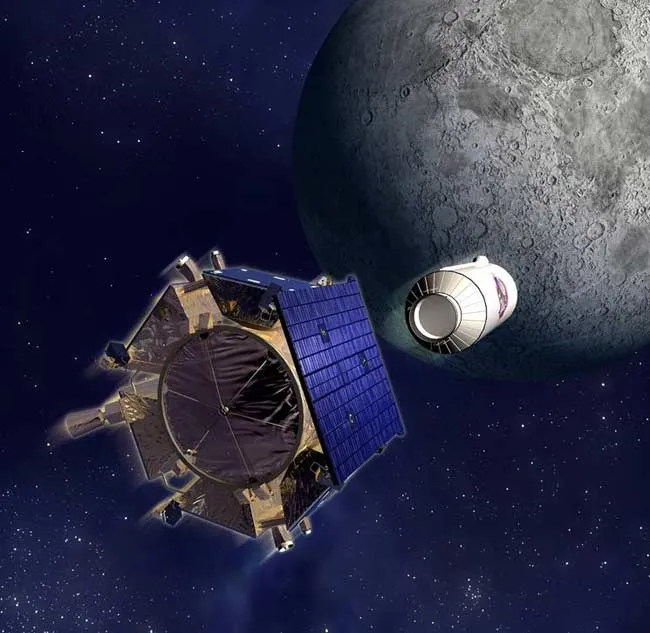
A NASA spacecraft and its trusty rocket stage are drawing ever closer to the moon to intentionally crash to their doom Friday, all in the name of science.
The cosmic collisions are expected to kick up tons of moon dirt in giant debris plumes that will then be scanned for signs of water ice suspected to be buried beneath the floor of a permanently shadowed crater at the lunar south pole.
"Everybody is feeling very excited," said Victoria Friedensen, NASA's program executive for the LCROSS mission at the heart of the moon crash. "There is a great sense of anticipation."
Moon crash
NASA launched the LCROSS probe in June along with a powerful lunar orbiter that is currently circling the moon to determine whether water ice, which could be a vital resource for astronauts in the future, actually exists in the perpetual darkness of craters at the moon's south pole.
Since then, the $79 million LCROSS — short for Lunar Crater Observation Sensing Satellite — has made three long loops around the Earth while attached to an empty Centaur rocket stage, its first weapon in the upcoming lunar double whammy.
The two vehicles are due to separate late tonight and the first impact is set for 7:31 a.m. EDT (1131 GMT). That's when the 42-foot (13-meter) long Centaur rocket stage will plow into the crater Cabeus at the moon's south pole. NASA will start broadcasting the event live on NASA TV at 6:30 a.m. EDT (1030 GMT).
Seasoned amateur astronomers may be able to see the crash using 10 or 12-inch telescopes depending on their location, local weather and lighting conditions. [Click here to see how to watch the LCROSS moon crashes.]
The Centaur rocket stage weighs 5,216 pounds (2,366 kg), about as much as a sport utility vehicle, and will slam into the moon at about 5,600 mph (9,010 kph). Researchers believe the blast will create a debris plume about 12 miles (20 km) wide and send moon dirt soaring to heights of 6.2 miles (10 km), where it would be illuminated by the sun.
"It will kick up whatever is on the floor of the crater," LCROSS project manager Daniel Andrews has said. "That may very well include water ice."
But the first crash is only the prelude. Riding aboard the LCROSS spacecraft are nine different science instruments, including cameras that will beam live views of the impact back to NASA's mission operations center at the Ames Research Center in Moffett Field, Calif. Those tools will be used to scan the debris plume for evidence of water ice.
"We expect to see the crater getting closer and closer," Friedensen told SPACE.com.
The 1,664-pound (891-kg) LCROSS shepherding craft will follow its Centaur rocket stage down to make its own crash about four minutes after the initial lunar hit.
More than 20 observatories on Earth, as well as a host of amateur astronomers, museums and volunteers will be watching the two crashes to search for signs of any water ice in the debris clouds. The Hubble Space Telescope and other space-based observatories will also turn their camera eyes on the moon for the event.
"Our last day in flight promises to be the most challenging and the most rewarding for the project," LCROSS flight director Paul Tomkins wrote in his NASA blog today. "Our 112 days in orbit are focused entirely on the last four minutes, after the Centaur impacts our target crater and raises a plume of lunar material for the LCROSS Shepherding Spacecraft to observe for signs of water, but before the Shepherd also impacts the moon."
Unlike other spacecraft that have smacked the moon, like Japan's recent Kaguya probe, Europe's Smart-1 and NASA's Lunar Prospector, the LCROSS impactors will hit at a steep angle in order to get the biggest boom for their buck, mission managers said.
LCROSS has not had a completely smooth ride to the moon. An August glitch forced the spacecraft to use much of its propellant supply, but not enough to prevent its ultimate mission.
NASA also unexpectedly switched target craters last week, choosing the 60-mile (98-km) wide Cabeus over its nearby neighbor Cabeus A because data suggested the new target had a higher concentration of hydrogen — a signal for potential water ice.
Hunting moon water
Scientists already know that some small amount of water exists on the moon, but LCROSS is designed to seek out buried water ice at the lunar south pole — a region where the sun has never shined on some craters with permanent shadows.
NASA scientists say the areas may be the coldest places in the solar system, with temperatures reaching minus 400 degrees Fahrenheit (minus 240 Celsius) in the crater shadows. Finding usable amounts of water ice would be a boon for NASA's vision to send astronauts back to the moon by the mid-2020s.
But Friedensen said that it will take time before scientists know if any water is present in the debris plumes. A few hours after the two impacts, LCROSS scientists will hold a press conference, but will likely only be able to discuss how accurate the hits were, she added.
"We will not be able to talk about how much water is there, if it's water we find," she said. "The science team will need a couple of days, maybe even a couple of weeks to make sure."
The live stream of data from LCROSS will be recorded in triplicate — at the mission control center at Ames and two other sites — to make sure it is saved for posterity, Friedensen added.
Tompkins said that knowing LCROSS will soon meet its fate is a bit sad, even if it was already preordained for the cause of science.
"Well, we all knew it was going to happen. It was inevitable. It was the whole design of the mission," he wrote. "LCROSS was destined to end its wonderfully fantastic journey by intentionally crashing into a permanently shadowed crater at the south pole of the moon."
SPACE.com is providing full coverage of the LCROSS moon crash. Click here for a look at the mission and return to SPACE.com at 6:30 a.m. ET (1030 GMT) for live crash coverage.
