


Thisstory was updated at 5:12 p.m. EDT.
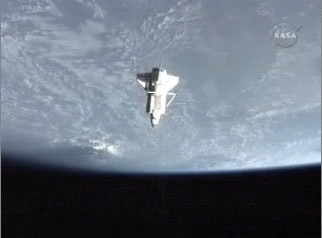
Spaceshuttle Discovery cast off from the International Space Station Tuesday andbegan the trip back to Earth, wrapping up nearly nine days of joint work by 13astronauts aboard both spacecraft.
Discoveryundocked from the space station at about 3:26 p.m. EDT (1926 GMT) as the twospacecraft flew 220 miles (354 km) over western China near the Mongolianborder.
?Houstonand station from Discovery, physical separation,? astronaut Tim Kopra said fromthe shuttle as it backed away from the orbiting laboratory. Kopra is returningto Earth on the shuttle to end a two-month flight to the space station.
Sturckowand his crew launchedto the station Aug. 28 on a 13-day mission to deliver vital supplies,science gear and a new crewmember for the space station?s six-person crew. Theyperformed three spacewalks to retrieve old experiments from the station,replace a massive coolant tank and swap out broken components.
?Alright,you guys, Godspeed, you?re on your way home,? said station astronautMichael Barratt.
Beforeleaving the station, shuttle pilot Kevin Ford flew Discovery on a victory laparound the orbiting lab while his crewmates took photographs. Astronauts on thestation also watched as Discovery circled their spacecraft.
?Those weregreat views of that magnificent spaceship as it flew under us,? Barratt said. ?Wewere all glued to the windows.?
Skywatchersin the United States and southern Canada have several opportunities over thenext two days to spot theshuttle and station, weather permitting.
NASAofficials also said Tuesday that the space station will not have to dodge apiece of space junk left over from a Chinese anti-satellite test in 2007. Theorbital trash was expected to zip by the space station twice early Wednesday ata comfortable distance of about 15 miles (25 km) of the outpost.
Stationsupply run
Altogether,the astronauts delivered 18,548 pounds (8,413 kg) of supplies to the spacestation and are returning about 5,223 pounds (2,369 kg) of trash and surplusitems back to Earth.
The nearly11-year-old space station is now 84 percent complete and weighs about 711,000pounds (322,504 kg), NASA officials said Tuesday. Astronauts have compared theinterior living space of the station's nine rooms to the passenger cabin of ajumbo jet.
Theshuttle also ferried NASA astronaut Nicole Stott to the station, where shereplaced Kopra on the orbiting laboratory?s six-person crew. Stott is beginninga three-month stay at thespace station with two big chores already on her plate.
Later thismonth, Stott will use the station?s robotic arm to capture Japan?s first-everunmanned cargo ship and attach it to an Earth-facing berth on the orbiting lab.JAXA, Japan?s space agency, will launch thenew spaceship on Thursday. It is expected to arrive at the station Sept.17.
Stott willalso help build the station?s new $5 million treadmill, which is named after TVcomedian Stephen Colbert and was delivered to the station in more than 100pieces.
Colbert wonthe naming rights for a new space station room in an online NASA poll earlierthis year, but the space agency named the module Tranquility - the Apollo 11moon base - to honor the 40th anniversary of the first manned moon landing.NASA named the new station treadmill the Combined Operational Load BearingExternal Resistance Treadmill, or COLBERT, as a consolation prize.
Later tonight,Discovery astronauts plan to take one last look at their spacecraft?s heatshield to check for new damage from space junk or micrometeorites. The standardsurvey will take hours, but is identical to one performed just after launchthat found the heat shield panels on Discovery?s wing edges and nose cap in fineshape.
Discoveryis due to land Thursday at 7:05 p.m. EDT (2305 GMT) on a NASA runway at theKennedy Space Center in Florida.
- Easy to Spot: Space Station and Shuttle Together
- Video - Stephen Colbert to NASA: 'No Chubby Astronauts'
- New Image Gallery - Shuttle Discovery's Midnight Launch
SPACE.comis providing complete coverage of Discovery's STS-128 mission to theInternational Space Station with Managing Editor Tariq Malik and Staff WriterClara Moskowitz in New York. Clickhere for shuttle mission updates and a link to NASA TV.
